In the television series, Life after People, concrete jungles are gradually transformed into actual jungles. Without humans to control and manage vegetation the eventual encroachment of weeds leave little opportunity for less competitive plants to establish themselves.
Weeds can be a catch-22 situation. If you wait until they have bloomed and set seed before digging them up you risk seed dispersal which can result in even more weeds. Pull up only part of a weed such as Canada thistle, or rototill it under, and the bits and pieces of rhizome left behind can reproduce amazingly efficiently.
Failure to control weeds in perennial beds or vegetable gardens ultimately competes with more desirable plants for light, moisture, nutrients and space. Equally problematic, weeds act as hosts for aphids and other pests, as well as diseases.
What's a gardener to do?
When Free Press reader Eugene Brokopiw sent me a photo of a rapidly spreading plant with fern-like foliage, I was fairly confident it was a weed, but wasn't certain of its exact name. Proper identification of weeds, as well as knowledge of their growth habits, is helpful in determining the method of control, particularly of the most bothersome ones. Annual weeds, for example, as part of their survival strategy, produce large volumes of seeds. Prevention of seed set is essential.
If you are a vegetable gardener, identifying weeds at the seedling stage is the best approach. Weed identification, though, at later plant stages is much easier.
Laura Reeves is a botanist who resides near Gardenton and is founder of Prairie Shore Botanicals. She conducts plant identification field trips and is passionate about wild edibles which yes, include weeds. Lamb's Quarters is an edible weed. It has flowers that form in clusters on top of spikes with dusty green, diamond shaped leaves. Reeves recommends using all of your senses when trying to identify weeds and their relatives. Examine the leaf structure and their arrangement on the stem. Are the leaves opposite, alternate, or whorled? Do the leaves feel hairy, rough or silky or are their edges smooth or serrated? Study the plant's flowers, their shape, colour and number of petals as flower structure often makes identification easier.
Weeds may be prostrate such as common knotweed or strongly upright, emitting latex when cut, such as perennial sowthistle. Scent is also a distinguishing feature. Don't forget to take into account the underground structure of the weed, says Reeves, as some, such as redroot pigweed, a summer annual, are relatively shallow rooted.
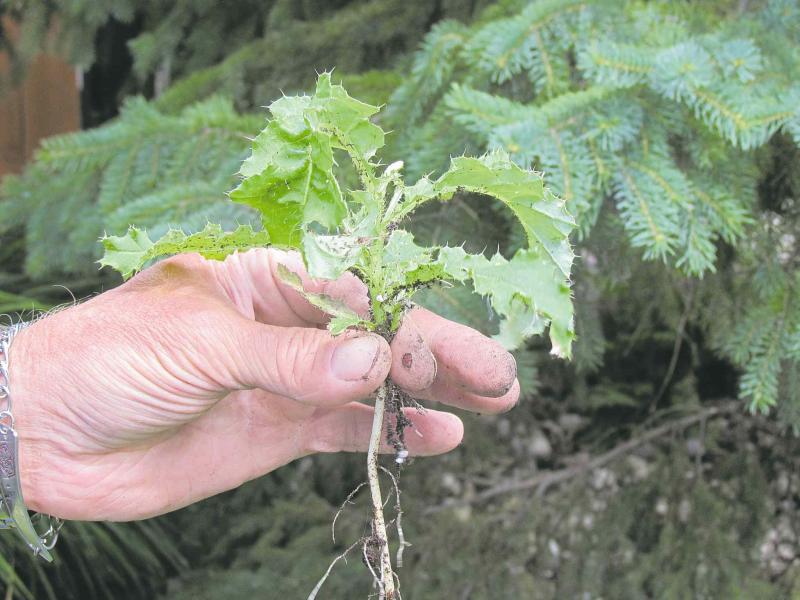
Others, such as Canada thistle, have extensive creeping root systems. As for Brokopiw's weed, it has since been identified as annual wormwood. Fortunately this particular weed does not have a vigorous root system.
Entomologist Ian Wise pulls weeds out of his garden as well as at a 14 hectare baseball complex and urban forest at Charleswood Place as part of a volunteer initiative. The baseball complex has an infestation of quack grass and Canada thistle that requires a great deal of vigilance, says Wise, as the plants spread rapidly by both rhizome and seed production.
A noxious, long-lived perennial, Canada thistle's reputation as a North American horror story is well earned. Its extensive root system can grow laterally to as much as three to four meters per year. It resides in many lawns with control mainly consisting of mowing over it time and again. Ignored, it can shoot up to a height of 90 to 120 centimetres, producing purple flower heads that appear in midsummer. The spiny-toothed leaf edges make it a formidable plant to pull.
Chopping it up with a rototiller and tilling it under only makes the problem worse, says Wise, who recommends digging up as much of the weed as possible. Remove every piece of rhizome that you can find. Repeat when new growth appears as it surely will. Eventually, though, you will deplete the plant's energy reserves by consistently removing its above ground or aerial portions.
Why not use a hoe instead of pulling weeds? In most cases, says Wise, just chopping off the top of a weed with a hoe while allowing the root system to remain underground only results in a new weed popping up fairly quickly.
Depending on how many weeds you have or the state of your knees, using a long-handled weed remover that utilizes leverage without any bending can be a handy tool. Simply center the tool over the weed and step on the foot lever to push steel claws into the ground. Available at Lee Valley Tools, this can be used to remove deep-rooted weeds such as dandelions and more shallow-rooted weeds such as plantain while remaining in a standing position.
A tool I simply would not be without is my Yankee weeder. It has a short wooden handle and a wickedly sharp blade for weeding in near-impossible places such as the narrow spaces between brick pavers. It can be used to remove weeds such as prostrate knotweed from cracks in concrete sidewalk slabs as well.
Knotweed, says Wise, produces a long narrow taproot and is capable of withstanding a lot of foot traffic making it highly suitable for growing in patios. Not even driving over it on paving stone driveways deters its growth.
If I had polymeric sand between my patio pavers, weeds wouldn't be such a problem. Instead I have sand, an ideal environment for weeds, says Wise, as the sand acts as an insulator, preventing evaporation of the moisture in the clay beneath. Monster weeds can result in no time.
Oxalis (wood-sorrel), not to be confused with the ornamental variety used in container designs, loves to congregate beneath the leaves of plants such as hosta. It may be reddish in colour if it is stressed by drought or extreme heat. Often by the time it is noticed, this rampant weed with its clover-like leaves and tiny yellow flowers has multiplied and spread.
This summer I experimented with a homemade weed killer by combining 85 grams of salt and a squirt of Dawn dish detergent in a one-litre spray bottle, filling the remainder with vinegar. I tested it on an assortment of weeds, taking care to not spray neighbouring plants. The oxalis shriveled up within a day while only a bit of browning could be observed on Canada thistle.
Lately I have been curious about a tall weed I spotted growing in my neighbourhood. Wise identified it as a nearly mature sow thistle.
There are two types of sow thistle, annual and perennial. Both contain latex and produce yellow dandelion-like flowers on multiple stems. Annual sowthistle grows up to 120 cm from a small taproot. Perennial sowthistle has an extensive creeping root system (rhizome). Buds on the rhizome produce seedlings which develop into a plant that also produces rhizomes and so on until eventually, you can have a thick population. It flowers from July through September and grows as tall as 183 cm. It produces an average of 30 seeds per plant, many of which will restock the garden with weed seed each year unless it is quickly removed before it flowers.
Weeds are incredibly adaptable, says Wise, and will produce seed no matter the growing conditions, whether ideal or not. It is key to cultivate in the fall and spring to eliminate perennial weeds and to remove any rhizomes. There are few options for vegetable growers, says Wise, other than pulling up weed seedlings or hoeing. Mulches, plastic underlay, surface cultivation and hoeing are the most common option in the perennial flower bed, says Wise.
Reeves cautions against adding weeds to your compost bin that have gone to seed as the temperature may not be sufficient to kill all of the weed seeds. Instead she suggests drying the weeds, then burning them and spreading the ashes in the garden for an addition of micronutrients.
Her new book, Laura Reeves' Guide to Useful Plants -- From Acorns to Zoom Sticks, will be available this fall.
colleenizacharias@gmail.com
Notices:
On Monday, August 10, Agassiz Garden Club hosts its annual Flower/Craft and Baking Show from 1:30 to 7 p.m. at the Lac du Bonnet Community Centre. Free coffee and goodies. For more information contact Carol at 204-345-8419.
The Transcona Garden Club hosts its 49th Annual competition and show at Kildonan Place Shopping Centre, 1555 Regent Avenue West, August 10 and 11.
On August 12 and 13 St. Vital Agricultural Society hosts its annual display and fair at the St. Vital Centennial Arena. For more details visit www.svas.ca