Vern Yip / The Washington Post
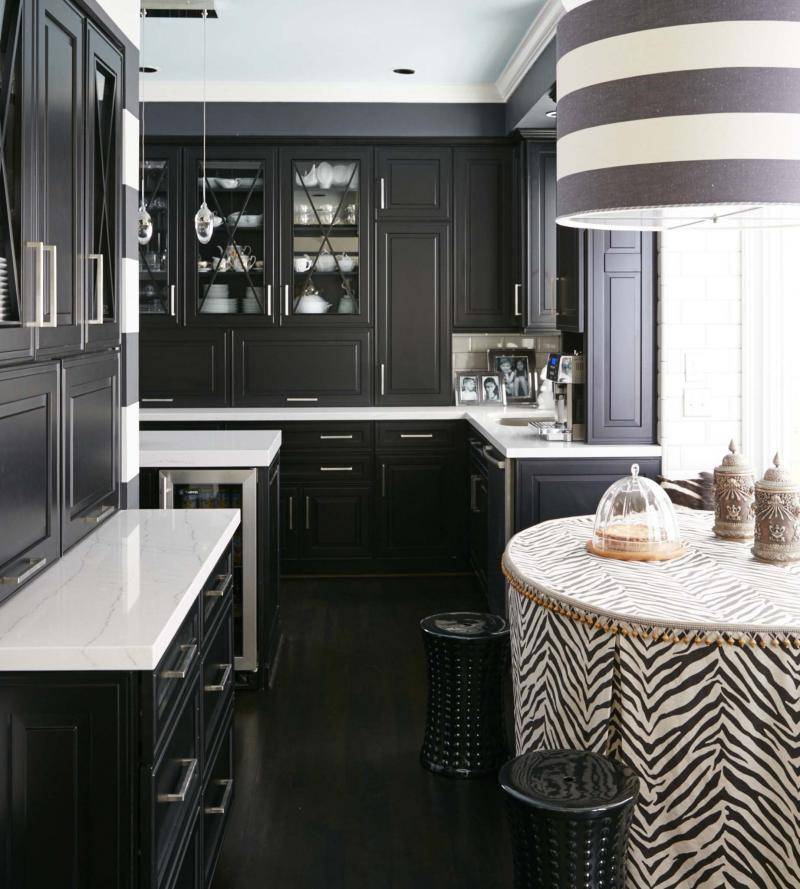
Transitional black and white kitchens are on trend and rising in popularity. Omega’s transitional Clio door style in a black opaque finish pairs here with Cambria’s Ella quartz countertops to reflect a look that is both fresh and timeless.
At a different time in our history — when it was more popularly accepted that "children should be seen and not heard" — kitchens were to be neither seen nor heard.
Tucked into tiny spaces behind closed doors, the residential kitchen was purely functional and the exclusive domain of homemakers and domestic helpers. The idea that it would become the most important and celebrated space in a home would have been unfathomable.
But that’s exactly what’s transpired. Somewhere along the way, expectations of the kitchen — and its design — dramatically elevated. For many, the kitchen is now the undisputed heart of the home and family life. And where everyone seems to gather at a party.
Even when average United States home sizes were on the decline, kitchens were still proportionally growing. And far from being relegated to the outskirts, the kitchen is now at the literal centre. Today’s homeowners prefer their kitchens placed squarely in the middle, on full display, and void of constricting walls.
With the kitchen occupying such a prominent spot, it’s no surprise there’s a plethora of publications, books, blogs, Pinterest board and sites devoted to its design. As the most visible room in a home, and with the increasingly high price tag, there’s understandable interest in getting it just right.
In that spirit, here’s my curated list of the best new products to further fatten those kitchen design files:
Cabinets
Although it’s possible to have a boiled-down view of kitchen cabinets as basic wood boxes, they really are so much more. Aside from the construction aspect (plywood boxes and solid wood doors are still the gold standard), there’s also the important matters of esthetics and function. Open almost any design magazine from the past 10 years and you will notice the unmistakable influence of Nancy Meyer’s film Something’s Gotta Give.
From the moment Diane Keaton first walked into her Hamptons house, homeowners everywhere took notice of the timeless charm her character’s transitional, white kitchen exuded. And ever since, white kitchens have dominated.
More than 13 years after that film debuted, cabinet colour trends have finally pivoted to warm grays and dramatic blacks.
"The current trend in black finishes showcase depth of colour," says Stephanie Pierce, director of design and trends for industry leader MasterBrand Cabinets.
"This translates to finish textures that allow for variety in light reflectivity or translucency in shades ranging from dark charcoal to deep black. When done right, black can convey a dramatic elegance not attainable with other colours."
Countertops
Countertops are widely considered workhorses of the kitchen, so there’s an inordinate amount of pressure to get them right. With granite resembling a dated, ’80s remnant — but on-trend — marble so susceptible to staining and scratching, quartz has emerged as the perfect problem-solver by delivering a wide palette of esthetic options accompanied by superhero durability without the need to reseal.
It’s nearly all the good with none of the bad. And Cambria, the most impressive innovator in the quartz countertop industry, has been hyperfocused on growing quartz’s dominance by continually delivering new products to address changing design trends. A few years back, Cambria introduced its marble collection to address consumer desire for a marble esthetic without staining, scratching or constant maintenance.
It was a game changer for those who love the look of white marble but not its delicacy, resulting in a big hit for the company.
Cambria’s most recent efforts focus on addressing the growing trend for less shiny, honed finishes that exhibit an understated sophistication through smooth but not flashy surfaces. The problem for Cambria, however, had been figuring out how to keep its product’s maintenance-free characteristics since honed finishes also mean increased vulnerability to staining.
"The high demand for a softer honed finish esthetic is definitely there, but we first needed to address the undesirable soiling issues that typically come with it," says Summer Kath, Cambria’s senior vice-president of business development. "After a great deal of innovative, hard work, we’ve created a new matte finish that’s nonporous and maintenance-free, so we can confidently stand behind its performance."
Which is great news for those of us who want to have our cake, eat it too, then confidently place our dirty dish on a matte countertop without penalty.
Hardware
Of all the ways to esthetically update your kitchen, changing your cabinet hardware may be the easiest to tackle. Often considered the bling in your kitchen, cabinet hardware is the jewelling that generates a visual spark.
To ensure longevity, seek out solid brass or bronze foundations, keeping in mind that the metal finish is an independent decision. Foundations in brass (a copper and zinc alloy) or bronze (mostly copper) will hold up better than lesser metals. Among high quality and thoughtfully designed hardware introductions, Emtek’s new Urban Modern collection is a standout, addressing much of what’s current in design. With refined and timeless lines founded in a confluence of industrial chic and geometric forms, the overall look is both fresh and familiar.
"This collection, offered in five finishes, complements a range of interior styles from transitional cottages to upscale residential lofts," says Emtek creative director William Zhang. "The look is utilitarian, purposeful and designed to support comfortable, attractive spaces, while retaining the spirit of the industrial roots of reclaimed buildings."
As for finishes, satin brass and polished chrome both seem to be jockeying for top position. Though the presence of satin brass in magazines seems nearly inescapable, silvery, polished chrome is definitely on the rise and being touted for its adaptability, timelessness and modernity.
— Washington Post