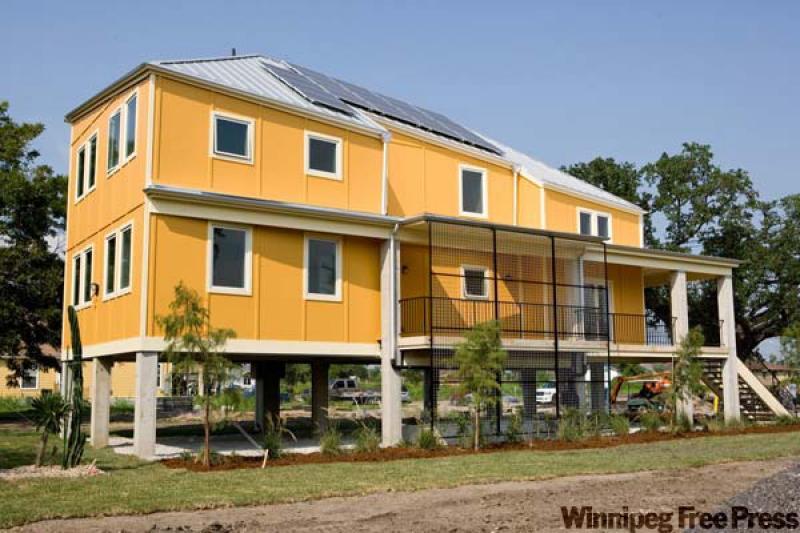
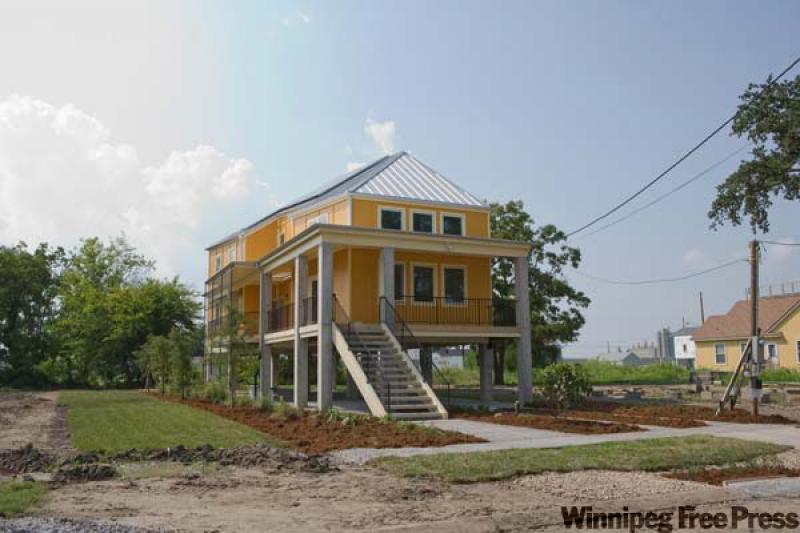
Last summer I had the chance to bring my crew down to the devastated city of New Orleans and build the first house in the Make it Right Foundation's efforts to rebuild the Lower Ninth Ward. Hurricane Katrina hit New Orleans on August 29, 2005, flooding homes, destroying levees and changing lives.
We went down to try and make a difference.
The Lower Ninth Ward is built on what was once a cypress swamp. It's low-lying, and has just a crust of dried clay on top of hundreds of feet of muck. None of the houses that were in the area had foundations -- they were just built on top of cinder blocks sitting on the ground. That's why they floated away without a trace in the storm surge.
To create solid footings we drove over 30 28-feet long wood pilings down into the silt that lies below the crust. The pile driver sank them like nothing -- they slid into the mud like butter.
The pilings are treated wood so they won't rot. And, since they are in a saturated mud environment there's a lack of oxygen, which helps slow down decay. It's like logs that are salvaged after spending 100 years in a river -- they're in perfect shape.
On top of the pilings we poured trenched footings with rebar grids. Then we set forms for the columns that provide the structure for the house.
We built the house in nine weeks; an impossible job. First, framing and sheathing all out of BluWood for mould and insect resistance. The roof was a huge challenge: A pitched ridge-tipping down from back to front, and each hip is pitched at a unique angle -- the design calls for the roofline that faces south to be at a specific degree to receive maximum sun exposure. Every single piece of wood needed to be measured and cut and placed one at a time. It was a slow process and it needed to be perfect.
It's especially tough to do the impossible in New Orleans. The heat is intense, and the humidity is insane. And every day it rained -- torrential rain, lightning and thunder like clockwork. You could set your watch by it. It came down so hard I felt like we were building an ark.
Once the roof was on, we were able to spray closed cell spray foam insulation to create a perfect thermal break -- think of a cooler, on stilts. This house is tight. There's no air leakage.
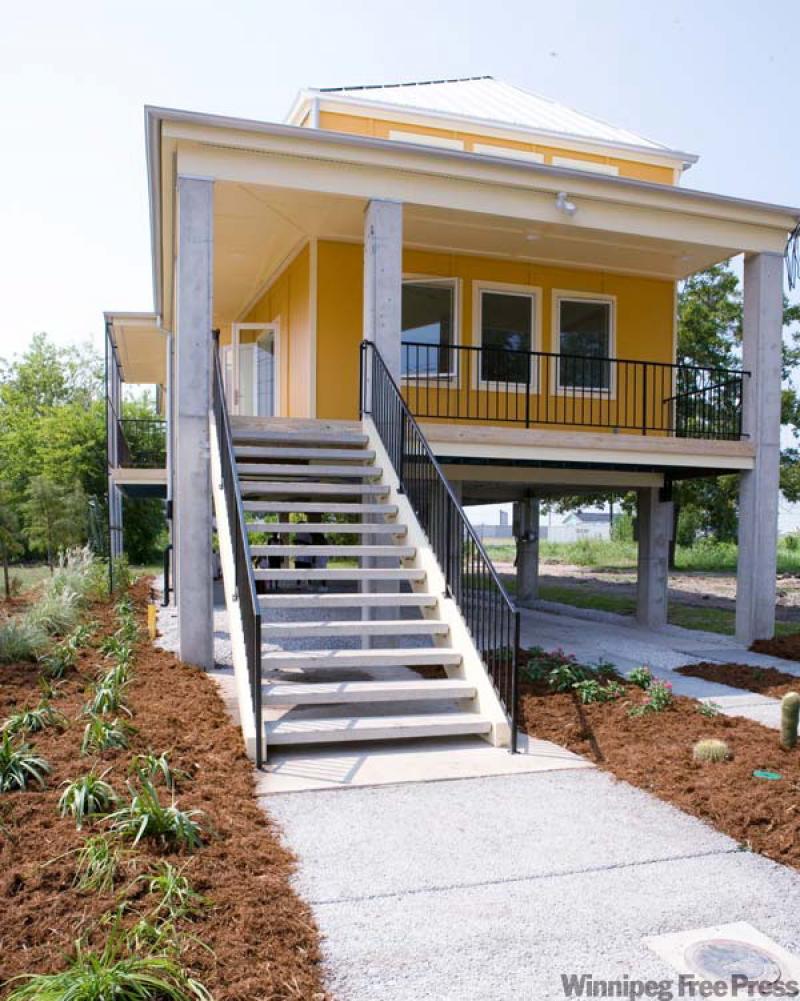
The house was wrapped in Typar, and the exterior finish was board and batten HardiBoard siding, painted yellow.
I loved this project. Everyone involved took the opportunity to think new and to build better, instead of just replacing what was there before the hurricane. It would have been easy to throw up a few stick-framed cottages on cinder blocks. I'm sure we could have built half a dozen of them in the time it took to make this one house. But what would be the point? That's not the way to protect the people if it ever happened again.
New Orleans is hit by hurricanes and tropical storms all of the time, so it's really important every home helps protect residents during a storm. This house is built 2.43 metres above grade, which raises the house above flood level. If there is ever a massive storm surge from a storm or levee break, it will flow around the columns and under the house.
The structure and roof load of the house are designed to withstand up to 150 kilometres an hour winds. The metal roof is designed to withstand wind of up to 130 km/h. All the windows are made with glass that can withstand impacts of up to 80 km/h.
Exterior doors on the house open out, rather than in, to prevent the doors from blowing in from wind pressure.
All Make it Right houses have an escape hatch, to allow homeowners to get out in case of a catastrophic flood. In this case, a window on the second floor above the side porch opens onto the low pitched roof.
Gloria Guy is one of the first homeowners to have their home rebuilt through the Make it Right Foundation's efforts to help rebuild the Lower Ninth Ward. The name on the building plans for Gloria's home is the Lagniappe House.
I've learned lagniappe means 'unexpected gift'. And it is a gift -- to the family who lost so much, and to myself and the crew, since we never expected to get so much from this experience.
I'm happy this house is going to a deserving family who lost so much in Hurricane Katrina. I'm proud of it. It's beautiful, it's energy efficient, it's perfectly designed for the climate and local geography, and I think it's going to change the way building is done in the future of storm-sensitive areas.
The pebble is in the pond. I'm waiting to see the ripples spread.
Watch Mike Holmes and his crew rebuild a home and restore hope in the New Orleans community hardest hit by Hurricane Katrina in Holmes in New Orleans premiering this week on Global and HGTV. For more information visit www.hgtv.ca/neworleans
See the Lagniappe house on Global April 7 and April 8 at 9 p.m. ET/PT, and starting April 9 as a six-part, six-week series on HGTV at 8 p.m. ET/PT. Then visit www.makeitright.ca and see more.
-- Canwest News Service