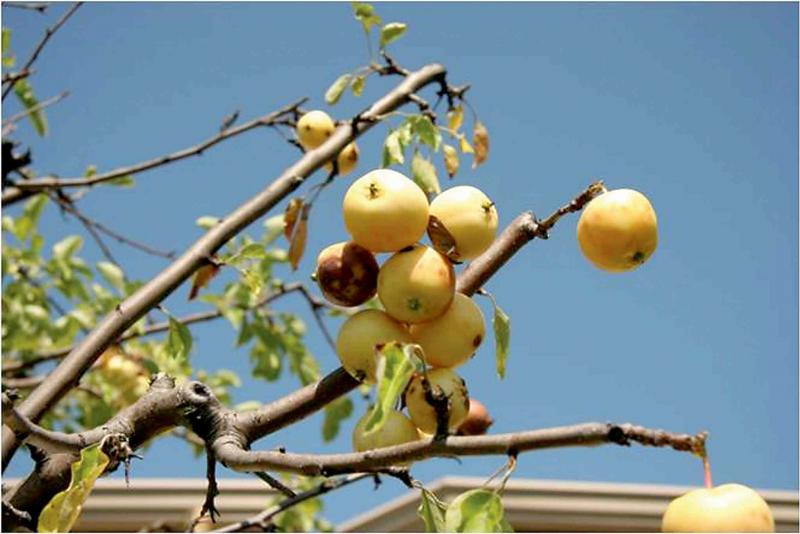
Often I am asked what the most common problem people have with trees is. Trees in Manitoba are separated into two categories: coniferous evergreen and deciduous broadleaf. Colorado blue spruce tops the coniferous problem list, and fruit trees, apple especially, top the broadleaf problem list. This year I am receiving many calls and emails about apple trees. The questions relate to premature fruit dropping, sudden dying of branches and main trunks, premature leaf dropping and premature leaf yellowing. This issue is the first part of a two part series on apple tree problems. My next article will continue with the remainder of the common problems.
At the start of the spring season, fruit tree buds started to open as usual. Very soon after the buds opened, many of these trees were hit with freezing temperatures that damaged or killed the emerging flowers and leaves. To make matters worse, strong winds blew off many developing healthy fruit. However, if the apple trees were established in a protected location, their growth was all right.
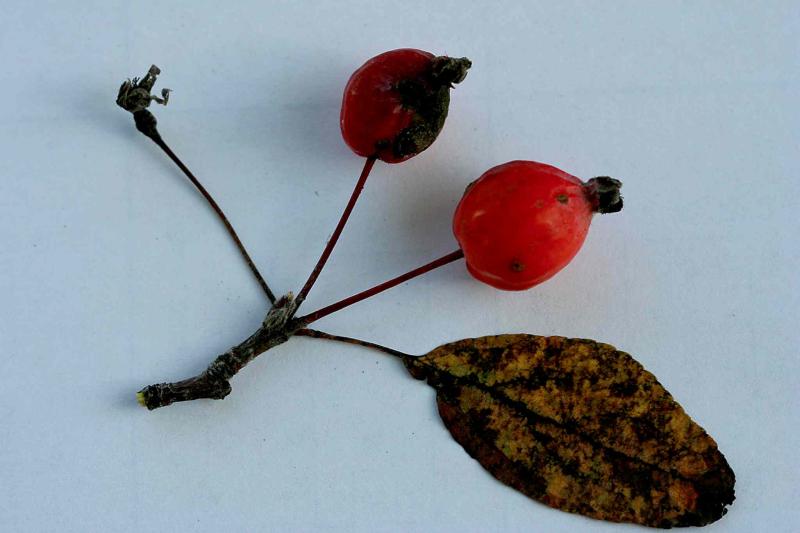
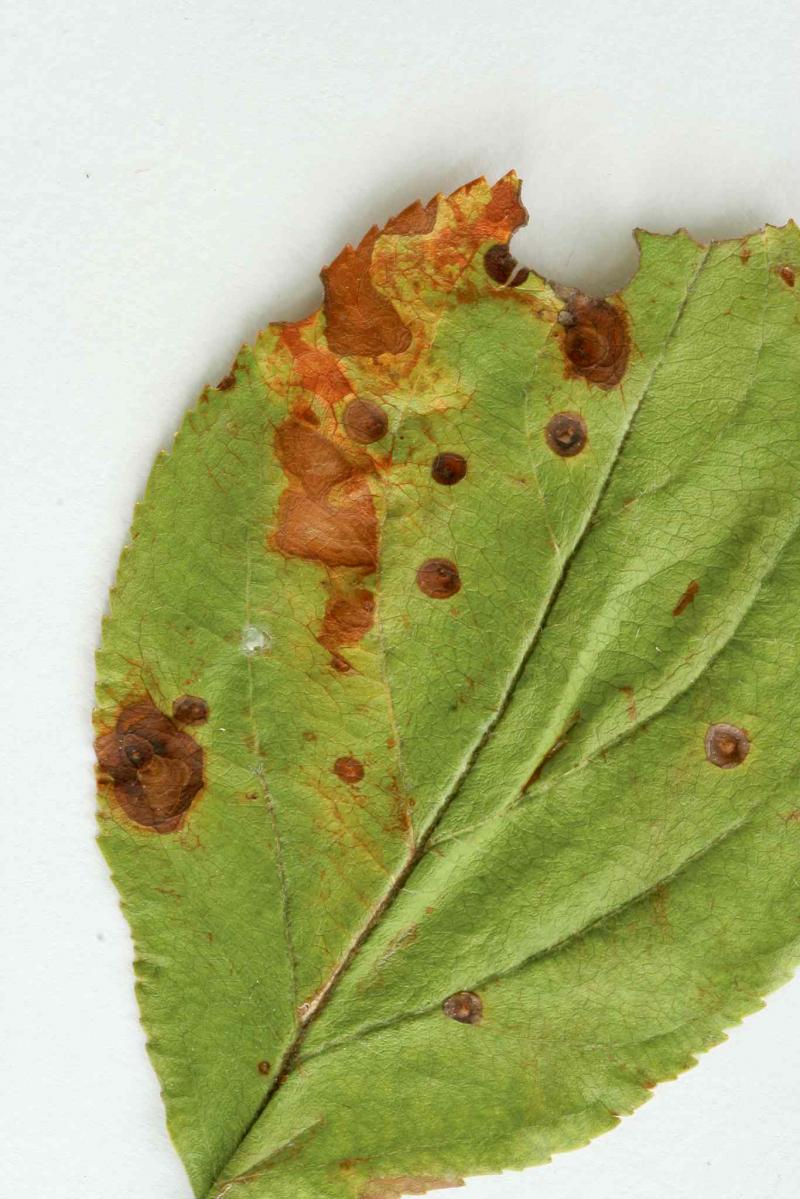
So why are apple trees having such a hard time this season? There has been a resurgence of a deadly fungal disease that affects apple trees in and especially outside the Winnipeg area. It is called black rot disease. There is no known cure for this disease. Its scientific name is Botryosphaeria obtusa. (I have a detailed write up of this disease in my new book, Dr. Tree's Guide to the Common Diseases of Urban Prairie Trees.) This is a complex disease showing inconsistent patterns of fungal infection. Sometimes purple-brown leaf spots often referred to as "frog-eyes" will show up on the upper leaf surfaces. Sometimes it may not show up at all. The apple fruit turns mushy and brown and may show a distinctive red ring around the blemishes. On crabapple fruit, this disease can show up as a prominent black spot covering up to half the fruit's surface area.
Curiously, I have noticed the disease symptoms described above may or may not show up from year to year on the same tree. There is, however, one feature of this disease consistent from year to year. The main trunk or stem in smaller trees will have a distinct line separating the shrunken diseased bark portion from the healthier part of the trunk. The disease portion is in the lower trunk closer to the ground.
In mature apple trees, the disease kills the twigs and branches first. Twigs and branches will have a dense pattern of black spots called pycnidia located just under the peeling thin bark. Pycnidia will produce microscopic spores that will be carried by the wind and will infect other trees. Often the upper trunk areas will have a distinct vertical crack wide enough to place a 25- cent coin inside. This feature as well as the mass of pycnidia are shown in my book.
Can the tree be saved? Moderately to severely infected trees with black rot disease will succumb to the disease. The poorly growing tree will have to be removed, especially if there are healthy susceptible apple trees nearby to help stem the spread of the disease. Not sure if your apple tree has this disease, do not hesitate to contact me for assistance.
Michael Allen M.Sc.F., RPF (ret'd) is a consulting urban forester, tree diagnostician and certified arborist. He owns Viburnum Tree Experts. He makes house and garden visits, diagnoses hazardous trees, and can be reached at 204-831-6503 or 204-223-7709.
viburnumtrees@shaw.ca