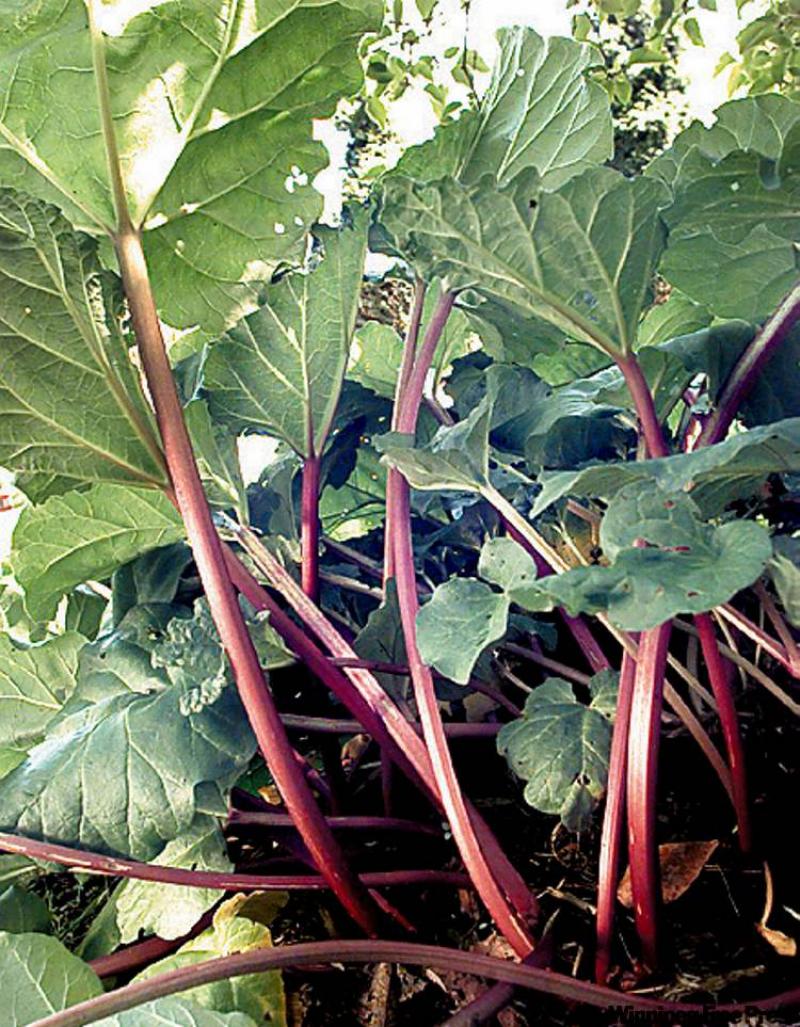
QUESTION: We are leaving our home, and with it a large patch of rhubarb. We have not yet purchased a new home. Is it possible to take a small part and care for it in a pot until it can be replanted? If so, what do I have to do?
ANSWER: You most certainly can grow rhubarb in a container. Rhubarb can easily be propagated by division. Just make certain you get a piece of the crown as well as a good portion of the roots when you are dividing the plant. The best time to do the division is in the spring just as the plant begins to grow, but the division can be done later in the season as well.
Choose a large container if the plant will be in the pot for some time. The container should be more than 25 centimetres in diameter to allow for root growth. Use a sterilized potting soil. When planting the division, the crown should not be more than 2.5 cm below the surface of the soil. Place the container in full sun.
QUESTION: My mature Mayday tree has a long black spot like a swelling on one of its upper branches. My neighbour thinks it may be a fungus. Can you tell me what it might be and how to treat it?
ANSWER: The swelling is a disease called black knot. A fungus does indeed cause the problem. If left untreated, the knots can reduce the vigour of the tree in time.
The knots survive over winter and will grow and expand the following year(s). The disease spreads through fungal spores, especially on windy and rainy days. The only treatment is to prune out the infected branch or branches. Disinfect the saw or pruners in bleach after making the cut.
QUESTION: I have a three-year-old French lilac that looks healthy, with bushy green leaves, but has had no buds or flowers ever since I bought it and planted it in my sunny backyard. It is now about one to 1.5 metres tall. Can you please tell me what I'm supposed to do to get some flowers out of it? I planted a Pocahontas lilac beside it at the same time, and it has been blooming well every spring.
ANSWER: There are a few reasons that your lilac is not blooming:
-- It may be too young. Many varieties of lilacs won't bloom until they are at least three years old.
-- Since too much nitrogen can actually inhibit bloom, cut back on any fertilizer you are giving the plant.
-- It may not be getting enough sun.
QUESTION: We have two huge birch trees in our backyard that provide considerable shade and nesting areas for the birds. The top of one tree was dying last year and my husband cut the dead parts off. It is spreading and more of the tree is dying this year. The other birch tree has started dying from the top as well.
Our neighbour cut his tree down because he was told there was nothing that could be done. Are we going to lose our trees or is there something we can do to make them healthy besides cutting off the dead branches until there is no tree left?
ANSWER: The problem may be caused by the bronze birch borer. This insect targets old and stressed birch trees. They bore under the bark and feed on the tissue of the tree that conducts sap. The borers start at the top of the tree and work down.
Unfortunately, once a tree is infested, it is impossible to eradicate them. Signs to look for include ridging of the bark. You can actually feel the ridges by running your hand along the trunk and/or branches.
Another telltale sign are D-shaped holes in the bark from which the adult borers emerge. The holes look just like a typewritten D and are of the same size. If there are no signs of the insect, then the problem may be a lack of water. Soaking the soil heavily in the fall is the key.
-- Postmedia News
Gerald Filipski is a member of the Garden Writers Association of America. If you have any questions, email them to filipskishaw.ca