PHOENIX PERENNIALS
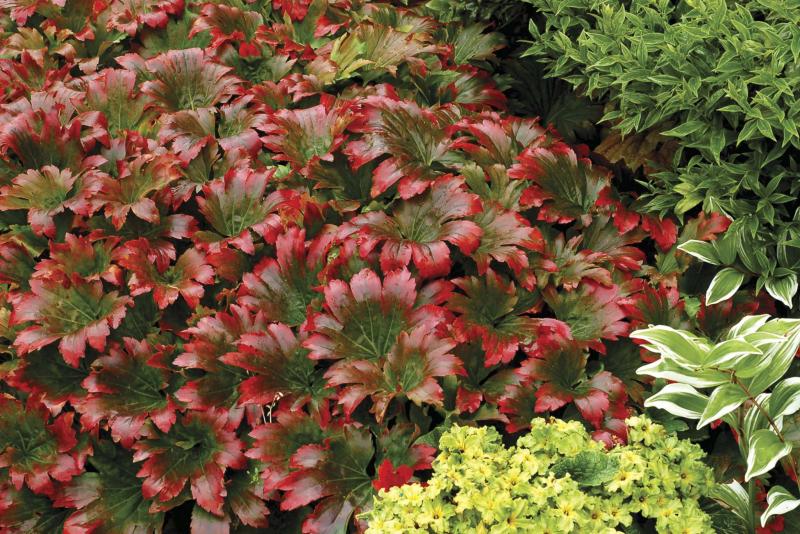
Is it a bergenia? No, it's Mukgenia Nova Flame, a handsome relative.

PHOENIX PERENNIALS
Snow Frills is a delicious frilly white petalled zone 4 hellebore with showy yellow stamens.
WALTERS GARDENS
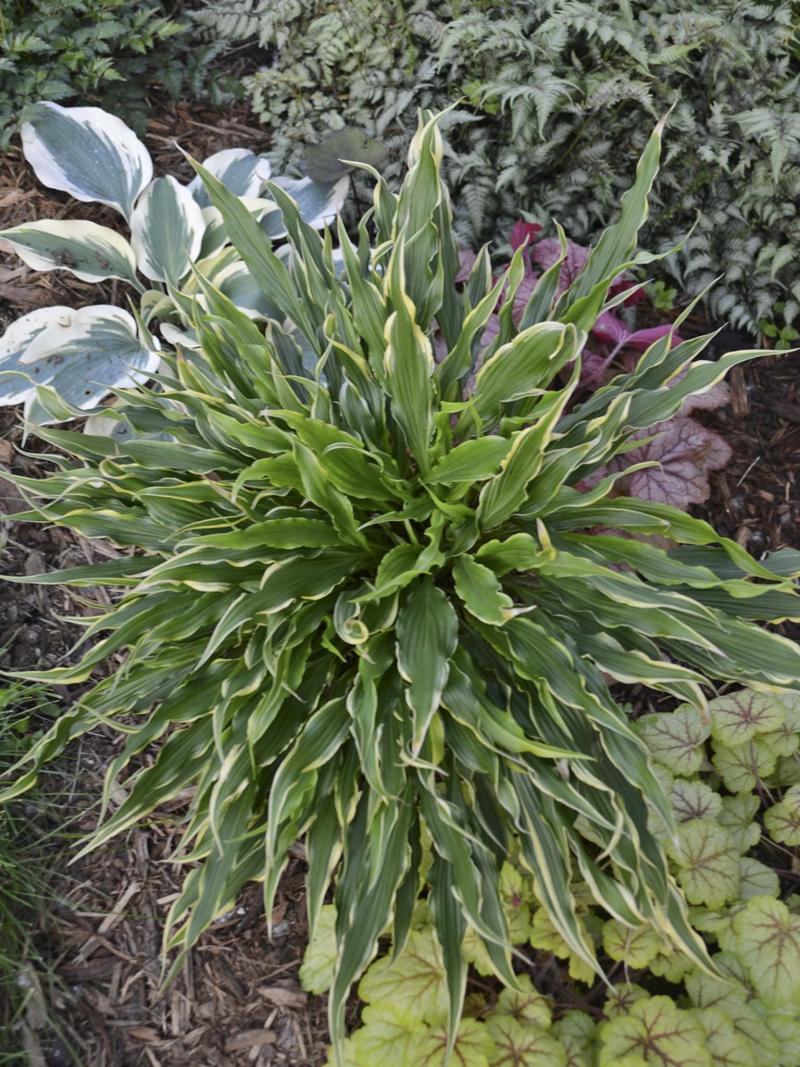
For a shocking new twist to your shade garden, try Electrocution Hosta.
PHOENIX PERENNIALS
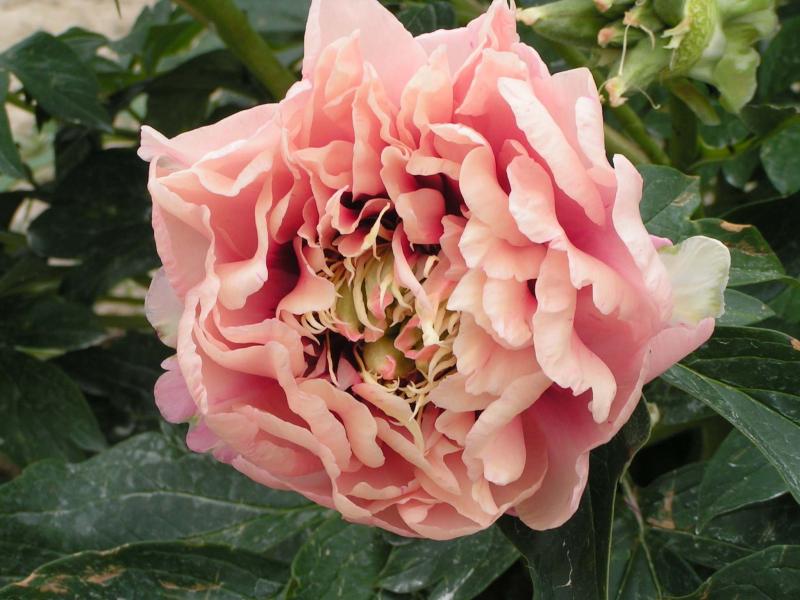
Caroline Constabel's beauty will have you convinced that one Itoh peony isn't nearly enough.

E. HONEYCUTT
Tempted to grow Spigelia marilandica, the firecracker plant? Try overwintering it in an unheated garage or shed.
How easy is it to shop for plants online, and what should you expect when your purchases arrive? Some mail-order companies such as Winnipeg’s T&T Seeds ship plants as bare-root or dormant, while others ship plants that are leafed out and similar in size to plants in the garden centre. To the uninitiated, who may be unfamiliar with bare-root plants, it can be a shock to unpack their order and see only plastic bags containing a small number of roots packed in peat moss, so unlike the lush, leafy images in plant catalogues.
The first step is to inspect the condition of the roots to ensure they are firm and healthy. Mail-order companies use a number of techniques to keep bare-root plants hydrated and healthy through the shipping process. However, if the roots are dry, give them a little sip of cool water. Don’t drown the plant.
It is recommended to plant bare-root plants immediately. Because the ground is still cold and wet when plants arrive, usually in May, pot up each bare-root plant in separate containers filled with moist potting mix, providing room enough for the crown and roots to grow. The crown should be about 21/2 cm below soil level. Store pots in a cool area away from direct light. Water the pots once signs of growth are visible, but even then only minimally.
Kevin Twomey, co-owner of T&T Seeds, says they buy seed varieties from all over the world and grow most of the varieties listed in their catalogue, shipping between 45,000 to 50,000 parcels annually to their loyal customer base across Canada. While herbaceous plants that are shipped bare-root may be tiny, the hardy fruit trees for which they are famous are packaged in boxes 1.5 metres long.
Twomey says the mail-order side of his business has increased significantly in the past two years, in part because T&T grow most of its own plants and sell them through both its catalogue and greenhouse. In addition, says Twomey, he brings in new varieties each year and trials them for next year’s catalogue.
Sandy Venton, a Winnipeg gardener, has been ordering bare-root plants from mail-order nurseries for many years. Confident about their potential, she has no qualms about their initial appearance.
Why buy plants through mail-order when the added expense of shipping costs makes it less costly to shop locally? Venton says she is obsessive about her plants, which could explain why she grows 17 different varieties of Itoh peonies in her garden. She likes to cast her net further afield in the search for the unusual. To save on the cost of shipping, she often places an order together with her friend, Naomi Wiebe.
This spring, both Venton and Wiebe placed an order with Canning Perennials in Paris, Ont., for Anchusa azurea Loddon Royalist (Italian Bugloss), a plant Venton first saw while travelling in England a few years ago. Thrilled to discover it in Canning Perennials’ online catalogue, Venton plans to provide a protected location for the tall (91 cm) bugloss and its masses of bright, gentian blue flowers.
Chris Lepard, owner of Canning Perennials, closed her retail garden centre about five years ago after operating it for 20 years, and switched wholly to a mail-order operation. Lepard now sources her inventory from local growers and today ships plants to customers across the country. Lepard does not ship any of her plants as bare root.
"All of our plants are leafed out," she says, "and have mature root systems."
Plants are grown in pots that range in size from nine cm to 15 cm, or in the case of shrubs, much larger.
Lepard says it would be cost prohibitive to ship plants in pots. Instead, some of the soil is washed off, the root ball is moistened and wrapped in newspaper, then the plant is placed in a plastic bag.
"We are very careful not to have any excess moisture on the foliage as that can result in mildew," says Lepard, who also ensures plants are carefully packaged in boxes to prevent any movement, which can cause damage or breakage to the plants during shipping.
Canning Perennials offers more than 1,500 varieties of perennials, ornamental grasses and shrubs. Lepard says one of the most popular plants this spring is Princess Kate clematis.
"Sales are through the roof," says Lepard, who acknowledges the popularity of this variety may have something to do with its name. Princess Kate clematis is a Zone 3 vine that has lily-shaped white blooms with dark pink on the outside and plum-toned stamens. One of her all-time popular plants is Spigelia marilandica Indian Pink. Also known as the firecracker plant, it has brilliant red, slender, trumpet-shaped blooms with a yellow star-shaped top and throat. Rated as zone 5, it’s not suited to our climate, although Lepard says sometimes it is possible to overwinter borderline hardy perennials in pots in an unheated garage or shed. Nevertheless, she carries many Zone 3 plants.
Gary Lewis, owner of Phoenix Perennials in Richmond, B.C., operates both a garden centre and a mail-order business. With an educational background in plant ecology and botany and a passion for the rare and unusual in his plant offerings, Lewis was selected in 2014 as one of Canada’s Top 10 Horticultural Professionals under 40 by Greenhouse Canada magazine. In 2015, Phoenix Perennials was selected for the 2015 Revolutionary 100, honouring the 100 best cutting-edge garden centres in North America. Lewis is also the Canada region director for the Perennial Plant Association, the North America-wide industry association that brings gardeners the Perennial Plant of the Year.
Phoenix Perennials has an ever-changing inventory of about 4,000 different plants. Lewis embraces constant learning and says in the plant world, learning is almost limitless. His quest for the unusual has taken him to countries all over the world, most recently to South Africa.
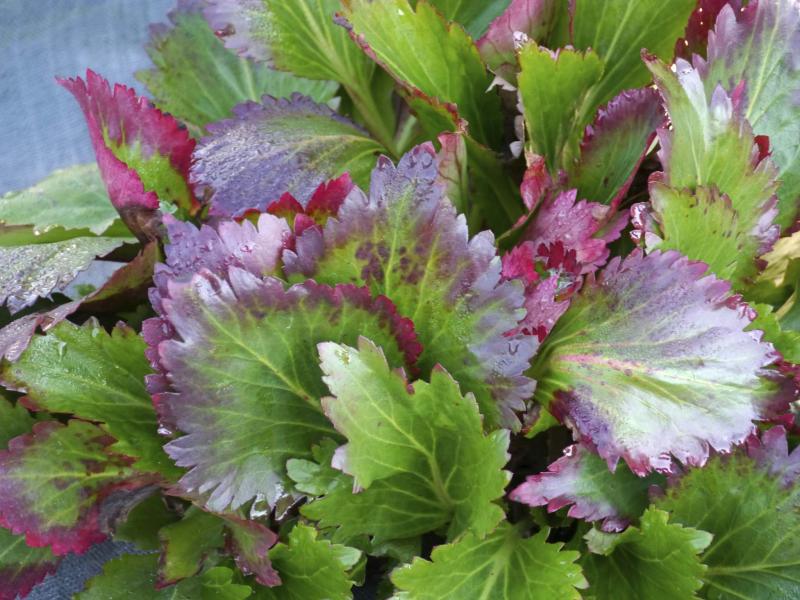
One interesting selection for partial shade is Mukdenia Crimson Fans, a relatively little known Asian perennial. Rated as Zone 4, it has large, shiny, toothed leaves that emerge bronzy green, later turning all green and then taking on red splashes that become gold in fall. Mukgenia Nova Flame, Zone 3, is equally intriguing. An intergeneric cross between bergenia and mukdenia, both of which are closely related genera within the saxifrage family, Nova Flame has leathery, glossy, red-flushed leaves with jagged edges. Both Crimson Fans and Nova Flame are about 20 cm by 30 cm.
Among the many plant species that appeal to plant collectors, some of the most sought after include hosta, hellebore and Itoh peony varieties. Hosta Electrocution, in addition to its interesting name, offers tightly rippled and twisted variegated leaves on a medium-sized form. Rated as Zone 3, it would be a reliable addition to a cold climate garden. Hellebores, on the other hand are showing up in more of our gardens but continue to have an elusive quality. Lewis says cold-climate gardeners are finding success with Helleborus niger. He recommends H. niger Snow Frills, which has ruffles of pure white petals surrounding yellow stamens.
The Itoh peony, with its voluptuous, full double blooms, has earned a coveted place in many of our gardens. An intersectional hybrid between tree peonies and garden peonies, a mature Itoh peony can produce more than 50 blooms. Room for one more? Lewis suggests Caroline Constabel, a Zone 3 Itoh peony with heavenly pink to salmon pink blooms with dark centres.
Phoenix Perennials does not ship any bare-root plants. Instead, plants on the mail-order side of his business are the exact same size as the ones he grows for his customers at his garden centre. He describes these as big, boisterous plants that are ready to perform.
Lewis says people are essentially predisposed to being excited by new things.
"If we weren’t excited by new things," says Lewis, "we wouldn’t have made it from caveman and woman to the modern age because it’s through constantly searching for new things that we developed all the knowledge and technology that we have today."
Lewis adds that when people are experiencing plant lust and can’t seem to help themselves from buying so many new plants, they can just say it’s an evolutionary thing.
Works for me.
colleenizacharias@gmail.com
NOTICE
GIANT Pumpkin Growers Seminar and Seed Swap & Sale, Sunday at the St. Norbert Community Centre, 3450 Pembina Hwy., 1 p.m. to 3 p.m. Learn techniques for growing giant pumpkins. Special guests: Henry Banman, five-time provincial champion, and Milan Lukes, 2015 provincial champion.