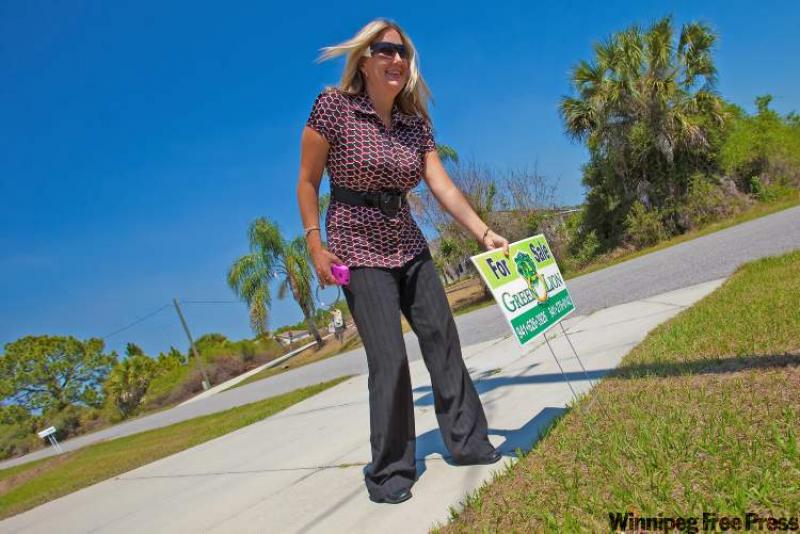

When Shannon Moore crosses the threshold of each of the 70 Florida homes she inspects weekly between Tampa and Naples on behalf of foreign buyers, a property needs to pass her unique smell test.
"I literally start by taking a good whiff," says Moore.
These are tempting times for cross-border shoppers, who can take advantage of crushed U.S. housing markets and a strong Canadian dollar to scoop up finds in the opportunity-rich Sun Belt.
But a distinctive burnt-firecracker odour tells Moore, owner of Green Lion Realty, in Port Charlotte, Fla., that a home for sale was likely among the 100,000 or so built or renovated from 2004 to 2007 across the southern U.S. using sulphurous 'Chinese drywall,' a toxic, corrosive substance that turns a bargain listing into a worthless white elephant.
It's a reminder never to make a decision based on low price alone. Instead, for the one in five Canadians who, according to a recent Leger Marketing poll, are considering buying U.S. real estate, veteran realtors like Moore advise a detailed, step-by-step approach to evaluating deals in Tampa, Vegas or Scottsdale.
'Air conditioning, electrical and plumbing systems will be toast. You can have trouble breathing, and MLS may not tell you about any of that," says Moore, referring to the Multiple Listing Service, MLS.com, where Canadians often begin overseas property searches.
Buyers should take at least two trips to an area of interest to be able to spot troubled homes and get a feel for the neighbourhood's schools, beaches, marinas and golf clubs, advises Phil Soper, chief executive of Royal LePage.
Soper feels termites are a bigger risk than Chinese drywall in the Sun Belt, where in certain states homeowners are advised to have termite insurance and regular inspections. But both concerns are reason enough to "play tourist, and be an unabashed question-asker" -- and prepare to return home without putting in an offer, he says.
There may be no better time to go cross-border shopping. Consumer unease over Standard & Poor's veiled warning in April that the U.S. may lose its prized AAA credit rating because of rising debt will likely contribute to holding home prices down, says Soper -- even as prices fell to new lows in 11 U.S. cities this winter, including overbuilt areas of Florida and Arizona, according to the S&P/Case-Shiller Home Price Index.
Washington, D.C., was the only market where prices rose in January, according to the widely followed index. And market researcher Metrostudy reported the median home price in Florida alone was $121,900 in February, down 53 per cent from June 2006.
Short-term opportunity aside, both pros recommend as a general rule sacrificing a home's size and amenities to get a better location. "The worst house in the best location," says Moore. "If you can negotiate the list price down right now, it's ideal."
Royal LePage's studies of the Canadian summer recreational market have shown waterfront property more consistently holds its value or appreciates over time, a principle that applies equally in the U.S., Soper believes.
Moore sees better value in properties a street or two back from the beach, rather than premium oceanfront. And in Florida, the most valuable are canal-front homes with channels deep enough to fit tall-masted sailboats -- one to 1.5 metres off the dock is the bare minimum -- with the route to open water brief and unobstructed by bridges, or it isn't a bargain, she says.
Soper and Moore differ when it comes to whether Canadians should consider becoming property speculators.
Moore has several return-oriented foreign customers -- some who invest only in duplexes and triplexes, others who fix and flip and a sizable group of Macedonians from Toronto, who have been flying down to nab 1,500-square-foot, three-bedroom homes in North Port, Fla., near Siesta Key, for as low as US$70,00, which they rent through a property manager for $800 monthly and up.
Her firm lists bank-owned properties, 'short sales' -- where bank and seller agree to a price that's less than the outstanding mortgage -- and Moore personally participates in bank auctions as a speculator. But auctions aren't for novice foreign buyers unless they have an experienced local real estate agent at their back, she cautions. Presale inspections aren't allowed, meaning it's harder to tell if a listing has terminal flaws such as Chinese drywall or mould.
Soper recommends steering clear of speculative properties. He advises zeroing in on a "living, vibrant, quality community' with lower rates of crime and foreclosure -- property that delivers an emotional connection, not necessarily income potential.
"If you wouldn't have considered owning (in the U.S.) five years ago, you shouldn't consider it today," Soper says. "There are much better places to invest and easier ways to get a U.S.-based sun vacation, such as renting or going to a resort."
For people wondering whether to buy a house or a condo, Moore says detached and semi-detached homes are a safer investment. Annual condo dues "eat up what you get in rent," she says, and after purchasing there's nothing preventing the condo board from levying unforeseen, hefty charges for big-ticket maintenance, such as hurricane upgrades or roof replacement.
A condo's value can also nosedive as the foreclosure rate for the building edges up, she says, and if there are too many foreclosures in a complex it's difficult for new buyers to even arrange financing.
But for semi-retired Montrealer Stan Wasserman, those risks were simply outweighed by the incredible deal he got on two Florida condos in the past four years; the first in Deerfield Beach, the other in Boca Raton.
Wasserman, with his girlfriend Debbie and an agent the couple sourced through a squash buddy, spent a week this January property-hunting in Boca Raton, where they chose a 1,000-square-foot, two-bedroom, 1.5-bath condo in a gated community, a short drive from the beach and close to their favourite golf course.
The entrepreneur paid $50,000 cash, plus around $7,000 annually in property taxes, utilities and fees for the condo, which had sold to previous owners for $160,000 at the height of the boom.
Would Wasserman consider taking a chance on a short sale or foreclosure, in exchange for potentially greater reward?
"You've really got to know your way around," he says, "whereas I didn't go down there really to buy. The dollars and cents just steered me that way."
-- Postmedia News
U.S. home-buying tips
Find a U.S. real estate agent either by word of mouth or via referral from the U.S. relocation co-ordinators of national firms such as Re/Max, Century 21 or Royal LePage.
To narrow choices, don't rely solely on MLS.com: Phil Soper, chief executive of Royal LePage, says he likes YouTube for the first-person videos uploaded by local lawyers, accountants and insurance brokers, who can supplement a realtor's expertise with useful, unvarnished advice. Or try City-Data.com, which profiles thousands of real estate markets.
American banks generally won't grant a traditional mortgage unless the buyer has excellent credit and at least a 25 per cent down payment, says Soper. Cash purchases are common for Canadians buying in the U.S. You could also dip into your first home's value with a home equity line of credit (HELOC) arranged through a Canadian financial institution or mortgage broker.
Expect to pay a risk premium on home insurance for property that sits empty part of the year. You'll also pay more for auto and health insurance once you arrive at a holiday home, if you intend to stay long.
Watch bank-transaction snafus: Moore frequently contends with incorrectly calculated exchange rates that leave wire transfers short by a few dollars, delaying closing.
At tax time, Canadians need an individual taxpayer identification number (ITIN) issued by the IRS for property purchases. If you're planning to rent to holidaymakers or become an absentee landlord, you'll need to file U.S. income tax, and therefore might benefit from legal advice to explain any beneficial deductions; if you're buying a house to flip it, there may be ways to maximize credits to reduce capital gains tax. A realtor can inform you of property tax laws, which differ by state and municipality.
Buying a condo? Review its balance sheet, budget for the coming year and maintenance history and avoid complexes with a vacancy rate higher than 30 per cent. To ensure you don't face unreasonable fees for upkeep or a new roof soon after becoming an owner, Moore advises checking that the condo has followed Fannie Mae rules to set aside 10 per cent of budgeted income. If it's intended as a holiday rental, make sure board regulations allow this. Annual property tax and condo fees are typically two per cent of the purchase price.
Hire a house-sitter: Air conditioning is a crucial measure to prevent mould in Sun Belt homes, so someone should drop by weekly to check that the AC is on, verify potential damage after a storm, etc.