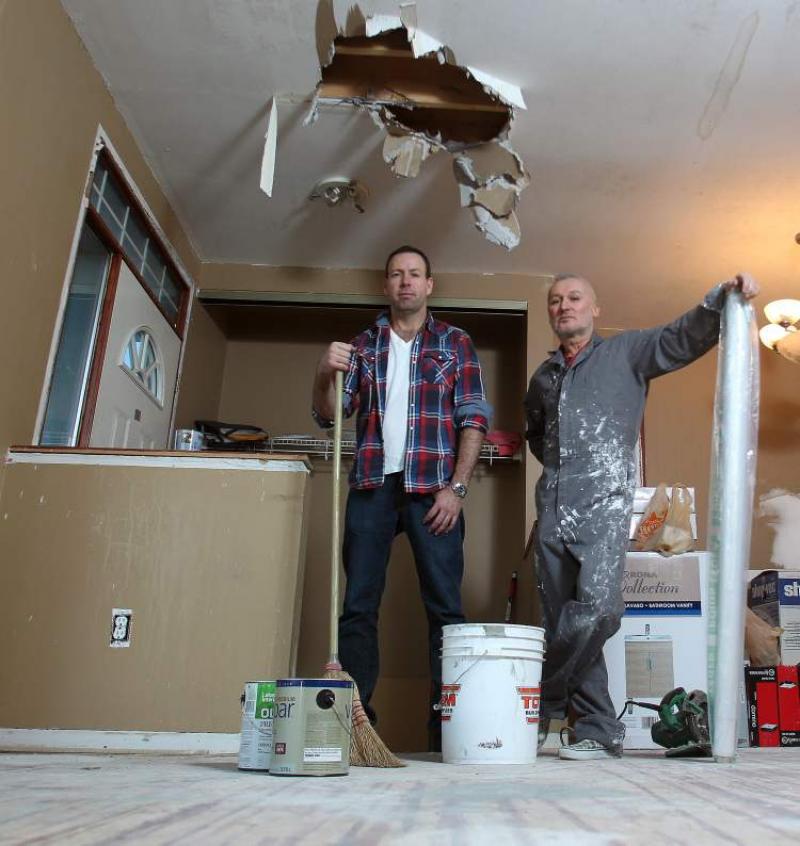
After a month-long search for the perfect home to remodel, Jason Holt and Jym Genesta were eager to follow the lead of their real estate agent to a home in southeast Calgary that had been subject to foreclosure.
But when they walked into the bank-owned home that was just hitting the market, the couple found a grisly scene.
"It was like a total CSI DNA-fest in here," says Holt, a manager at IKEA, pointing out the stains on the subfloor.
Walls formerly used as dartboards and punching bags, living quarters that had served as a hockey rink and a colour palette that featured curry brown and shocking pink greeted them.
Foreclosure has become emblematic of our times, at least in the U.S., and stories of Canadians getting steals on distressed properties there abound. Genesta, who runs a salon in Los Angeles, was well aware of the opportunity this sort of property can present to homebuyers, but wondered what value they might find in Calgary.
On his first visit, he kept an open mind, pulled the sleeves of his cashmere sweater below his hands and cautiously peeked around the corner.
The duo uncovered a four-bedroom, 3.5-bathroom family home in Riverbend, complete with a backyard next to a green space with a walking path.
"You know, Jason, it does have a lot of potential," Genesta ventured.
Holt couldn't help but agree.
As the U.S. economy spiralled down, Canadians turned their attention south of the border.
"We had clients who were going down and buying foreclosures from the banks in big blocks," says Jeff Kahane, senior partner with Kahane Law Office in Calgary. "They were buying big houses with a pool for 25 cents on the dollar for what they're worth."
Canadians now represent 60 per cent of business for some U.S. real estate agents.
The hype surrounding foreclosure sales surfaces in Calgary as well. One bank-owned property in the city's northeast, visited for this article, was shown to 20 interested parties over the course of just three days.
But Canada is a completely different ballpark from the U.S.
"I don't see tremendous deals," says Kahane, who founded what is now one of the busiest real estate law firms in Alberta. "There's one every once in a while... There's always been a rationale for it."
The biggest discounts are often former grow ops or properties that need significant work. Since foreclosures don't come with any guarantees, the risks can be jaw-dropping -- and there are costs homebuyers may not have considered.
A new owner can expect to shell out about $700 to get a Real Property Report, a survey showing property lines and structures, plus $100 for a stamp of compliance from the city. And what the documentation reveals can be a surprise.
If a garage or a fence is in the wrong place, the owner may have to pay for an encroachment agreement, which could cost anywhere from $500 to $20,000. There's also a chance you'll discover structural damage or serious mould problems after the fact.
Foreclosures can be a good buy, however, if you're purchasing with the right perspective, says Ann-Marie Lurie, chief economist with the Calgary Real Estate Board.
"It depends on your objective," she says.
"Are you going to be able to buy it, hold on to it and expect those strong appreciations that we saw in the boom years? Unlikely."
At one point Lurie herself considered a foreclosure purchase but decided against it, realizing she wasn't interested in a fixer-upper.
A month into their reno, Holt and Genesta are still in the thick of things. They're saving a bundle doing all the labour themselves. They've ripped up the carpets, removed all the door moulding and are constantly patching and sanding the walls. They feel lucky they haven't come across any serious problems -- yet.
"You have to look beyond what you're going to walk into," Genesta says. "You make it amazing."
Having saved 17 per cent of the sale price of the average benchmark home in the area that month, and sticking to a $25,000 remodelling budget, they're confident they'll come out ahead, whether they decide to live in the house or flip it.
Holt says a foreclosure purchase wouldn't make sense for everyone.
"This would be very difficult to do with children," he offers, adding necessary renovations could also cause cash-flow issues. "For most people, it takes them some time to save downpayment money, let alone a whole other pot of money to then start doing renovations."
They've started to become part of the community, too.
Neighbours wave as they drive by and pass along horrendous stories about former occupants.
"This place was a disaster," remarks Genesta. "But the thing is, would I do this again? Absolutely."
-- Postmedia News
Tips for purchasing a home after foreclosure
Pay for a home inspection before making an offer, if you can.
Neighbours can be an excellent resource when researching the history of the property.
Do your homework on average sale prices for similar homes in the area.
Set a budget and stick to it.
Before making an offer, ensure financing is securely in place.
Check the furnace for efficiency and gas leaks.
Do renos yourself if you have the skills, time and expertise required; obtain any city permits needed.
Seek lightly used instead of new appliances.
Home insurance may end up paying for itself.
Buy necessary items in bulk.
Search the Internet for DIY ideas to help speed up home reno projects.