For comfort, ease of movement and a visually pleasing décor, keep traffic patterns in mind when arranging your furniture and accessories. If you've ever barked your shins on a coffee table, you'll agree that obstacle-free traffic areas are important in the home.
Here are some basic rules to follow when arranging furniture. Use these as a guide when purchasing furniture as well. There's nothing more frustrating than purchasing a furniture set only to find out it's too large to fit comfortably into the intended room. Take a measuring tape with you when purchasing any furniture to be sure it will fit comfortably into your décor.
A well-planned furniture arrangement will not only be more comfortable, but will naturally bring visual harmony to any room. If you find yourself banging into furniture in your own home, take a second look at how you and your family move around the space and find a more suitable furniture layout.
Simple rules
Remember that these recommended measurements are the minimum required for each situation.
Allow at least 45 centimetres width for lower traffic areas and a minimum of 1.2 metres for heavy traffic areas. A lower traffic area would include the space between a sofa and coffee table as an example. A higher traffic area would include the space in entryways, hallways and stairways.
Bedroom
Leave at least 45 cm of space between the bed and the wall for easier access when making the bed. In front of a dresser or wardrobe leave at least a metre of clearance to allow for the opening drawers and doors.
Dining room
There's nothing more uncomfortable than a cramped dining space. When you're trying to entertain and enjoy your company you want them to feel at home and welcome. You also want to be able to serve them without climbing over obstacles. To ensure a suitable dining experience, leave two feet of clearance behind each chair. If the chair(s) are in front of a large china cabinet or in front of a wall, allow three feet of clearance.
Hallways
Hallways are high traffic areas and should be free of furniture and other obstacles unless the hall is unusually wide. Hallways are where people cross paths, especially in the early morning rush so anything that can be tripped over ultimately will be. When hanging a shelf or other protruding object on the wall, be sure the item is high enough so you won't bump into it. Shelves with sharper corners need special attention in this regard. In fact, any furniture or shelving that has sharp corners should be placed well away from traffic areas or the corners can be rounded off or padded, especially when there are small children in the home. Be cognoscente of potential accidents before they occur. If the space is really tight, leave the walls free of pictures and shelving altogether.
Kitchen
In the kitchen, when buying new appliances be sure to consider the space required in front of the respective appliance to allow room for appliance doors to be fully opened. For example, a refrigerator with dual doors might work better than one with a single door if space is tight. Oven doors take up a lot of space when opened so be sure, especially for safety sake, that you have enough room to work in this area. Dishwashers, microwaves and cupboard doors all take up space, so I recommend opening all of the cabinet and appliance doors to see if any improvement is required or possible.
Other things to consider
Even hanging lighting can be in the way if it's in the wrong place or hung too low. You certainly don't want to hit the decorative pendant lighting that hangs over the dining table when passing the salt and pepper or hit your head on task lighting hung over the kitchen island. Ask your lighting consultant for proper heights for specific areas of the home. Traffic patterns don't only pertain to where you walk. Where and how you move need consideration as well.
In a small bathroom, opt for towel rings that hang flush against the wall rather than towel bars that protrude. Purchase foldaway hook bars that sit flush when not in use. Flip hooks by Umbra can work in the bathroom, bedroom or hallway with the same sleek effect. A recessed medicine cabinet will take up a lot less space than one simply hung on the wall and so on.
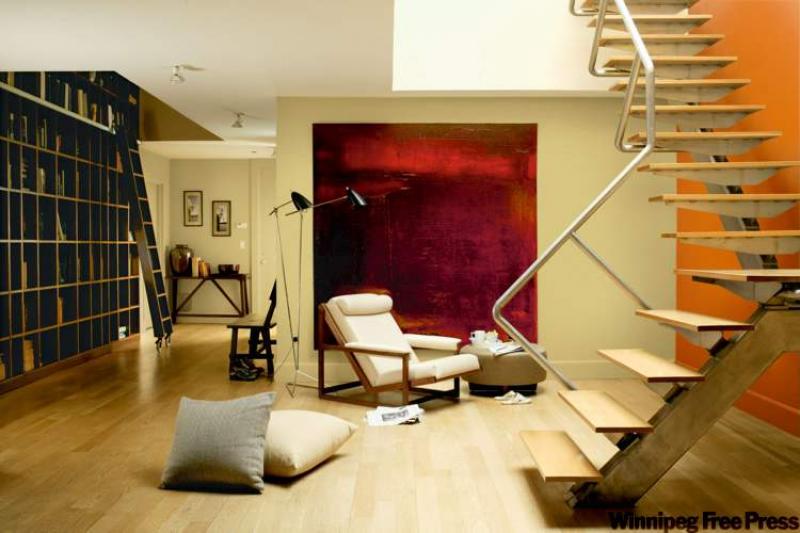
As you can see from our feature photograph, courtesy of Pratt & Lambert Paints, a furniture arrangement that considers traffic patterns is airy and spacious. There is enough room in this home for a bench in the hallway and to allow the library ladder to move freely. The hall table in the background fits snuggly into a nook so it's not in the way of the entrance to the other room. The large painted canvas might have been a worry with regard to people bumping into it if it were placed in another area. Creating a stationary furniture setting in front of it keeps it out of harm's way by removing any potential for traffic to get anywhere near it yet still allows it to hang in full splendour. If the painting were hung in a hallway, for instance, it would be in a less protected space where an accidental brush against it could damage it.
Basically, if you keep barking your shins on a coffee table, fight to get the fridge door open or your family members keep knocking down that picture in the hallway there is a spatial problem. Solve it by removing the offending item or making more room for it.