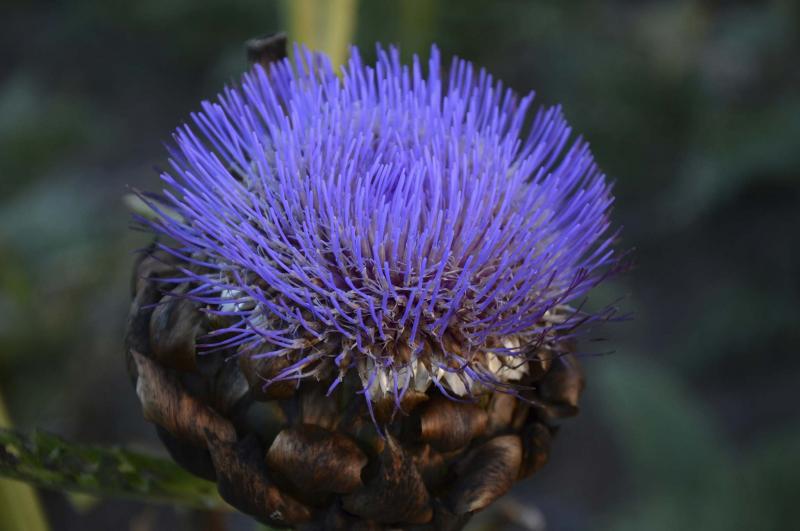
Is every common vegetable going purple? Purple broccoli, purple cauliflower, purple carrots and purple bok choy now have pride of place in the seed catalogue kaleidoscope, along with the more customary purple cabbage, lettuce and beans. I say the more colourful antioxidants the better, so let’s give a hearty welcome to a new, gorgeous purple globe artichoke called Colorado Star.
Purple artichokes have long been part of the gene pool, both globe-shaped ones and the pointy kind, which have been easier to find. I grew a pointed heirloom called Violetta years ago and loved it. The heads were small but many and kept bearing in fall long after the green ones had gone to seed.
What’s new about Colorado Star is that it’s the first purple one bred for annual production. Artichokes are perennials that normally start producing in their second year, when grown from seed. They must go through a chilling winter to make the flower buds we eat. But by sowing them indoors in late winter, then giving them six weeks of the mildly cold outdoors in early spring, you can trick them into producing in their first summer.
This process, vernalizing, was pioneered at several research stations, including one at Virginia Tech. Then in the 1980s, a breeder in Imperial County, Calif., named Keith Mayberry developed Imperial Star, which could produce with a chilling period of only 10 days. That’s a boon to gardeners with winters too cold for overwintering artichokes outdoors and to those with winters too mild for sufficient chilling.
Mayberry, now retired in Colorado, went on to cross Imperial Star with varieties he found in Peru and developed the first vernalized purple artichoke variety, Colorado Star.
So now, my magnificent, spiky artichoke plants are topped with deeply purple globes. They appeared about 10 days before I normally expect artichokes and continue to add an extra note of glamour to an already beautiful crop. Any I leave uncut will tower over the garden like neon-blue torches as the amazing thistlelike flowers bloom.
Our new, colourful variety is very good to eat, and I’ll look forward to cooking with it well into fall. Over the years, I’ve tried various methods of preparing artichokes. I’ve boiled them, grilled them and smashed them in a frying pan to flatten them, the way they do in Rome, with olive oil, garlic, herbs and a little water so that they steam when the pan is covered.
Some moisture is essential to tenderize the firm flesh, but boiling can make artichokes soggy and waterlogged and dilute their flavour. Steaming them (at least 45 minutes for large ones) is better. So is oven-braising in a covered casserole, along with olive oil, a small amount of water, and savory additions such as anchovies, garlic, capers, olives, parsley, rosemary and lemon.
I’m already thinking of baby artichokes, braised with garlic and a nice glass of — no, not wine. The one bad thing you can say about an artichoke is that it pairs horribly with wine. Make that a cold beer.
— The Washington Post