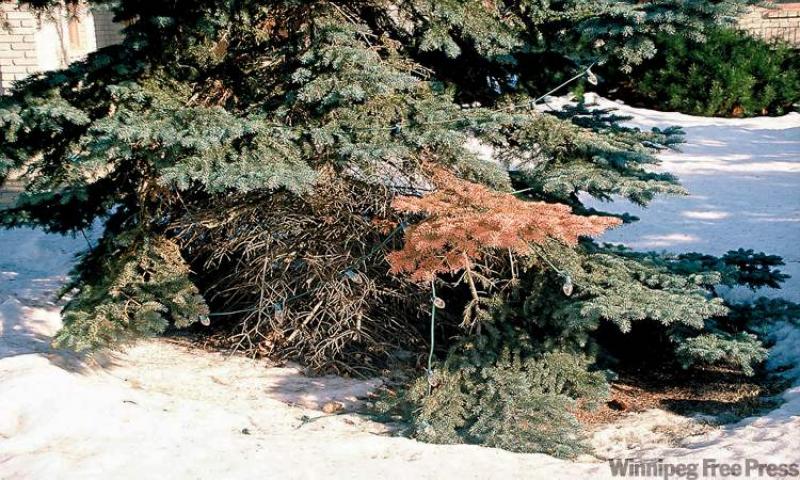
This spring season has been a very busy one for me with literally many dozens of people calling or e-mailing me about the situation with sudden needle discolouration in their spruce trees. What is going on, I am asked? There is not unfortunately a simple cause-and-effect answer.
Over the many years I have been associated with the care of trees on the Prairies and northwestern Ontario, the number-one tree concern I receive above all others relates to spruce trees -- Colorado blue spruce, our indigenous white spruce, and on rare occasions, Norway spruce. Sudden needle fall and discoloration can be caused by excessive rain, excessive heat, accumulative years of growth stress and especially by a slowly acting potential lethal canker disease. Along with Cytospora there are spruce tip blight, sooty mold and needle cast diseases.
Reaction to climatic extremes is not the only factor involved with spruce needle discolouration. Nearly all spruce trees in southern Manitoba 15 years and older have a slowly lethal fungal canker disease called Cytospora. I refer to it as the white blister disease. It is an indigenous disease to Manitoba white spruce. the other diseases also contribute to the needle browning situation.
Cytospora disease displays several forms on the tree as signs of infection. There is no known cure for this fungus canker disease which is the most common and most widely spread disease of ornamental spruce trees in southern Manitoba. Here is a description of this complex disease
(1) In the early stages, newly formed cracks or lesions will exude a clear resin-sap. The disease has successfully killed the living wood cells under the bark at this time. Soon after the clear resin will oxidize into an amber colour and then to white-grey colour often crystalline in appearance.
(2) Look for resinous white blisters on the lower or middle branches and/or resin bleeding from cracks in the bark of the trunk. Often these blisters are bluish-grey in colour in very active stages of the disease.
(3) On some trees there can be numerous soft chestnut brown blisters that are approximately oval in shape and be 1/2 to 2 inches in length. This is another phase of the Cytospora disease.
(4) Old blister sites will show resin-sap accumulation that gradually discolours with age. The old swollen blisters can be a muddy orange brown or black.
Treatment options are very limited, but here are some suggestions:
(1) Some arborists will spray the branches with fixed copper but there is no evidence that this is effective on the internal canker fungus. Fungicide sprays can be sprayed onto the needles to help control the spread of the needle blight but it would need to be done in
(2) late summer before the needles turned colour. This is not a practical solution as the onset of needle discolouration can be sudden and move through the tree very rapidly.
(3) Timely removal and disposal of the dead and significantly infected branches (a sanitation process) on all spruce trees are the first actions that should be taken. Prune dead branches back to the bark of the trunk or living larger branches that is at the point of attachment.
(4) Keeping all spruce trees healthy through regular aeration, fertilization and watering will significantly slow the rate of expansion of Cytospora white blister canker disease and other diseases such as tip blight disease, needle cast disease, and needle rust disease. Fertilization however will not cure the disease. The spruce twigs and needles will however show much improved size, colour and growth.
Michael Allen M.Sc.F., RPF is a consulting urban forester and certified I.S.A. arborist. He owns Viburnum Tree Experts, a Manitoba company that provides objective assessments of the condition and the care required for trees and shrubs on home and business landscapes. He can be reached at 204-831-6503 or viburnumtrees@shaw.ca His web site is www.treeexperts.mb.ca