Michael Allen / Winnipeg Free Press
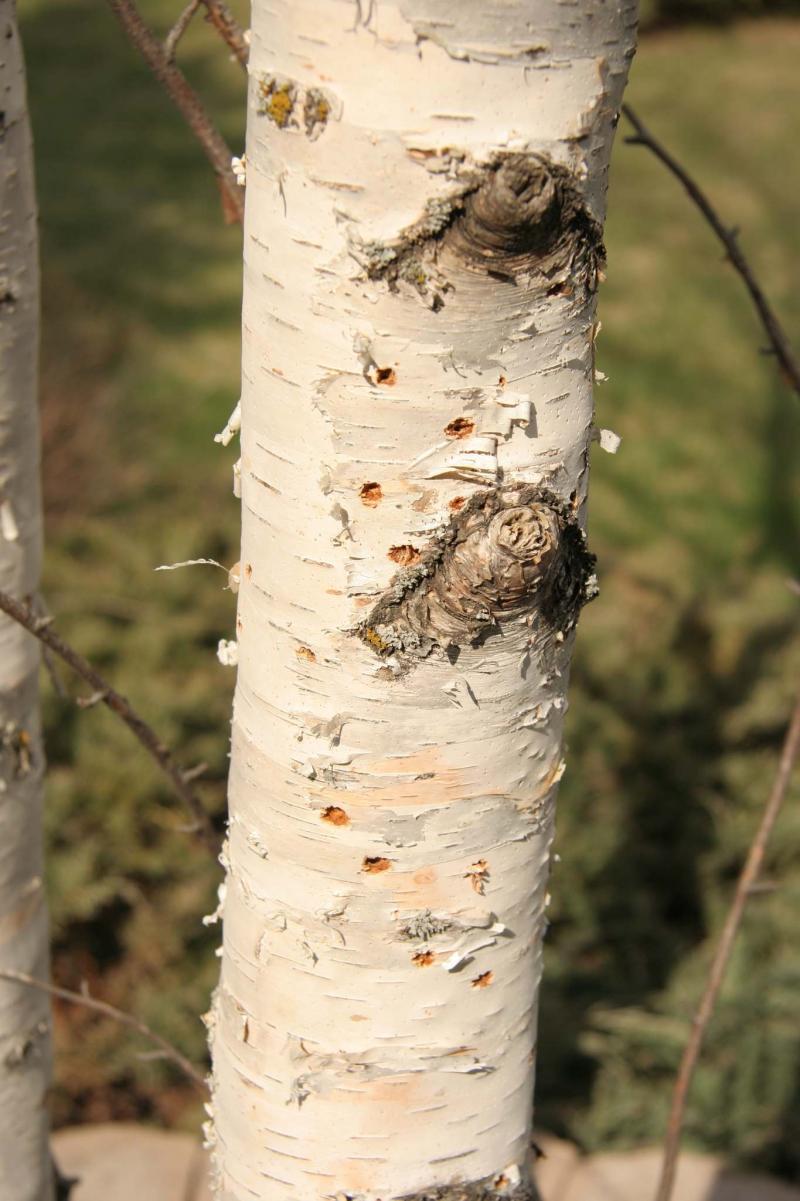
Young Dakota white birch with bronze birch borer holes.
The bronze birch borer is an insect pest that kills both the weeping European birch and the indigenous white or silver birch. This pest also kills Asiatic birch trees. The adult is a black beetle with a bronze coloured head.
If you are able to, go online and Google this insect to get an idea of its characteristic features.
As this beetle spends a great deal of its time under the bark, it is rarely seen outside the tree.
The insects usually feed high up in the tree.
But why are some birch trees infected and some not?
Beetles infest certain birch trees because they can detect the airborne chemical signs of stress in that particular tree.
When birch trees are planted in our heavy clay soils, they are in their least optimum rooting environment. The tree prefers well-drained, but moderately moist, sandy loams and tills (variable stony, mixed soils).
Clay soils do not adequately allow birch to thrive as they mature. With age, the growth stresses in the tree increase, and unfortunately so do the beetles.
The first sign of this pest is the presence of dying branches near the top of the tree. Usually the leaves of the tree shrivel up and turn brown.
With careful observation, especially with binoculars, the presence of what arborists call "ripple or muscle" bark can be seen in infested branches or in the stems near the top of the tree.
Usually, rippled and muscled bark is associated with ‘D’ shaped feeding holes.
The rippling is the result of internal callous wood created by the tree to limit the feeding area of the grubs (the larval stage of the borer).
The grubs consume the living cambial wood under the bark, thereby girdling the affected area at the feeding zone.
The more the beetles feed, the more the tree changes the characteristics of the living wood.
This living wood contains conducting columns of cells, sort of like arteries that transport water and nutrients to the leaves.
Girdling by the beetle cuts off this supply, starving the leaves on the upside of affected branches and stems to wither and die.
There is no approved chemical control for this pest available in Manitoba to deal with the beetles once they are in the tree. It is essential to prune off the top, dying branches when they first show up to stop the beetle’s downward spread.
A skilled arborist can climb the tree and look for the characteristic ‘D’ shaped holes.
Even though there may seem to be no visible holes, the beetles can be under the bark, feeding.
The area of current active feeding would, however, be at least half a metre to a metre below the series of feeding holes seen closest to the ground.
To stem the proliferation of the beetles, the arborist would need to cut into what the average person would say looks like living wood, with healthy looking leaves, to remove the infested wood.
All signs of the beetles’ presence on the tree’s stems and branches should be removed and taken away from the property.
Usually, an arborist will put the infected wood into a chipper.
But it must be stressed that the sooner you remove the infested branches and wood, the more likely you will be successful in controlling the spread of the beetles.
Many older, infested trees are beyond saving and should be removed as the borers will likely spread to healthy trees.
If the birch tree looks healthy and there are damaged birch trees in your area, it is a good idea to keep your tree healthy through periodic spring or fall fertilizations.
However, these fertilizers are made up of potent chemicals and may not be appropriate to add to soils located near any water body or high water table area, because of environmental reasons.
As mentioned before, remove all dead and dying twigs, branches and wood as soon as possible.
In recent years, tree nurseries have been selling varieties of Asiatic birches — especially one called Dakota Pinnacle birch (Japanese white birch). I have advised some tree nurseries about problems with this tree.
This birch is susceptible to the European bronze birch borer when planted in our heavy clay soils.
I have found the small larvae of this beetle in young Pinnacle birches often less than 2.5 cm in diameter.
Another popular columnar birch is the Purple Rain European birch.
Unfortunately, this colourful tree is also attacked by the bronze birch borer.
Michael Allen M.Sc.F., RPF (ret’d) is a consulting urban forester, tree diagnostician and certified arborist. He owns Viburnum Tree Experts. He can be reached at 204-831-6503 or 204-223-7709, or at viburnumtrees@shaw.ca His web site is www.treeexperts.mb.ca