IN my previous article (Sept. 25) I mentioned that I would explain how to fertilize trees especially those under stress.
Aeration and fertilization is a process that can be done by property owners to open up the root zone of trees to air, water and nutrients -- all three are essential ingredients for life in that order. Why do we want to aerate and fertilize? For two reasons:
(1) Reduce severity and duration of pest infestations and disease infections.
(2) Provide a source of nutrients and energy to help restore growth of weak woody shrubs and trees.
For most trees a higher nitrogen (first number) fertilizer such as 21-7-7, or 20-20-20 or 30-10-10 and so on can be used. If you contact me I will tell you where to find bulk sources of fertilizers.
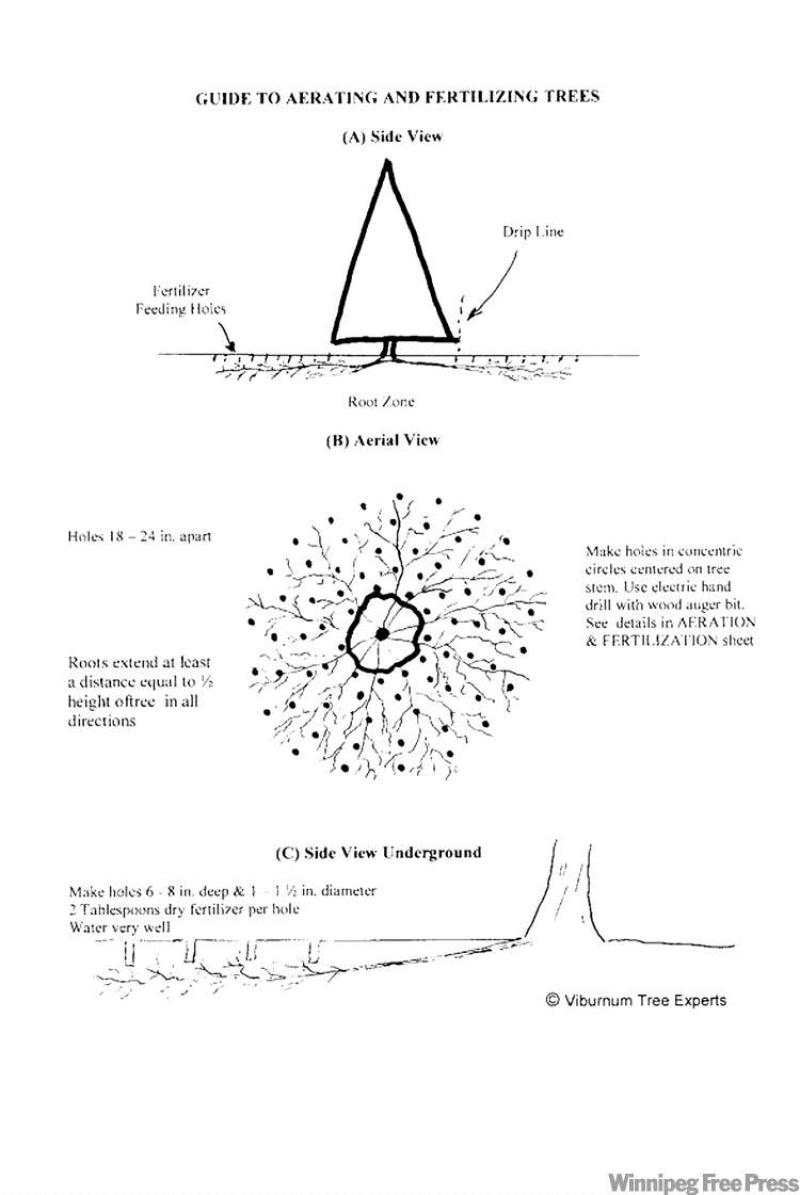
For most trees it is important that you or a licensed applicator inject a suitable tree fertilizer such as one of those previously mentioned into the soil. For clay loam soils place the fertilizer six to eight inches deep. In sandy loam soils do this to a depth between 10 and 14 inches. Place these holes between 12 inches to two feet apart as I show on the diagram. Spacing distance depends on size of tree and amount of area near the tree that can be fertilized. Drill holes when ground is dry using an half inch drill with a one inch diameter wood auger drill bit. Add two tablespoons of dry granular tree fertilizer to each hole. Holes can be covered.
Do not accept a single row of soil injections close to the drip line. Ideally the holes should use the entire area extending at least a distance of half the height of the tree from the trunk in any direction not withstanding physical restrictions.
Badly stressed trees and newly planted trees should be fertilized with 10-52-10 or equivalent such as bone meal. The high phosphorus helps to restore damaged roots. Use all of the open areas within this distance near the trees that you can. I will let you know if this type of fertilizer is necessary.
All trees would benefit from aeration and fertilization treatments. I recommend that these treatments be done at least annually (spring or fall only never in summer) for stressed trees for at least the next two to five years depending on the severity of problems occurring in the tree. In many instances fertilization is the only way that certain diseases inside trees such as fire blight can be slowed to the point where the tree may start to use its own defences to combat the disease.
Michael Allen is a consulting urban forester and certified I.S.A. arborist and owner of Viburnum Tree Experts. He makes house and garden visits to assess tree and shrub problems. He can be contacted by calling 831-6503 or by e-mail at viburnumtrees@shaw.ca You can also mail questions to Michael Allen, c/o Newsroom, Winnipeg Free Press, 1355 Mountain Ave., Winnipeg, MB, R2X 3B6. His website is www.treeexperts.mb.ca