New Homes

New Homes

A quiet dream

Joel Schlesinger
June 22

Advertisement

New Homes

Why U.S. housing crisis won't happen here

There has been great concern expressed lately that the housing crisis happening in the United States will spread to Canada. Consumer confidence on the part of the American buyer has dropped to its lowest level since 1980.

Americans are cutting back on discretionary spending, as reflected in the lowest vehicle sales period in the last 10 years. If it were not for personal tax rebates totaling more than $100 billion, the situation for the average U.S. taxpayer would be even worse. Banks are not taking any credit risks and, when they do, the payoffs are extremely high.

New housing starts in many markets have practically disappeared. We have seen American-based real estate companies offer seminars in Winnipeg recently in an effort to stimulate buying by Canadian snowbirds in the southern U.S.

The big question on many people's minds is "Will this happen here?" In a word, no.

Canada's mortgage market has avoided the turmoil in the U.S. Sub-prime lending is only about five per cent of our mortgage market. Our banks do not engage in reckless lending. In fact, mortgage rates continue to show substantial declines due, in part, to Bank of Canada rate cuts.

Canadian motor vehicle sales have continued to increase steadily over the past four years. This is an indicator of consumer confidence and shows that Canadians are not shying away from big ticket, discretionary spending.

Oil prices continue to rise creating, in effect, the same impact as a tax increase. Consumers have a greater incentive than ever to invest in energy efficiency. However, as stated by the Canadian Energy Alliance Association, new homes in Manitoba are the most energy efficient in Canada.

Nowhere else in all of Canada do new homes meet energy efficiency standards than those of Manitoba builders. Manitoba Home Builders' Association members are committed to maintaining this lofty position.

Granted, housing starts are down considerably in Alberta. However, they are down from all-time record highs, not traditional patterns. Manitoba and Saskatchewan are both showing positive population flow from Alberta. Employment opportunities here continue to increase.

Manitoba is enjoying its second strongest year in terms of new housing starts in the past 20 years. Single family detached units are actually above last year's record-setting pace. Manitobans are not only buying new homes, but they are also putting equity into the homes they currently own.

Manitoba leads the country in the percentage of increased renovation spending compared to the first quarter of last year.

All of this growth is at a steady, moderate rate. Manitoba's new home industry has never been based on a boom or bust mentality. The development of sustainable communities is always a primary consideration for both the developer and the builder.

The housing industry has relied on a well planned, calculated growth that the market can bear. Manitoba home builders work very closely with the province and various municipalities to plan according to the market. They build based on what can be sold, according to consumer demands.

Quality has always been at the forefront, and the value of an investment in a new home has consistently paid dividends.

Current and historical economic indicators demonstrate that Canada, and especially Manitoba, will not face the current crisis being experienced in much of the U.S. It's not going to happen here.

This column prepared by the Manitoba Home Builders' Association


June 15

New Homes

Kid-friendly and cool

CALGARY -- After Erin Ryan-Walsh and her husband Rob Engelhardt moved out of their downtown apartment into a contemporary townhouse, they were thrilled to spend time decorating and adding personal touches to their new home.

Relocating their old, inherited furniture into the basement, Erin, a 30-year-old communications specialist and Rob, a 36-year-old financial analyst, happily furnished their new digs with custom furniture and artwork, establishing their first, truly grownup house.

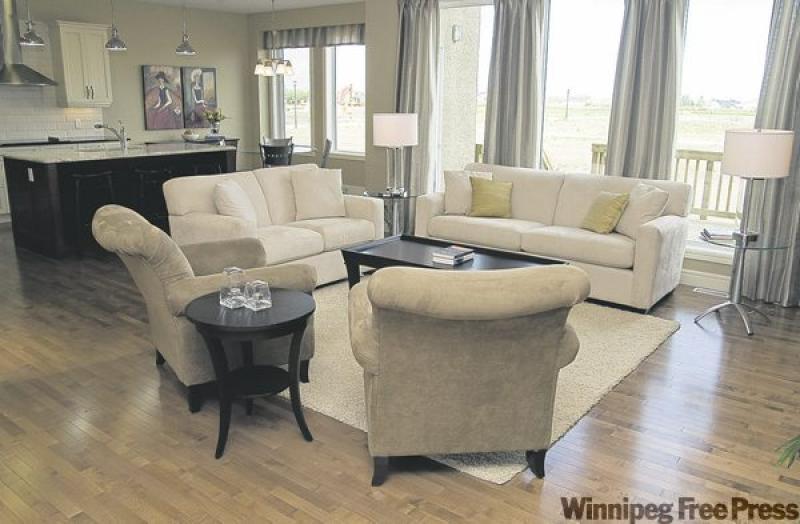
Beautiful framed artwork, hardwood floors and treasured accents that reflect their travels and life together make their home modern, comfortable and elegant. Along with the thrill of adding a pristine ivory linen sofa set to their living room came the exciting news of Erin's first pregnancy. One of Erin's first reactions?

"Oh no, I should have ordered a different couch," she recalls.

Suddenly, the couple was forced to confront a new dilemma: Can we keep our sense of style when the baby arrives?

They're not alone.

More than ever, Canadian couples are waiting until later in life to start a family. Statistics Canada estimates that since 2003, nearly half of Canadian women having their first child were 30 years of age and older. Albertans are no exception: The average age of mothers in the same study was 29.

By the time many couples are welcoming their first baby, it can put those expensive and sophisticated bits and pieces into question.

Nevertheless, Erin and Rob have found there is an advantage to having children later in life.

"We're much more established now," Rob says. "If we were in our 20s having kids, it would be more about what hand-me-downs we could acquire. Erin is picking out artwork to dictate the theme of the baby's room; 10 years ago, I don't think we could have imagined decorating like that."

Stephanie Koo, co-owner of Pink or Blue Couture, a high-end baby shop selling fashionable baby clothes and furniture in Calgary, agrees.

"We target what we like to call the modern-day family. To us, a modern-day parent is in their 30s or 40s, professionals who have good jobs and are just starting their families," says Koo.

"They don't want to decorate with Winnie the Pooh and princesses; they want to paint (their children's room) chocolate brown and have stylish furniture and bedding."

Koo, 25, is a native Calgarian who opened Pink or Blue Couture in August 2007 with her sister, Jennifer Koo Ishigura, 28.

"There are a lot of new, innovative designs that are very streamlined and clean looking and they actually have storage compartments that are hidden," says Koo.

Staying stylish with kids isn't necessarily cheap; customized cribs start at $1,100 and most of the other furniture starts at around $600. Despite the costs, some new parents are not inclined to let children take over their high-style habitats.

Jacqueline Corea is the principal designer for Calgary's Corea Sotropa interior design. Her main clientele consists of homeowners between the ages of 35 to 45, many of them with young children or a baby on the way.

"Some parents allow kids to take over, but most of (our clients) have established a style of living and they don't want their whole life to be completely turned upside down," says Corea.

For most parents, combatting the piles of toys, books and games that children inevitably accumulate is one of the biggest challenges to maintaining a stylish home.

"They (children's toys) are a real eyesore and it's one of the things that parents struggle with," says Corea. "A lot of these toys are massive and they are really bright and don't really co-ordinate with your interior."

Parents certainly don't have to sacrifice style to find storage, as Corea suggests. She recommends finding pieces that "don't look like they came out of a children's store," but instead using a beautiful bureau or armoire, and organizing the toys in the drawers. Choose a coffee table with drawers or an ottoman that flips up and has built-in storage."

Beyond the mountains of toys, the issue of safety often poses a dilemma. Baby-proofing a home is a quick way to relinquish any sense of elegance in the home. Corea has some advice for new parents.

"I think you need to baby-proof to a point; you need to make sure that you get things out of their reach that are dangerous or that you don't want to see broken. The rest of it depends on your comfort level."

Materials and high quality are of the utmost importance for any parent with small children. When buying furniture, Jacqueline Corea suggests choosing fabrics that are patterned or textured, as they hide stains much better than a plain, solid fabric.

"If you're going to have an area rug, get a patterned one for the same reasons. You could invest in a tribal, Afghan rug and that's an exquisite piece of furniture built to last."

Many couples have found a livable balance with the carefree lives that they established when they were childless. Six years ago, Wade Hawkins, 36, a post-secondary instructor, and his wife, Lee-Ann Hawkins, 32, a physician, purchased their first home and worked hard to decorate in style.

"Our living room was the first room that we did, without even thinking about kids," says Lee-Ann. "Just based on what we liked."

As it turns out, one of the key pieces to their living room was an antique-style coffee table with a glass top. "We love solid woods and things that look like they're built to last. We bought the antique-style coffee table with a glass top that flips up and decorated with pieces that went with it."

When Megan, now three, was born, the couple had some initial panic about the safety and durability of their beloved coffee table.

"We had to be cautious with (Megan) obviously, and as she grew up, we had to really enforce the rule that she couldn't slam her toys on it," says Wade.

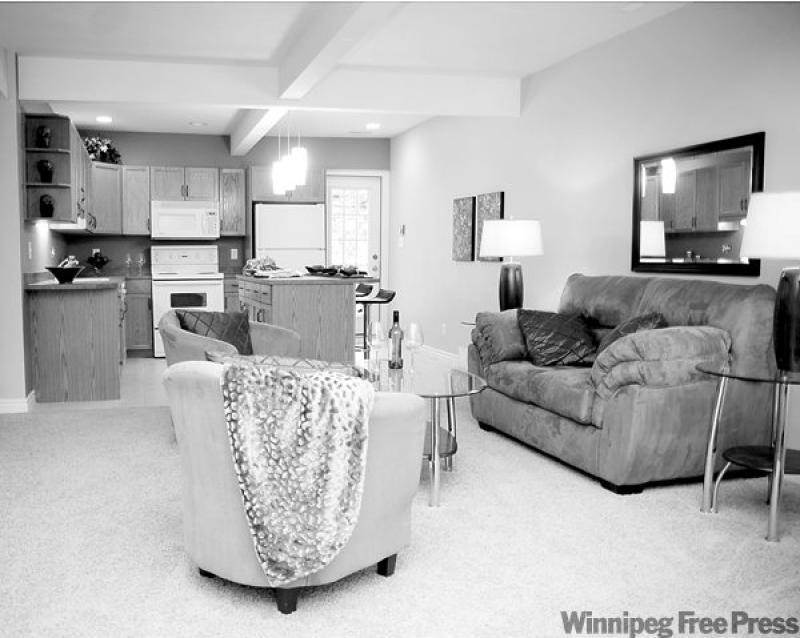
Before their second child Kiera, now six months old, was born, they renovated the basement to create a more rule-free space -- with the whole thing designed around the kids' comfort and safety.

The couple took their time to create a kid-friendly space that still respects their need to live in a well-designed, adult-looking home. The flooring is resilient and allergen-free hardwood laminate. They installed sconces and pot lights to avoid any standing lamps that could be knocked over. Wiring for TV and stereo was kept behind the walls.

-- Canwest News Service

Jackie Paduano
May 18

Browse Homes

Browse by Building Type