Renovation & Design


Renovation & Design
Easy to concoct your own fabric softener
Question: Do you have a recipe for homemade laundry fabric softener? Dave
Answer: Here is an easy recipe using products you may already have on hand. Into an empty squeeze bottle, combine half a cup of your favourite hair conditioner with one cup of white vinegar and one cup of hot water. Gently stir. Add one quarter cup of homemade liquid fabric softener per wash load.
Question: I was wondering if you have a solution for removing Miracle Gro fertilizer stains that have dripped through pots and baskets onto concrete pavers. Our high-pressure washer doesn’t work. Your help would be greatly appreciated. Thank-you, Walter
Answer: Begin by pouring lemon juice onto the stained areas. Leave for five minutes and scrub with a stiff brush. Iron Out is a commercial product that has also proved successful, but test on an inconspicuous area first.
Question: Can you let me know why my roast beef shrinks so much after cooking and suggest a better way to cook it, so it doesn’t shrink?
Answer: The amount of shrinking depends on the type and cut of the meat. Generally, the leaner the cut, the less the meat will shrink; this is because leaner meats contain less water and fat. On average, a cut of meat will lose 20-25 per cent of its size during cooking. The longer you cook the beef, the more it will shrink. To reduce shrinkage, stew, braise or boil the meat.
Question: I cooked a turkey and used the drippings to make gravy. I poured the liquid from the roaster into a bowl and let it cool, and then I added flour and stirred it until it boiled. The gravy kept separating and would not thicken. Where did I go wrong? Sydney
Answer: There are many ways to successfully make gravy. I separate the fat from the drippings before adding flour or cornstarch. Pour the drippings into a cup or bowl and place it in the fridge. The fat will float to the top and become solid. Remove the solid fat from the liquid. In a pot, add flour or cornstarch to the liquid, and whisk. Heat and stir until the gravy thickens.
Question: How can I remove wax from winter gloves? Wanda
Answer: To remove wax from fabric, I’ve had success using an iron set on low to barely melt the wax. Sandwich the waxy fabric in between paper towels, and dab with the tip of the iron. The melted wax will be absorbed by the paper towel. Change paper towel often, and work slowly.
Inexpensive gifts to show you care
Personalized ornaments: Purchase glass or plastic ornaments then use a permanent marker to decoratively write the name of the recipient on the ornament. Write in pencil first to avoid mistakes. You can even create a collection with the names of every person in the family.
Photo gifts: A delightful gesture to show you put a lot of thought into the present. Take your favourite photo to a store where it can be transferred onto a gift such as a mousepad, mug, blanket or a canvas picture.
Repurposed furniture: Sand and stain or paint a chair, table or bench.
A variety of spices: Add spices to jars and creatively label each. Put the spices in a basket and wrap and decorate.
Note: Every user assumes all risks of injury or damage resulting from the implementation of any suggestions in this column. Test all products on an inconspicuous area first.
Have a great suggestion or tip? Please send an email. Reena Nerbas is a popular motivational presenter for large and small groups; check out her website: reena.ca.
info@reena.ca


Renovation & Design
Sump hose length vary depending on slope
Question: Could you please advise about winter sump hoses? How many feet long should a winter sump hose be? We have heard that they can freeze up if they are longer than 20 feet. We understand that if the hose is placed too close to the foundation the water that is pumped out will just sink back down into the ground and cause the pump to keep pumping, which could cause it to burn out. We want to place the hose safely and effectively, so that it will not cause freeze up or burn out the pump.
We are using a four-inch diameter discharge hose for the winter. We have placed 15 feet of hose along the side of the house, at a distance of four feet from the foundation, but water is still going on to the road beside us. Also, can you please advise what is the minimum amount of space that the winter hose should be placed from the foundation of the house? There is only about six feet between the side of our condo unit, where the discharge is located, and the street.
This seems to be a yearly problem, especially when there is a lot of late fall and early winter precipitation, until the ground freezes. Our neighbour has complained to the condo board! We did have a plumber come to investigate if the discharge could be moved to the back of the condo unit, but due to the location of sump pit, discharge hose, and furnace in the basement, this cannot be done.
So much appreciated!
Margo B.
Answer: Addressing sump pump discharge water in the late fall, winter, and early spring is definitely a challenge to prevent excessive ice buildup. Using a loosely secured, larger pipe terminating only a few feet away from the foundation, but dumping into a proper drainage swale, may be the answer to this dilemma.
You have identified an extremely common issue that happens to numerous homeowners in our area, especially when homes are newer, but older than about 10 years. The reason for the problem getting worse after that time is due to compaction and erosion of the original backfill and grading around the house. When a home is complete, the backfill is typically installed slightly higher than desired, knowing that it will compact significantly in the first few years after construction. Even with finish grading completed, typically with topsoil and sod installed over top, this area may rapidly drop in height for the first couple of years. Most lots around new homes are designed so the soil has a significant slope away from the foundation, especially on the side where the sump pump discharge is located. The adjacent neighbour’s homes should have similar slopes and together those should form good drainage swales.
Most swales should be sloping to the front or rear yard of the home, or both at the same time, with the highest point approximately half way along the side of the home. This is designed to direct excess water from precipitation, and the sump pump discharge, away from the foundation. If a small amount of water is present, it may easily be absorbed by the soil in the swale, itself. But, if that soil is saturated or frozen, or if the swale is not properly graded, the excessive water can pond and cause a large amount of ice buildup in cold weather. Once the weather cools below freezing all day, any new discharge water may overflow the yard onto the street or sidewalk, causing a safety hazard.
The typical solution to a problem like yours, is to regularly bring in new soil to build up the swale, to ensure good drainage to the front or back yards. This will distribute the water over a larger area, which will help with absorption. While this may work well in the warmer months, it may not be sufficient in the shoulder seasons when underground water is still draining into your sump, but the surface ground outside is frozen and unable to absorb the liquid water discharged. The good news is that this typically only occurs for a short period in the fall and spring and should be a temporary problem. It normally stops once the weather either cools sufficiently to stop filling the sump or warms enough for the ground to thaw.
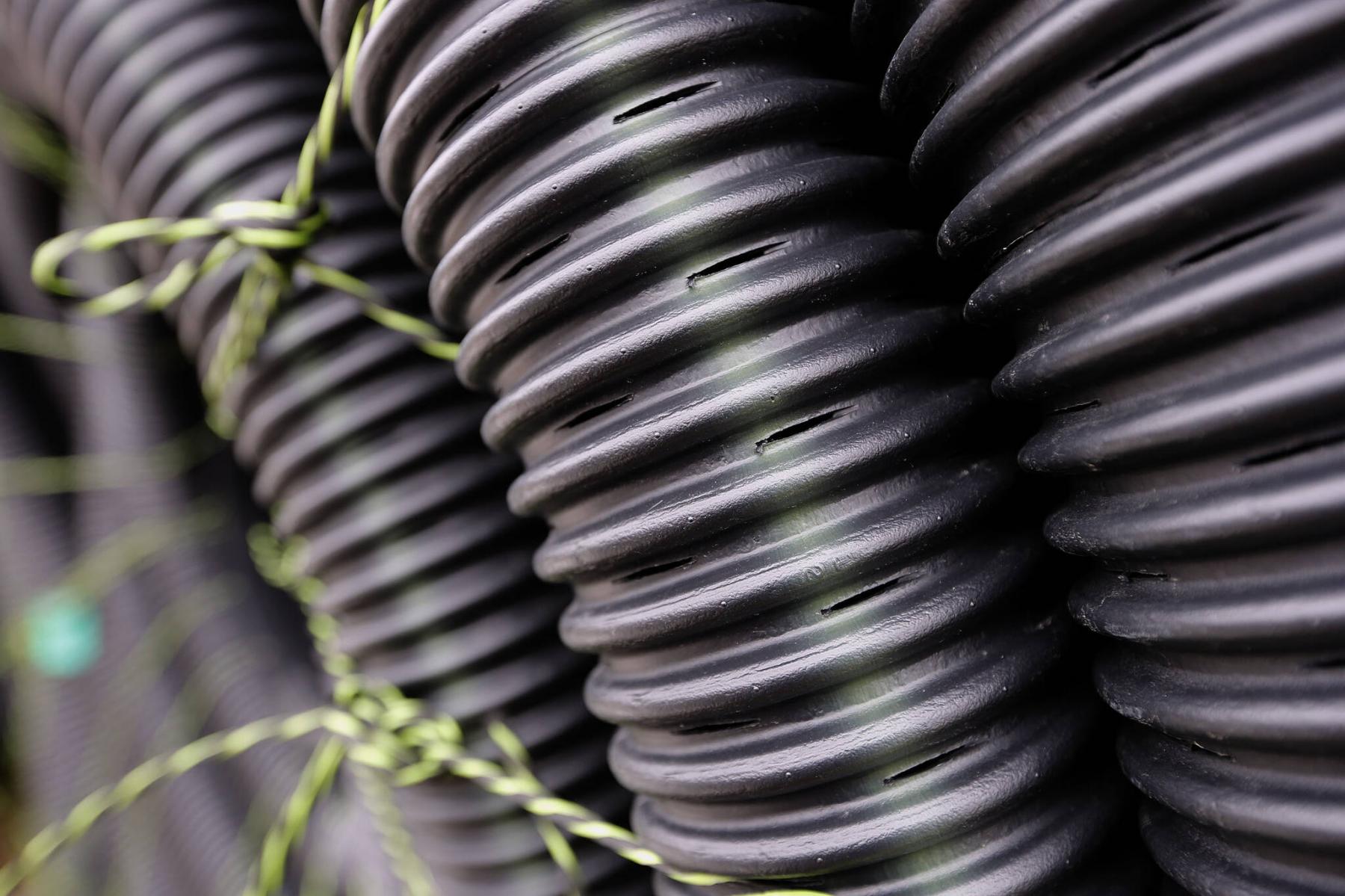
There is no definitive length that a sump pump discharge hose should be, or distance from the foundation. This will largely depend on the height of the grading around the home, the proximity of other buildings, amount of vegetation, and location of driveways, roads, and sidewalks. You are exactly correct in using a larger discharge pipe for the winter, as that will prevent freezing, but only if it is loosely connected at the top and properly sloped. The loose top connection will let excessive water drain away, if the lower portion of the pipe becomes frozen or otherwise blocked. It is a frozen and blocked hose that will cause your pump to run continuously, eventually burning out, not being too close to the foundation. In fact, running a hose as long as yours should be closer to the foundation to allow for increased soil absorption. This may only work if the hose is perforated, to let some of the water drain into a larger area of soil, which may be a partial solution to your issue. Otherwise, talking to the condo board about regrading the soil next to your home, to prevent overflow easily dumping onto the road, should be your next undertaking.
Minimizing the amount of water that drains from the frozen soil adjacent to your home, onto the nearby road, may primarily be a grading issue and should fall under the partial responsibility of the condo board as a common element. Consulting the board to address the poor grading, which allows your sump discharge water to freeze on the road, may be the proper approach to resolving this issue.
Ari Marantz is the owner of Trained Eye Home Inspection Ltd. and a Registered Home Inspector (RHI)(cahpi.ca). Questions can be emailed to the address below. Ari can be reached at 204-291-5358 or check out his website at trainedeye.ca.
trainedeye@iname.com

Renovation & Design
YES: Peanut butter and a hair dryer clean up glue mess
Question: I have laminate floors and when the felt floor protectors on chairs etc. fall off, they leave a sticky residue on the floor. I have tried Goo Gone, dish soap with a microfibre cloth, even scraping with the scraper I use on my ceramic top stove and nothing gets it off. Any help you can provide would be greatly appreciated. Thank you, Pat
Answer: Using a hair dryer, heat the area to loosen the glue. Next smear the area with smooth peanut butter and then lift the adhesive off the floor with the help of a plastic putty knife so that the floor does not become scratched.
Feedback from the heart
Re: Watermarks on Wood
I read your tips about removing watermarks on wood furniture, and they really work. Here is another suggestion: Heat the watermark using a hairdryer on the high setting. Hold the hairdryer in place, and watch the mark disappear! Cathy
Re: Smelly ice cubes
Here is a tip for getting the smell out of ice cube trays. The solution that works for me is to wash the ice cube trays in the dishwasher after every use. I also use filtered water i.e., Brita Filter. Distilled water makes flat-tasting ice cubes. There’s nothing like stinky ice cubes to ruin a good drink of water or anything else! Linda
Share your discoveries
Brighten silverware by rubbing it with oatmeal. — Serena
I use a rubber glove to clean pet fur off furniture. Wiping my gloved hand along the furniture makes the fur collect into a ball. Then I gather the fur and compost it. — Jason
My best kitchen secret: to prolong the life of a jug of milk, add a quarter teaspoon baking soda to the jug. Shake it, the milk lasts several days longer. — Chef Tony
I found the best way to sear steak is to dry the meat with a paper towel. Next, I rub the steak with cornstarch and salt to season. Place the meat in the freezer for 30 minutes before grilling. — Chef Tony
Reduce freezer burn. I buy a bucket of ice cream once every summer. Since I live alone it lasts me for months. To prevent freezer burn, I remove the lid and lay a piece of plastic on top of the ice cream to prevent freezer burn, and then I replace the lid. — Q
Another way to reduce freezer burn: purchase a roast; leave the roast in the plastic wrap and wrap it one more time in aluminum foil. — Q
The beauty of herbs
Basil brings out flavour in tomato dishes.
Bay leaf enhances stews.
Chives for soups and salads.
Cinnamon for baking, desserts and drinks.
Cloves are great in meat and vegetable dishes and soups.
Cumin for an earthy flavour in marinades, rice, chili, and tomato sauce.
Curry adds heat and flavour to rice, chicken, fish, and vegetables.
Dill in sandwiches, salads, and soups.
Ginger gives zest to meat and baking.
Garlic salt for soups, stews, potatoes, and rice.
Marjoram for meat, fish, and vegetable dishes.
Mustard enhances breads, salads, stews, and marinades.
Onion keeps soups and casseroles from tasting bland.
Paprika is the finishing touch to potatoes, chicken, and fish.
Parsley adds to soups or sandwiches.
Rosemary and sage for meat, poultry, or fish.
Note: Every user assumes all risks of injury or damage resulting from the implementation of any suggestions in this column. Test all products on an inconspicuous area first.
Have a great suggestion or tip? Please send an email. Reena Nerbas is a popular motivational presenter for large and small groups; check out her website at reena.ca.
info@reena.ca