Renovation & Design

Renovation & Design

Rare find in River Heights

WHILE there are few downsides associated with living in River Heights, at least one one must be taken into consideration when considering purchasing a home in the community.

Get past the great location, mature, tree-lined streets and beguiling blend of homes -- many of which date back to the turn of the century or just after -- and a thought pops into your head.

While laden with character, River Heights classic homes more often than not require significant upgrades to bring them up to contemporary standards, and a steady diet of repairs to keep them functioning thereafter. Consequently, it often takes quite a bit of blood, sweat and, possibly, tears, to keep a 70-plus-year-old home up to snuff.

That is, unless you find a new infill home in the midst of all the vintage homes.

While rare, it just so happens Dueck Homes has built a two-storey home on a 40-foot by 103-foot lot at 26 Renfrew St. in River Heights.

"When we heard about the availability of the lot, it was an opportunity we just couldn't pass up," said Cal Dueck of Dueck Homes. "It was an opportunity to provide consumers with a new home in a great area, a home that features an intelligent design that contains all kinds of eco-friendly features."

The 1,827-square-foot home's intelligent design starts downstairs with an insulated concrete form foundation.

"There are two reasons why we go with ICF foundations in all our homes. It's more energy efficient, and it's much quieter than a conventional concrete foundation," he explained. "We then back that feature up with an insulated floor with warm-floor technology. There's also polystyrene under the floor itself to provide additional insulation, to make for an area that's very energy efficient and comfortable with nine-foot ceilings."

On the main floor, the focus was placed squarely on designing an area surrounded by an energy-efficient envelope, while making it as allergen-free as possible.

"As far as insulation goes, we put dense-pack, recycled cellulose (with 85 per cent recycled content) in the walls. In terms of R-value, it's almost as good as spray foam. It isn't quite as dense but it's far greener and not as expensive. Its density prevents air currents from moving through the wall, and most importantly, this is a no-fibreglass home. Fibreglass is considered a carcinogen by organizations such as B.C. Hydro."

Like the rest of the home, the main floor was designed to provide a healthy environment in which to live.

"Take the kitchen, for example," said Dueck. "The cabinet boxes are made of plywood, not chip board. Using that type of material has two advantages. It's a stronger product, and it doesn't emit VOC's (volatile organic compounds) that can inflame people's allergies."

Dueck also said flooring throughout the home was chosen to make the interior as livable and allergen-free as possible.

"Carpeting in the home is made of corn, not oil, which is also 100 per cent VOC-free, and the oak hardwoods that run through the main floor are easy to maintain and keep as dust-free as possible. Floors are made of three-quarter plywood rather than OSB, which also eliminates VOC's."

Just as importantly, the home's layout and finishing materials make it easy to navigate and easy on the eyes.

"A host of big tri-pane windows on the main and upper level let in lots of light, while we designed the floor plan to use every bit of available square footage. This is a very functional home," Dueck said. "And with finishes such as quartz countertops, dark oak hardwoods, marble countertops (in both bathrooms), white kitchen cabinets with soft-close drawers and doors, it's a home that's as stylish as it is functional."

Head upstairs, and you find three large bedrooms plus a main bath and laundry room. The 14.5-foot by 12-foot master suite is particularly impressive with its elevated park view (via two large windows), an ensuite with double-tiled shower and 11-foot vanity. A nice touch is the panelled doors that come with user-friendly levered handles and lintels above, design features that build on the home's craftsman-style theme.

"I'm really happy with how the home turned out," said Dueck. "It fits nicely into the neighbourhood and offers a new, efficient, eco-friendly design that features a nice blend of livability and style in a great location."

lewys@mymts.net

By Todd Lewys
November 8

Advertisement

Renovation & Design

Windows get eco boost

Windows are an important part of any home, letting in light and providing views while sealing out harsh outdoor weather. Due to changes that are part of the latest National Building Code -- a tested and recommended set of codes that becomes law when a province adopts it -- windows installed in new homes will need the latest materials, multiple layers of glass and special coatings for energy efficiency.

Glen Janiszewski, director of marketing deliverables with Ply Gem, says compared with windows installed in new homes 20, 30 or 40 years ago, the windows the company manufactures today are much more energy efficient. He says it's all about the glass. "The majority of heat loss is going to go through the glass," he says, which is why windows went from single-pane sliding glass in the old days to double pane and now triple-pane units.

Various coatings applied to the glass -- layers known as Low E, or by brand names such as Ply Gem's Eco Glass or Eco Shield -- significantly boost energy efficiency, while the use of an inert gas such as argon in between glass layers further reduces heat transfer.

Janiszewski says in very cold climates, the right choice might be windows with coatings designed to allow solar heating in winter, basically giving a home free heat. In a sunny locale, the window coatings are designed to reduce the intrusion of solar energy and prevent homes from overheating, he says.

In the end, improved comfort might be what buyers of new homes with more efficient windows notice the most. On a nippy winter day, there won't be the cold draft near a triple-pane window that you might have in an older home. Janiszewski says during summer, homeowners will be able to enjoy the real point of a window.

"If you have a beautiful home with a fine... view, you don't have to close the blinds to avoid heating up your home."


-- Postmedia Network Inc. 2014

By Gerald Vander Pyl
November 8

Renovation & Design

Getting rid of radon

On Sunday, we turned our clocks back an hour. It was also a good time to change the batteries in smoke alarms and carbon-monoxide (CO) detectors (as batteries need to be changed twice a year, doing it when we change the clocks makes it easy to remember).

But it's also time to think about a silent killer in every home: radon.

November is Radon Action Month, aimed to boost awareness of the gas that is the leading cause of lung cancer in non-smokers. If you're a smoker and have elevated radon levels in your home, over time your chance of developing lung cancer is one in three. It's estimated that radon causes 3,200 lung cancer deaths a year in Canada.

What really gets me is that these deaths could be avoided.


What is radon?

Radon is a colourless, odourless, radioactive gas that comes from the breakdown of uranium, which is found in rocks, soil or water. When diffused into the open air, radon isn't dangerous. It becomes a problem when it gets trapped and accumulates, such as in a home.

Most homes are more tightly sealed -- which is great for energy-efficiency, but not if you have a radon problem.

Because radon is a gas, it seeps into homes very easily, through small cracks in the floor slab, foundation, crawl spaces, the sump pump and openings for venting and plumbing. It can even get in through the water supply.


How much radon is safe?

Every home has some radon in it, depending on geography. The question is how much? The only way to know is with a test.

Health Canada recommends that radon in indoor air should not exceed 200 becquerel per cubic metre (Bq/m3; becquerel is an international standard unit of radioactivity). I recently saw a house that had more than eight times that amount. Think that's bad? I've heard of homes having more than 2,300 Bq/m3. One home in Quebec had 20,653 Bq/m3, while the house next door had only 125 Bq/m3 -- and it had a crawl space with a dirt floor.


Testing is essential

There's no telling if a home has a radon problem, and that's why testing is so important.

There are short- and long-term radon tests. You can also buy radon test kits, but testing isn't so simple. Do it wrong and you compromise the results. For example, you have to place the device a certain distance away from walls, the ceiling, floor and other objects, and it can't be near any vents.

You also have to keep all your windows and doors shut during the testing period, which is typically between three to five days for short-term testing and a minimum of three months for long-term testing. The best time to test is during winter, when we keep our windows and doors shut the most.

Hire a pro who is certified by the Canadian-National Radon Proficiency Program (C-NRPP). You can find these pros on the C-nrpp.ca website. They'll drop off the device, place it, pick it up when testing is complete, send it to the lab and deliver the results.

If your home has elevated radon levels, they can help you take the necessary steps to make it right and find a certified radon-mitigation contractor. And the good news is fixing the problem is relatively inexpensive.

Get your home tested for radon. It could save a life.


Watch Mike Holmes on Holmes Makes It Right on HGTV. For more information visit makeitright.ca.

By Mike Holmes
November 8

Renovation & Design

2015 colour palette all about self expression

The paint experts have spoken and the colour trend for the coming year is all about self expression.

"Next year's colour palette can be likened to an artful collage dominated by rich, bright tones and supported by saturated, nature-infused neutrals -- intended to be used together in creative ways according to people's individual preferences," said Alison Goldman, brand manager for CIL paint, a brand of PPG Architectural Coatings. "Like the styles we're seeing on the fashion runways, the home décor trend in 2015 will be all about mixing, not matching, and anything goes."

Citing ocean blue as the standout colour of the year, she said the 2015 colour palette should be used as a starting point and adapted to personal tastes. In particular, here's what's trending in each colour family and where those colours best fit in terms of décor style, according to Goldman.

Blues: Next year's popular blues are neither too dark nor too light; rather, they are mid-toned. Think crisp, clear sky and sea: the shade of worn jeans. Upbeat and fresh, these blues are best suited for those who have a classic or traditional décor taste, especially when paired with light and dark greys and tans. The CIL brand's top blue pick for the year is Hidden Harbor (70BG 32/238).

Reds: Berry red -- reminiscent of ruby slippers, Valentines and lipstick -- will continue to accent home décor in the year ahead. Infused with energy, next year's glamorous reds -- such as Drum Beat (00YR/08 409*) by CIL paint -- coordinate well with chocolate brown, cream and tan, and they are fitting for those seeking to create an opulent look.

Oranges: Orange will tone down in 2015, taking on an easier-to-live-with flair. Conjuring up images of autumn leaves, pumpkins and spice, the new oranges -- including Indian Summer (30YR 26/330) by the CIL brand -- are ideal for bohemian-inclined tastes. They work especially well on an accent wall and can be warmed up with sunny yellow or cooled down with ocean blue.

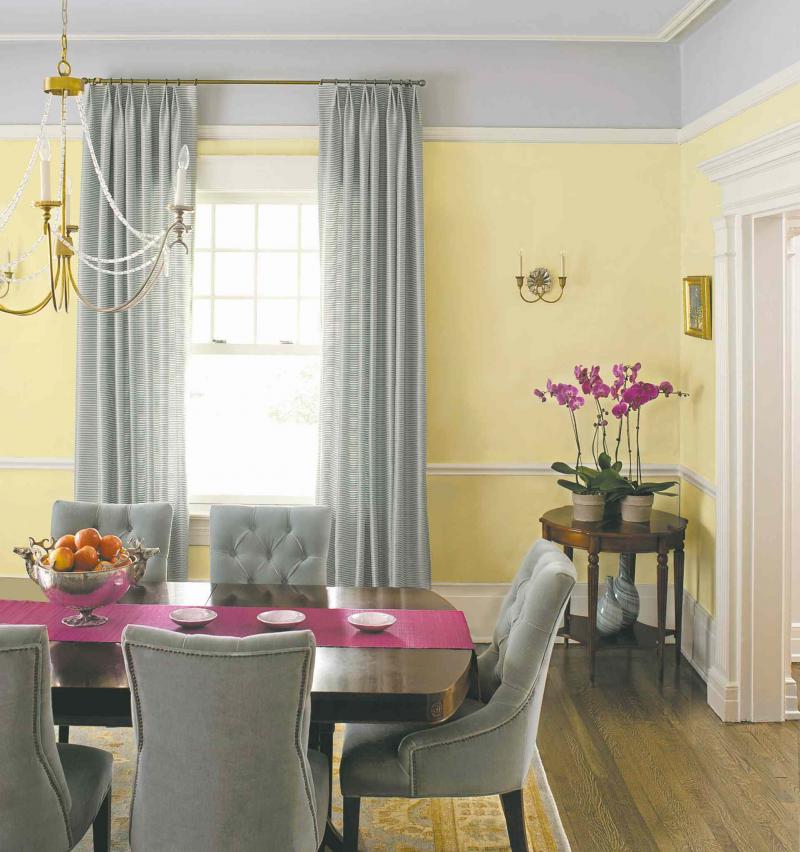
Yellows: Moving away from the buttercream hue that was popular last year, yellows in 2015 will be strong and dramatic. This vibrant yellow, such as Curry Spice (45YY 62/805*) by CIL paint, can be likened to the colour of a taxicab, sunflower or happy face, filled with optimism. Geared towards a modernist style, it works best as a pop colour, particularly when combined with grey, white and soft blue.

Greens: Grey-toned pastel green, such as Jade Frost (50GY 53/033) by the CIL brand, will increasingly make its way into home décor in the coming year. Emitting a modern, oceanic feel, the new greens are both soothing and invigorating at the same time, perfect for the naturalist. CIL paint recommends pairing new greens with earth tones and wooden accents to bring comfort to living spaces.

Violets: Lavender will take centre stage in the purple family over the coming year. Think soft pastels, delicate accents, silk fabric, floral patterns and vintage pieces - dream décor for romantics. CIL paint's key violet for 2015 is Soft Wine (30RR 49/067 SE02).

For more information about the 2015 paint palette by CIL paint, and to help define your paint personality using virtual tools by CIL paint, visit www.cil.ca.

SICO paint, in unveiling its top colour picks for 2015, says the trend is moving toward bold colour. From rich wood and terra cotta shades to deep slate, aqua blue, fruity red and vivid jewel tones, next year's palette by Sico paint is filled with bold, energetic hues from all colour families -- with blues of all shades being a favourite in each group.

"There's a world of possibilities when it comes to infusing colour into home decor in the coming year," said Mylène Gévry, marketing manager for Sico paint, a brand of PPG Architectural Coatings. "Whether deep comforting shades or bright tones used alone or in combination, the 2015 palette has something for everyone."

Sico brand has unveiled four prevailing decor themes for the upcoming year: Comfort Zone, Tempo, Pattern Play and Introspection. Each theme offers a diverse range of bold colours, from down-to-earth to opulent tones. www.sico.ca.

Topping the Dulux paint brand's list of popular colours for the year is tropical blue, a vibrant, clean hue that is expected to dominate all areas of interior décor. Announcing Tropic Night (70BG 23/278) as the brand's 2015 colour of the year, Martin Tustin-Fuchs, brand manager for Dulux paint, explained that "next year's trendy blue evokes images of the sparkling Caribbean Sea and will be noticed wherever you put it."

Pairing well with a wide range of colours, from lavish yellow-gold and coral to black, grey and white, "Tropical blue is enthusiastically positive, charismatic and, like the horizon, represents possibility," said Tustin-Fuchs.

Think Spanish-influenced hot and spicy reds and oranges, Moroccan-inspired majestic emerald and sapphire tones, Turkish-patterned golden yellows, European timeworn mosaics of coloured darks and mid-tones, and bohemian-flavoured plums, indigos, blacks and greys.

Key colours from the Dulux paint 2015 collection include Ruby Ring (09YR 11/475) red, Red Badge (30YR 21/505) coral, Swiss Pine (12GG 10/310) emerald, Blazer Blue (43BB 09/340) sapphire, Golden Harvest (20YY 28/613) yellow, Stage Fright (70RB 16/220) plum, Light's Out (50BG 08/021) black and Heron Grey (20YY 37/094).

"Opulent and eccentric patterns such as stylized florals, new twists on old tapestry and ornate detailing will be everywhere in 2015." Also trending will be colourful bohemian home fashions, a throwback to the elegance, artistry and decadence of the '70s, Tustin-Fuchs said. www.dulux.ca.

Benjamin Moore released its highly anticipated 2015 Colour of the Year -- Guilford Green HC-116, a stunning silvery green that complements both modern and traditional styles in a seamless manner. In addition to unveiling the Colour of the Year, Benjamin Moore introduced Colour Trends 2015, a curated palette of 23 colours consisting of beautiful green, blue, blush and berry shades that can transform a space. Benjamin Moore continues to be the influential leader in paint colour for homeowners and designers by forecasting colours and combinations that are truly livable and practical for every style and home.

"We chose Guilford Green as our 2015 colour of the year because it can be the hero or the highlight in any room, enhancing the architectural identity of a space," said Ellen O'Neill, Creative Director at Benjamin Moore. "Guilford Green is the perfect thread to connect nature, spaces and interiors with colour schemes that signify fresh energy and growth."

The new year yearns for a fresh start. Think about which exciting new colours might uplift your décor and take the plunge with colour.

Connieoliver2014@gmail.com

By Connie Oliver
November 8

Renovation & Design

Growing cold

By Colleen Zacharias
November 8

Renovation & Design

Scale insects and anthracnose fungal leaf disease

Each year in southern Manitoba I have observed growing numbers of Lecanium scale insects feeding heavily on the twigs of ash and occasionally elm and linden trees, causing their twigs and branches to die. Sometimes the infestation is so severe that the tree can die.

In addition, trees, especially ash trees, have always had fluctuating infection levels of leaf fungal disease either with or without high levels of scale infestation. This disease is usually not a problem as it causes either brown blotches in the leaves or causes the leaf stalk and leaves to prematurely separate from the twig.

In recent years, I've noticed anthracnose killing the leaves of Manchurian ashes. I now see a twig anthracnose disease component especially in Mancana ash trees that have had repeated anthracnose leaf infections. The disease appears as a linear swelling in the twig with the twig bark splitting into fine parallel cracks, called lesions. As the disease intensifies in the twig, these lesions open up and become spore producing cankers. The spores will travel through the air and infect other ashes including the originating ash tree.

As anthracnose canker disease, in my experience, has been a problem in warmer areas of North America -- especially in the U.S. -- could this be a sign that our Manitoba climate is changing to favour the growth of this disease? Lecanium scales have always fed on the twigs of a variety of trees. Lately, they have become a serious pest issue with trees such as Manitoba maple, silver maple, American and Siberian elms, lindens, choke cherries and all fruit trees. It remains to be seen if future years bring along higher infestation levels of these scales. The same speculation could be made about the disease intensity of ash anthracnose.

The best means of controlling the scales is to spray the entire tree with dormant oil. This will smother over wintering eggs. The best means for controlling leaf anthracnose is to spray dormant lime sulfur fungicide. Both sprayings should be carried out in mid-April before the buds open in the spring. The buds, twigs and branches should be thoroughly soaked with dormant products. The lime sulfur can be mixed with dormant oil (if scale and mite control are needed) and sprayed on the tree together. Spraying a fungicide such as copper sulfate or another approved fungicide in early June may help control the early stages of the twig disease.

In the short term, the changes in diseases and insects affecting ash trees in Manitoba may be attributed to natural random variations in the levels of these problems. In other words, some years are worse than others. It is premature to speculate that these changes locally are related to changes happening globally with climate.

Those of us working in tree care should always be on the lookout for patterns of change relating to the health of trees. There has been much discussion about the potential invasion of the emerald ash borer into Manitoba ash trees. There is an invasion preparation alert in place. As our urban and rural ash trees become more stressed through diseases and insect infestations, they become prime targets for the feeding activities of these voracious borers. This is an alarming situation to think about, especially when at least 30 per cent of our trees are ash species.


Michael Allen M.Sc.F., RPF (ret.) is a consulting urban forester, tree diagnostician and certified arborist. He owns Viburnum Tree Experts, a Manitoba company that provides objective assessments of the condition and the care required for trees and shrubs. He is available to visit homes and gardens. He can be reached at 204-831-6503 or 204-223-7709 viburnumtrees@shaw.ca His web site is www.treeexperts.mb.ca


Michael's new book: 'Dr Tree's Guide to the Common Diseases of Urban Prairie Trees' is available from the author or from McNally Robinson book store.

By Michael Allen
November 8

Renovation & Design

Engineers can help solve moisture mystery

Question: I don't know who else to turn to. We had a Monarch sump pump installed in March 2011. We live in Meadowood, St. Vital. When it was installed, we were told we had a lot of water under the house and they had to work fast to install the sump pit before the hole they dug collapsed. It always smelled musty in our basement. Now that we have the sump pump, the musty smell is gone. We renovated our basement the year before and when we ripped up the carpet and scraped the underlay from the cement floor, amazingly, there were no cracks on the floor, it was in perfect condition.

In the last three years, the pump has run more often than others around the city, from talking to other people, especially in early to late spring and if we had a lot of rain. Usually in August, it slowed down through to winter and does not run in the very coldest months. In the middle of August this summer, the pump started running every half-hour, 24 hours a day and is putting out just over 10 gallons of water each run. It has not stopped and is still running with same frequency, despite virtually no rain in October. We have had the city come out twice now to check to ensure there are no leaks from the water pipes underground or from the fire hydrant that is in front of our house. They even listened where the water pipe goes into the house and also from the basement where the water pipe comes into the house. It has been confirmed there are no leaks anywhere. The city has also confirmed they have checked the sewer-inspection records and sump-pump-problem-reporting database and they have not found any information to suggest the problem is related to the city infrastructure.

The sump pit is 28 inches deep, with three intake holes, six inches from the bottom of the pit, three intake holes 13 inches from the bottom and another three holes 22 inches from the bottom. Once the pit has drained, we can see water pouring in through the intake holes near the bottom of the pit. There is no water coming in from any of the other intake holes. All the proper pipes and fittings are in place and none are leaking. I just don't understand where this underground water is coming from and why so suddenly.

I don't know what is going to happen this winter, whether the pump will eventually slow down or will continue to run. Because the pump was installed to drain to the front of our house we have to drain at least ten feet out, otherwise the water will just flow back towards the house. I am concerned that I am going to have ice build-up problems towards the sidewalk causing problems for the mail and paper delivery.

Can you provide any more insight to this problem? I wish I could just remove the sump because it is causing me a lot of stress.

Thank you, Cathy Bouchard.

Answer: Different areas, with differing soil conditions, may have drastically varying moisture contents, even within the same neighbourhood. While you may never be able to determine why there is so much moisture under and around your home, testing and evaluation by trained professionals may yield some answers.

My first question to you would be: Who were the contractors who installed your sump and pump and what was their reasoning for its installation? I would look to them to see if they thought this would eliminate the damp smell in your basement, which it apparently did, or whether there was another reason. I would also ask if they had this same experience when using this remedial action in other homes, and what they did about it. There is a chance they have done damage to weeping tiles or something else underneath your basement floor slab during or after installation, which is causing the excessive moisture. Even though that would likely have shown up soon after installation, it is still a slight possibility. It is not that unusual to install a simple perforated sump to help collect excessive water under a home, but it should reduce the soil moisture collected over time, not increase it.

While it may simply be unlucky timing on your part, the summers of 2012 and 2013 were two of the driest in recent memory. While the sump pump may have removed a large majority of the residual ground water under your basement floor shortly after installation, this moisture may not have been replenished due to the extremely dry weather. If you simply have a very high water table in the soil where your home was built, which is a possibility, the near-drought of the following years may have served to prevent the normal state of excessively high soil moisture. The return to more normal snowfall and rain this year may have served to saturate the dry soil and now you are experiencing more typical pump functioning. Your final note about wishing you did not have the sump installed would have ensured you continued to have a damp-smelling basement, and possibly more problems from all that water remaining in the soil.

While I commend you on making this enquiry to me, I will now tell you who you should really turn to. Professional geotechnical engineers are educated to evaluate soil conditions and provide recommendations related to those conditions. Their work may require soil sampling outside the home or beneath your floor slab, and other diagnostic testing, but should yield some answers to your overactive sump pump situation.

Ari Marantz is the owner of Trained Eye Home Inspection Ltd. and the past president of the Canadian Association of Home & Property Inspectors -- Manitoba (cahpi.mb.ca). Questions can be emailed to the address below. Ari can be reached at 204-291-5358 or check out his website at trainedeye.ca.

trainedeye@iname.com

By Ari Marantz
November 1

Renovation & Design

Manitoba's housing issues mirror Canada's

I just returned from our national (Canadian Home Builders Association) meetings in Ottawa and it was interesting to see the issues we have in Manitoba and Winnipeg are very similar to the issues other provinces and cities throughout Canada are facing.

At the urban council (14 largest Canadian cities) meeting, there was an outstanding presentation by the Greater Ottawa Homebuilders Association on housing affordability. They broke down the cost of a new home and clearly showed how municipal fees and taxes and serviced land represented half of the final cost of the home. Those numbers are remarkably similar across the country.

The renovators' council discussed the importance of consumer education at length. It is vitally important to have a written contract before proceeding with any renovation. The underground economy is alive and well and estimated to represent around $13.65 billion in construction in Canada. Doing business this way hurts us all.

MP Phil McColeman is chairman of the Conservative government's housing and construction caucus. This group has been very active in meeting with the Canadian Home Builders Association, the Canadian Real Estate Association, the Canadian Federation of Apartment Associations and numerous other groups in an effort to best tackle housing issues in Canada. Manitoba is extremely well represented on this caucus with MPs Candice Bergen, Joyce Bateman, Rod Bruinooge, Larry Maguire and Steven Fletcher all involved.

The CHBA is launching a net zero energy housing council this year. With considerable research being done by this council, it is anticipated the housing industry will continue to lead the way in housing energy savings without government legislation.

The professional development committee is pursuing how to maximize use of the new Canada Jobs Grant and opportunities to help resolve the skilled labour shortage through the express-entry system of hiring immigrants.

Skilled-labour shortages, energy conservation, underground economy, infrastructure and affordability; these are issues we have talked about in Manitoba and are constantly seeking to resolve. Perhaps, through a national effort, we can make a difference.

Mike Moore is president of the Manitoba Home Builders' Association.

By Mike Moore
November 1

Browse Homes

Browse by Building Type