Renovation & Design
Renovation & Design
Oven cleaner accidently sprayed on floor
QUESTION: I bought my regular fabric softener but with a different scent. I find the new scent is overpowering. I tried mixing it with my usual scent but even that is too strong. Can you suggest anything other than throwing out an almost full container of softener? Thanks.
Phyllis, Winnipeg
ANSWER: If you want to avoid throwing out your fabric softener, dilute the fabric softener with water. Next take an old washcloth, put the diluted fabric softener on the washcloth and throw in the dryer instead of the washing machine. Or create an air freshener by pouring one quarter cup of fabric softener into a spray bottle and add 2 cups of water. Spray around rooms, in sports bags or on fabrics to freshen up your home.
QUESTION: My elderly father has accidently sprayed oven cleaner on the floor, leaving the floor speckled with brown spots. Neither my mother nor father has ever used a computer in their lives but somehow they have your web site. I just received a frantic call asking me to contact you. Nothing that they have tried is working and I wonder if you might have a solution? My mother's parting words were, "Tell Reena it is an emergency!" Thank you so much for your help with this.
Rachel, Winnipeg
ANSWER: Oven cleaner contains a huge amount of lye which can cause permanent burns on surfaces. Begin by making a paste of baking soda and water. Leave the paste on the surface for one hour before scrubbing with an S.O.S pad. Second options include: Orange TKO or Brasso, both have had positive results. If the stain remains you may need to replace that section of the floor.
QUESTION: Can you tell me how to get rid of oil stains on paving stones? Thanks for your help.
Chuck, Portage la Prairie.
ANSWER: Soak up new oil messes with one of the following: Cat litter, wood shavings, corn flour or talcum powder. Scrub with dish soap and water and a stiff brush, repeat until stain fades. Clean oil typically disappears after several days. Dirty oil can be very difficult, if not impossible to completely remove. Use a degreasing agent or engine cleaning fluid (test on inconspicuous area first). Muriatic acid is another option, use with extreme caution according to the instructions, rinse and scrub with clean water, then repeat as required.
QUESTION: I read your column faithfully and I hope you can help me. I grated some lemon and orange rind on the fine side of my grater and I am having difficulty cleaning it. I've tried scraping it and using a toothpick to pick out pieces, to no avail. You have given me advice in the past and hope you can help me out again. Thanks in advance.
Pearl, Winnipeg
ANSWER: Here are a few suggestions for cleaning your grater. Grate a raw potato or apple, this helps unplug the holes on the grater. Use a nylon brush dish scrubber and scrub the inside of the grater, the rind should come out of the holes fairly easily. Anytime you decide to grate cheese (instead of fruit), spray non-stick cooking spray on the grater before you start grating. This helps clean the cheese out quickly, just a few dunks in warm, soapy water and the cheese should pop out. The next time you want to grate fruit, freeze the grater before and after use.
QUESTION: Do you have a great recipe for me to jazz up my boring Sunday night meatloaf? Donna, Winnipeg.
ANSWER: Put half of the ground beef mixture in your loaf pan, layer pepperoni and cheddar cheese and then cover with remainder of meat mixture. Bake as usual but fifteen minutes before meatloaf is done spread a half cup of your favorite pasta sauce on top and bake for fifteen more minutes. Remove meatloaf from oven and let rest for ten minutes. Speaking of meatloaf; don't toss out the bread crusts that your family won't eat. Soak them in two-third cups buttermilk for 10 minutes. Squeeze out excess milk and add to meatloaf before baking. Moist and yummy!
I enjoy your questions and tips, keep them coming. Missed a column? Can't remember a solution? Need a speaker for an upcoming event? Check out my brand new videos/blog/website: reena.ca!

Renovation & Design
The place to find reno experts under one roof
Today and Sunday are the last two days of the Kitchen Bath and Renovation Show at the RBC Convention Centre Winnipeg. The show runs today from 10 a.m. to 8 p.m. and on Sunday from noon to 5 p.m. If Friday's crowds are any indication, this may be one of the most popular shows in recent memory.
The Kitchen and Bath show has always kicked off the new year for home renovations and Manitobans lead the nation in that department. Manitoba is the only province where more money is spent annually on renovations than new home construction. In that Winnipeg has the third-oldest housing stock in all of Canada, home renovations are a very big part of our lifestyle.
The Kitchen Bath and Renovation Show is unique in that it provides a free avenue for consumers to test the renovation market. The Ask a Renovator segment of the Manitoba Home Builders Association booth is staffed by professional RenoMark renovators who are available to answer your questions about jobs you may be planning or dreaming about. They will provide a free 15-minute consultation to steer you in the right direction toward an enjoyable and exciting upgrade to your home.
Come to the show and you can pick the brains of Manitoba's finest renovators. Whether the job is big or small, whether it's something you're committed to or just thinking about, whether you are a do-it-yourselfer or looking for a professional to help, the Kitchen Bath and Renovation Show is the perfect place to start. Why drive all over town when the best advice for all your needs can be found under one roof?
Along with presenting sponsors All Canadian Renovations and Penta Spray Foam Systems, we are proud to feature Chef Rob Thomas on stage at noon and 4 p.m. today and at 1 p.m. Sunday as he presents fascinating cooking and pairing tips.
Tickets for the $10,000 Springfield Woodworking kitchen cabinetry grand prize are being sold by volunteers from Variety -- the Children's Charity.
Don't miss your chance to see all of Manitoba's best suppliers located in one convenient place. Tickets are available at the door.
Mike Moore is president of the Manitoba Home Builders' Association.


Renovation & Design
Supposed solution kicks up the dust
QUESTION: I received a commercial duster for Christmas this year. I had seen it advertised on television and it looked like a good cleaning tool. But I am wondering how well it cleans. Do you think that commercial dusters hold onto dust and help clean as well as they say? Love your presentations; hope you come to my area again soon. Betty (Dominion City, MB)
ANSWER: Instead of me giving you my opinion, you can do the following test and determine your own result. Allow something in your home to collect dust for a few weeks. Carry the item over to the window that allows in the most sunshine. As you dust, observe whether or not dust is flying freely or actually clinging to the duster.
Okay fine, let me tell you what happened when I did this. As great as the duster looked on TV, the dust flew everywhere and only some of it clung to the commercial duster. Next time, I will dust first and vacuum last to pick-up all of the dust that landed on the floor. Vacuum attachments and good quality micro fiber clothes are powerful tools for actually getting rid of dust.
QUESTION: Can you suggest what I can do regarding my toilet bowl? It has a layer of what I describe as "calcium deposits" meaning above the water line the surface feels hard and is slightly discolored, the other toilet bowl in our house, does not have this. I am thinking the reason for the other toilet bowl being free of this is because it is flushed far more often than the one with this deposit. I have tried sprays and cleaners to no avail. Would appreciate any suggestions. Glen, Winnipeg
ANSWER: To remove stains in a toilet, purchase a pumice stone and lubricate it with either cheap shampoo or dish soap. Wet the stone and gently wipe the toilet rim to remove marks being careful not to scratch the porcelain.
Did you know? According to the Southern Nevada Water Authority, toilets consume about 25 per cent of water inside a home.
QUESTION: I am going on a winter camping trip with my grandchildren who can't stand being outside. I want a treat idea that would be fun to make outside during the trip, maybe this will get them excited about the good 'ol days. Do you have a yummy recipe? Velma (Brandon, MB)
ANSWER: I've got two words for you, Chocolate Brownies! All you need for this recipe are a few ingredients, plastic bags and water. Into a sandwich bag put: One crumbled sleeve of graham wafer crackers, one quarter cup of your favorite chopped nuts i.e. walnuts or pecans and 2 tbsp. icing sugar. Into a different large sealable bag combine: One quarter cup water, three quarter cups chocolate chips (yum) and three tbsp. dry milk. Over the fire, simmer a little pot of water. Remove from heat and dip the sealed chocolate bag into the pot of water. When the chocolate has melted add the ingredients from the first bag. Combine and knead. Eat warm or cool and enjoy brownie chunks!
I enjoy your questions and tips, keep them coming. Missed a column? Can't remember a solution? Need a speaker for an upcoming event? Check out my brand new videos/blog/website: reena.ca!
Renovation & Design
MIKE HOLMES: Engineered hardwood can be as good as the real stuff
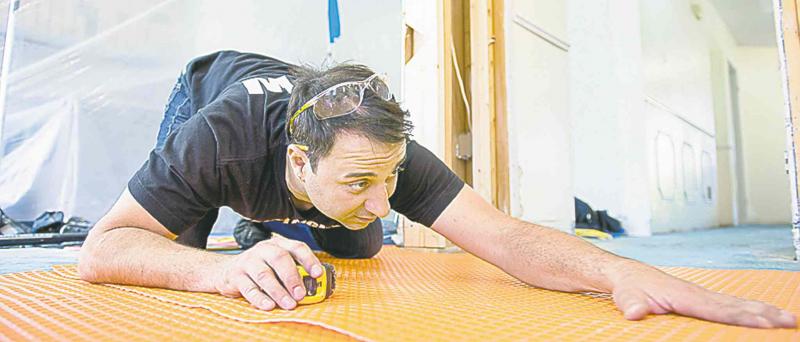
When it comes to hardwood flooring, there's solid hardwood and engineered hardwood. People are always asking me which one is better, but both have their pros and cons.
Solid hardwood floors are just that -- they're made from solid wood. Each board of solid hardwood flooring is made from a single piece of hardwood that's about 3/4 inch thick. Because it's so thick, it can be sanded down and refinished for however long the flooring is in the house.
But the main problem with solid hardwood is it shrinks and expands depending on the humidity in your home. In the winter when it's drier, hardwood floors will shrink. When there's more moisture in the air, like in the spring or summer, hardwood expands.
Whoever installs solid hardwood floors must have enough experience to leave the right amount of space for hardwood's natural expansion and contraction. The individual boards can't be too tight or too loose. If they're too tight, your floor will buckle. If they're too loose, the gaps between the boards will get too wide in the winter.
Then there's engineered hardwood flooring. It's made of layers of wood, bonded together with adhesives under intense heat and pressure.
Because of this process, engineered hardwood flooring isn't affected by humidity as much as hardwood. It doesn't shrink or expand, which makes it resistant to warping and cupping. And for that same reason, it's considered very strong and stable.
It can also be sanded and refinished -- not as much as hardwood, but a few times over a couple decades is fine, depending on the quality. But another reason why people love engineered hardwood is its application.
Unlike solid hardwood, engineered hardwood can go over concrete under the right conditions, like in a condo. And some people say it can also be installed below grade too, like in a basement. But there is some debate about that.
Hardwood and water don't mix. If they do, there is the potential for mould and water damage. What does that mean for you? Possibly ripping up your new floors and replacing them. That's why we never put hardwood in areas where the potential for moisture is high, such as in bathrooms, laundry rooms, kitchens and even basements.
Should we follow the same guidelines for engineered hardwood? It depends on how much you're willing to risk. I would never install it in a bathroom or laundry room, but when we talk about kitchens and basements things aren't so black and white.
I've spoken to a lot of professionals and many of them say engineered hardwood in the kitchen is fine. As far as wear and tear goes, it can get scratched or dented by falling objects or utensils. But if we're talking about potential water damage and mould, as long as you wipe up any spills quickly you don't need to worry.
They also say engineered hardwood can handle moisture levels found on most basement concrete floors, usually no more than four per cent. Some engineered hardwood boards allow for air movement between the flooring and the foundation, so if there is any moisture it can dry out. But the basement must be watertight.
Bottom line, if enough water gets into the boards you will run into the same issues you have with solid hardwood. That's why you never wet mop engineered hardwood floors -- or any hardwood floor for that matter.
Can engineered hardwood be installed in kitchens and basements? Yes. Many pros do this. But for most people, engineered hardwood flooring is expensive -- it can be more expensive than hardwood.
Then there's the issue of off-gassing.
All engineered and manufactured wood products are made with adhesives and resins, and most of those will off-gas, including plywood, OSB (oriented strand board), laminated beams, MDF (medium-density fibreboard) and particleboard.
But when it comes to off-gassing and engineered hardwood floors, the issue isn't the adhesives mixed into the wood -- it's the toxins in the stains and topcoat.
Some manufacturers do a really good job of making sure their engineered hardwood does not off-gas, including the topcoat and finish. But homeowners should make sure for themselves. Contact the manufacturer and ask about their green policies.
I love engineered hardwood, but as with everything else, you need to do your homework. Talk to the pros, ask the right questions and always follow manufacturers' instructions on proper installation and maintenance.
-- Postmedia Network Inc. 2013
Catch Mike Holmes on Holmes Makes It Right, Tuesdays at 9 p.m. on HGTV. For more information, visit hgtv.ca. For more information on home renovations, visit makeitright.ca.