Renovation & Design

Renovation & Design

Make sure your cookware is safe

QUESTION: I have a small Wear-Ever aluminum frying pan and the finish has been taken off on the inside. Therefore everything sticks like the dickens now! Is there any way I can re-season or coat it again so food won't stick so badly?

-- Bev, Winnipeg

ANSWER: If you head to the Wear-Ever website, you will notice that they carry a great warranty for their products. Replacement is the best bet for your pan because you want to make sure that the cookware you are using is very safe for you and your family.

QUESTION: What is the best way to clean a twisty straw without putting it into the dishwasher?

--Francis, Sperling,

ANSWER: If you happen to have a spray attachment with a hose on your kitchen sink. Cover up all of the holes except for one. Position the uncovered hole over the straw opening and turn the water on. After the inside of the straw is clean. Wash the outside of the straw with dish soap and water.

QUESTION: Can you please give me a recipe for making my own homemade pancakes so I can cross expensive boxed pancake mix off of my grocery list?

-- Samantha, Otterburne

ANSWER: In a bowl, combine four cups flour, two-thirds cup sugar, six tsp. baking powder, one tsp. baking soda, one tsp. salt, two-thirds cup cooking oil, half tsp. vanilla, six eggs and four cups milk. Stir well and fry. For a flavour twist, you can also add a dash of cinnamon to the mixture.

Feedback from Manitoban Who Cares

Dear Reena,

Last year I heard of a new idea to get rid of wasps, I tweaked it quite a bit. I don't recall if I caught any wasps, however each week I had at least 100 flies per trap to dispose of. With traps at the front and back doors as well as a few set out in the yard and garden that amounted to 500-600 flies a week.

This year, I had my supplies ready to again catch flies. However, up until a day ago I had only seen three flies inside and out. That is when I thought, "Is it possible that the flies I killed last year hadn't laid any eggs so... no flies this year?" Anyway I did set another trap and 24 hours later there is nothing in it and no flies around here. I am 70 years old and can't remember this happening before.

So here is my trap idea: Use a two-litre plastic bottle, preferably with a cap. Cut a hole slightly larger than an egg on the side close to the top. Wrap a thumb-sized piece of raw fish in a small square of vegetable-bag mesh. Secure this with a piece of string and hang it through the mouth of the bottle almost halfway down. Fill the bottle to just below the fish with soapy water. Attach the cap and place it in an inconspicuous spot wherever flies are a problem outside. Check periodically, empty and reset with fresh fish and water.

--Gwen, Winnipeg

Fabulous Tips of the Week

* I wash and save broccoli rubber bands. When necessary I use them to hang up a nightgown or something that could slip off the hanger. I slide an inside-out (so printing isn't seen) rubber band over the ends of the hanger. No slip offs!

* Here is an easy way to clean horizontal metal blinds: Combine one cup household ammonia in the bathtub with one teaspoon dish soap and six inches of warm water. While wearing rubber gloves, move the blinds back and forth to clean. Hang to dry. Extra Tip: Line the bottom of the bathtub with towels so that the metal does not scratch the tub.

-- Gwen

I enjoy your questions and tips, keep them coming. Missed a column? Can't remember a solution? Need a speaker for an upcoming event? Check out my brand new videos/blog/website: reena.ca!

Solutions/Reena Nerbas
October 5

Renovation & Design

It's all about the percentages

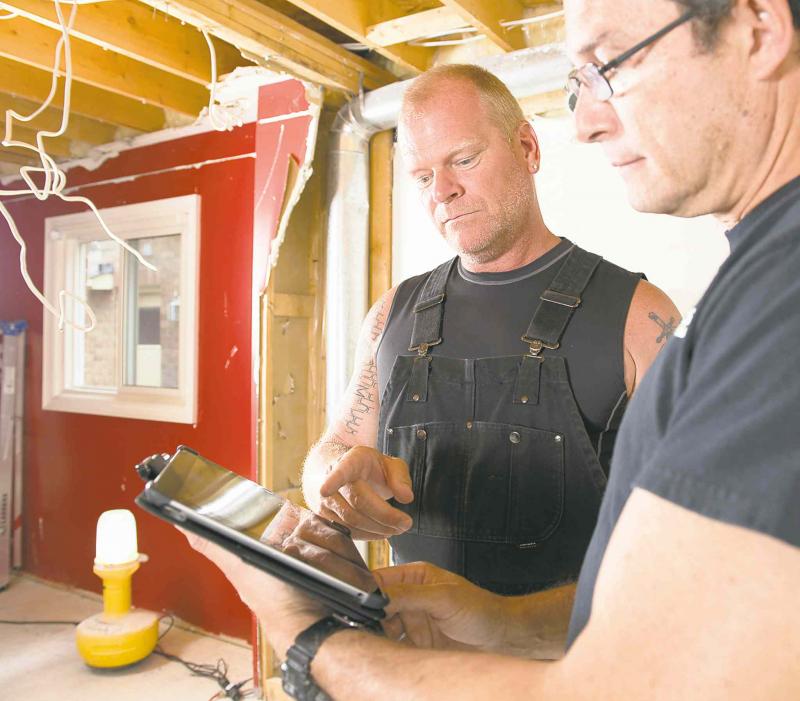
I've seen too many renos fall off their tracks. And there are two big reasons why they do: First, homeowners hire a friend, family or neighbour to do the job; and secondly, they don't have a payment schedule tied to specific milestones in the job.

Not hiring a friend of the family or someone you know as your contractor should be a no-brainer. I can't tell you how many people I have had to help because a contractor ruined their home and their lives -- and that contractor used to be their friend, or is their neighbour.

Nine times out of 10 the friend/family/neighbour as contractor leads to a doomed relationship. And there are a few reasons for that. But the main one is if it's a friend, you might be more lenient with the kind of work being done because you want to be nice. You don't want to ruin the friendship. You don't want to step on their toes or question their skill.

But if you're more worried about your contractor's feelings and potential fallout than your home, your renovation is doomed.

If you want results, you need to be clear about them, and you can't be scared to demand them. And, at the end of the day, a renovation contract is a contract; there are obligations. And the better you build your contract the better and smoother the job will be -- for you and the contractor.

The first step to keeping a renovation on track is to hire a good, reputable contractor. The next step is setting up a contract with a detailed payment schedule tied to specific project milestones. The most common milestones or stages are rough-in, drywall and completed.

Rough-in is when anything that has to do with the foundation, subfloor, framing, sheathing and roof are done, and all the electrical and plumbing has been roughed-in.

The drywall stage is when the drywall can go up and your contractor can start closing in on the job -- that means all electrical and plumbing is done.

The last stage is usually called "completed" -- but the project isn't exactly 100 per cent done; it's more like 90 per cent. That's why your contractor should have only 90 per cent of the total budget in his pocket at this point. You hold onto the last 10 per cent to make sure everything completed to this point is as it should be. Once you know it is (usually not more than a month after the job is done) you make the last payment.

Remember, the contractor's power is his work. Your power is money. A contract that ties payment to completed project milestones sets out all the rules for a fair exchange of these two powers.

Before anything starts, your contractor will ask you to secure the job with a down payment. It shouldn't be more than 10 per cent of the total cost of the job. There are exceptions to the 10 per cent rule, but they need a good reason, like having to order custom cabinets.

But any payment you make to your contractor after the initial deposit must be in relation to how much work is completed. For example, if a job costs $30,000 and the only progress your contractor has made is demolition, don't pay him $11,000. Why would you pay 35 per cent of the budget for not even 10 per cent of the work? That doesn't make sense and you know it. Don't agree to it in your contract and don't get bullied into it during the job.

Once you hand over the money, you lose your power. Now you've opened the doors for your contractor to postpone your job and work on other jobs he still needs to collect on. A good contractor won't do this. But then again, a good contractor wouldn't ask you to fork out 50 per cent of the budget for 15 per cent of work.

The best jobs are the ones that make sense and move forward at a good, steady pace -- weather permitting. Twenty per cent of the job gets done, 20 per cent of the budget gets paid. Another 30 per cent of the job gets done, another 30 per cent of the budget is paid. You get where I'm going.

And if there is a delay, your contractor should set up a change order, have you both sign off on it, and then give you a revised schedule and a revised bill.

Renovations are risky business as it is. Don't take more risks than you can afford.

Catch Mike Holmes in an all-new season of Holmes Makes It Right, Tuesdays at 9 p.m. on HGTV. For more information, visit hgtv.ca. For more information on home renovations, visit makeitright.ca.

By Mike Holmes
October 5

Advertisement

Renovation & Design

Get your lilies down

By Sandy Venton
September 28

Renovation & Design

Let a jeweller clean your precious heirloom

QUESTION: I read your column regularly and find it very helpful. I have found an old silver locket that belonged to my mother and it is very tarnished. What is the best way to clean it? I would like to wear it on my wedding day as something old. I would appreciate an answer as soon as possible as the wedding is at the end of the month. Thank you very much. Lynne, Winnipeg

ANSWER: I typically clean silver with the use of a baking sheet, washing soda, water and aluminum foil. However, seeing as this piece is very special to you and a family heirloom, you may want to consider taking it to a jeweller to have it professionally cleaned. They often clean jewelry for free or for a reasonable price.

QUESTION: Enjoy your columns very much. My problem: A ceiling pipe leaked in our basement bathroom, resulting in water running down a wall-papered wall. The pipe was fixed but there are light brownish water stains on the wall. Any suggestion as to how to remove them? I don't know if the paper is washable or not because it was there when we bought the house. Thanks in advance. Anna, Winnipeg

ANSWER: Not knowing whether or not the paper is washable hinders you from spraying the discoloured area with liquid. Either leave as is or scrub with a damp Mr. Clean Magic Eraser. If you are comfortable adding liquid to the area then spray with 50/50 bleach and water or hydrogen peroxide and water, or WD-40. Whatever solution, always test first. Worst-case scenario: cover the area with a light coat of touch-up paint or replace the wallpaper.

QUESTION: I purchased a pair of Calvin Klein black stretch lightweight denim jeans. They have a strange smell; I would say it is a chemical smell. I have washed them about six times and have tried anything I can think of to remove the smell with no success. I would have returned them except for the fact I bought them at an outlet store in Palm Springs. I hope you can help because they fit so nice and I would like to be able to wear them. Pam, Winnipeg

ANSWER: Your best bet is to soak the jeans in white vinegar and water for a few hours. Wash and wear. The smell is, like you said, caused by chemicals and will eventually dissipate. You can still call Calvin Klein's head office regardless of where the jeans were originally purchased and ask for advice, since the jeans do carry the brand label.

QUESTION: I so much enjoy reading your column in our weekly newspaper and always getting so many helpful ideas. On my kitchen chairs, the wood arms get sticky when resting on them. Would you have a solution to this sticky problem? Many thanks. Roger, Winnipeg

ANSWER: Clean the wood with a bucket of soapy dish soap water, rinse with clean water and wipe with a soft cloth. Next dry arms with a rag. Give the arms a light coating of either baby oil or olive oil. Remove the excess. If the arms are still sticky, sand and refinish the wood.

Fabulous Tip of the Week!

Before pouring brownie batter into a baking sheet, line the sheet with parchment paper. Make sure the paper hangs over both sides of the pan. Pour the batter over the paper and bake. After the brownies are baked, lift the paper out of the pan and cool. This makes cutting easier and saves your pans.

I enjoy your questions and tips. Keep them coming. Missed a column? Can't remember a solution? Need a speaker for an upcoming event? Check out my brand new videos/blog/website: reena.ca.

By Reena Nerbas
September 28

Renovation & Design

Easy, quick decor spruce-ups

Connie Oliver/Room for change
September 28

Renovation & Design

Cat, owner happy with home's new look

Renovations/David Square
September 28

Renovation & Design

No need to run HVAC, furnace fans continuously

QUESTION: My house was built in 2008. I have an HRV system and a high-efficiency furnace. My question is do I need to set the furnace blower/fan into an auto or on mode during the heating/cooling season? My HVAC technician says to run it continuously. However, as the HRV system runs continuously, why do I need to run the furnace blower continuously? What would be the potential problem if I put my furnace fan in an auto mode? I will appreciate your response. Prabal Ghosh

ANSWER: There are two elements that should be addressed -- the thermostat and fan-control setting for the furnace and the HRV. While these may seem like separate issues, they are often quite intertwined.

The answer to your direct question will depend on several factors, particularly the current settings of your Heat Recovery Ventilator (HRV). You're certainly not alone in your confusion about the proper way to use the controls for this ventilation device. To further complicate the issue, I've seen contradictory instructions in various homeowner manuals. One manufacturer may suggest intermittent cycling of the HRV, while another one may recommend continuous operation year-round. I'll try to explain the various options.

Since your home is relatively new and is likely well insulated and air/sealed, adequate ventilation is critical to maintaining healthy indoor air quality. Because of this, several manufacturers recommend running the HRV on low speed continuously. This may also be required to meet the ventilation standards of local building officials.

During the heating season, the HRV works to bring in clean air as well as dehumidifying stale, moist indoor air by replacing it with dry cool stuff from outside. This prevents condensation on cool windows and other surfaces, which can lead to mould growth. In my opinion, winter moisture control is the primary reason for installation of an HRV in a modern home.

What I don't understand is using a mechanical device to bring in exterior air that has a significantly higher moisture content than indoors during other seasons. In the hot summer months, this is likely the situation. We may spend a considerable amount of money on air-conditioning the indoor air, which dries it out considerably, only to pull in more damp air with the HRV in the name of adequate ventilation. In the summer, we are much more likely to enter and exit the home several times through the doors, which may provide adequate amounts of make-up air through natural ventilation.

In the shoulder seasons, when the outside temperature is moderate, leaving several windows open will easily provide enough ventilation for a normal home. For this reason, I don't think the continuous setting should be used, except in the winter.

A more frequent problem I often see with many HRV installations is the reliance on manual switches that operate only on a continuous on/off setting. This is the proper operation for switches in bathrooms that to remove excess moisture, but not at the main control. The main control should have an option for continuous use, but there should also be a functional humidistat which will operate when the continuous switch is off or on a low setting. This humidistat should work by turning on the HRV to a high setting when the Relative Humidity (RH) in the indoor air exceeds the setting.

In this way, the HRV will operate only when needed to dehumidify the indoor air while also removing indoor air pollutants. When the RH falls below this adjustable setting, which can be adjusted according to the outside temperature, the machine will shut off.

It's a similar situation with running your furnace fan continuously. It may not make sense to have your furnace circulating air continuously in your home on a temperate day when the windows are wide open. Even a slight wind should be enough to provide reasonable air-pressure differences for good ventilation on those occasions.

When the windows and doors are shut tight, and either the furnace or air conditioner is in use, continuous low-speed use of the furnace fan is prudent. This will improve indoor air circulation and prevent condensation from stagnant air when the thermostat is not calling for the furnace or A/C to operate.

Your HVAC technician is giving you good advice to run your furnace fan continuously when the HRV is operating. The fan and motor inside the HRV is much smaller and less-powerful the ones in the furnace. Because both of these appliances are connected to the return air ducting, running both fans at the same time will dramatically improve the airflow through the home when the HRV is operating. This should reduce the running time for the HRV on high speed, conserving energy and extending the life of the HRV motor.

What should also be included is a cross-link between the furnace fan and the HRV controls, so the furnace fan comes on at high speed when the humidistat exceeds its setting. This is when the maximum fan speeds should be used, to push the moist air through the home and ducts and replace it with cool, dry, exterior air.

Running the furnace fan on continuous low speed is a good idea to improve air movement within your home, but it only makes sense in the heating and cooling seasons. Unless you have areas in your home that are problematic for condensation and poor air circulation, seasonal use of this and the HRV should be sufficient.

Ari Marantz is the owner of Trained Eye Home Inspection Ltd. and the President of the Canadian Association of Home & Property Inspectors - Manitoba (www.cahpi.mb.ca). Questions can be e-mailed to the address below. Ari can be reached at (204) 291-5358 or check out his website at www.trainedeye.ca.

trainedeye@iname.com

Ask the Inspector/Ari Marantz
September 26

Renovation & Design

How to tackle an open-concept design

Connie Oliver/Room for change
September 21

Browse Homes

Browse by Building Type