Renovation & Design
Renovation & Design
Eliminate skunk smell with hydrogen peroxide
QUESTION -- My son was sprayed by a skunk and I would like to know what to do to remove the skunk smell from his clothes. Is there any combination besides laundry detergent that would remove the smell?
Bonnie, Winnipeg
ANSWER -- Here is the 'Skunk Spray Recovery Solution' from my first book: Combine four cups hydrogen peroxide, one quarter cup baking soda and one tbsp. liquid dish soap. Fill a tub with the solution and enough HOT water to cover the fabrics. Mix, lather and rinse. At a show a few months ago, a woman told me that she soaked her clothes in dish soap and water (only) before washing and the smell went away. Another option is to go to your local sporting goods store and purchase Get The Odor Out or a similar product that kill odors.
QUESTION -- Do you happen to know how to clean blinds? There are sticky gummy deposits all over my metal horizontal mini blinds which unfortunately have not been cleaned for a long time.
Thanks! Deb, Winnipeg
ANSWER -- Fill an empty ice cream bucket with water, one teaspoon dish soap and half teaspoon cooking oil. Scrub the gummy areas with a green scrubby pad. Rinse with plain water and dry with a soft towel.
QUESTION -- My car had an oil leak last year and my paving stone driveway now has a nasty oil spill. I'd hoped that it would wash away in time, but I use synthetic oil and it looks as bad as ever. What can I do to remove the stain?
Fran, Winnipeg
ANSWER -- Here is a method that works well instead of using bleach or muriatic acid to remove oil stains on cement driveways: Pour a small amount of paint thinner, Varsol, WD-40 etc. onto the oil stain and immediately cover the spot with Oil Dry. Oil-dry is an absorbent product similar in appearance to kitty litter; it can be purchased at auto parts stores. The paint thinner dissolves the oil and they are both absorbed by Oil-Dry. For a fresh stain Oil-Dry alone can absorb oil. Sweep up Oil-Dry the next day and store in a closed metal container such as a cookie tin, it can be reused over and over again for a long time.
QUESTION -- How can I make red velvet cupcakes with white cake mix?
Sam (Ashern, MB)
ANSWER -- Typically you would use a different recipe if you were going to make red velvet cupcakes but in a pinch, add several drops of red food coloring to mimic the red velvet appearance.
QUESTION -- I'm pregnant and having a baby around Christmas time so I need to get my shopping and baking finished early. My question is; if I make almond bark now, can I freeze it?
Colleen (Anola, MB)
ANSWER -- Absolutely, in fact the bark becomes smoother when frozen. Congratulations on the baby!
QUESTION -- Please tell me how to whiten plastic that has yellowed. Thanks.
Marie, Winnipeg
ANSWER -- While there are plastic whitening products on the market, you want to be careful and read the label to make sure that the cleaner is appropriate for your particular item. Another option is to soak the area in bleach and scrub with an abrasive cloth. Rinse with water.
Extra Tip: If you have bleach smell on your fingers, soak them in lemon juice or vinegar to remove the odor. Wash hands as usual.
Feedback from a Manitoban Who Cares
Regarding Stinky Sink Drain: We also had a similar problem with a double kitchen sink however, the odor was only evident in one drain. After numerous commercial solutions and the vinegar and baking soda trick which only provided a short term solution. We finally noticed water on the outside of the stack of the drainpipe. Turns out the coupling nut between the drainpipe and sink had loosened and allowed food particles to accumulate and decay. Cleaned up the decay, tightened the nut and voila no smell. Thanks for all your great solutions.
Fabulous Tips of the Week!
Don't throw out lipstick tubes. Save those old colors to label freezer bags. Food safe and cheap!
If you find sealable bags difficult to open, cut a good size V on the top of the bag, being careful not to cut through the seal. This will make opening the bag a snap.
I enjoy your questions and tips, keep them coming. Missed a column? Can't remember a solution? Need a speaker for an upcoming event? Check out my brand new videos/blog/website: reena.ca!
Renovation & Design
Multiple ways for a house to spring a leak
QUESTION: My son bought a house last June. In his basement, on the freshly painted south basement wall, there are five or six pinholes weeping reddish-brown water on the chimney side of the house.
The house is approximately 70 years old, with a new addition two years ago. The first time it leaked last July it was at the bottom, about a foot off the ground. We patched it up with tar and it stopped. Now he has streams of this reddish-coloured liquid dripping down the walls.
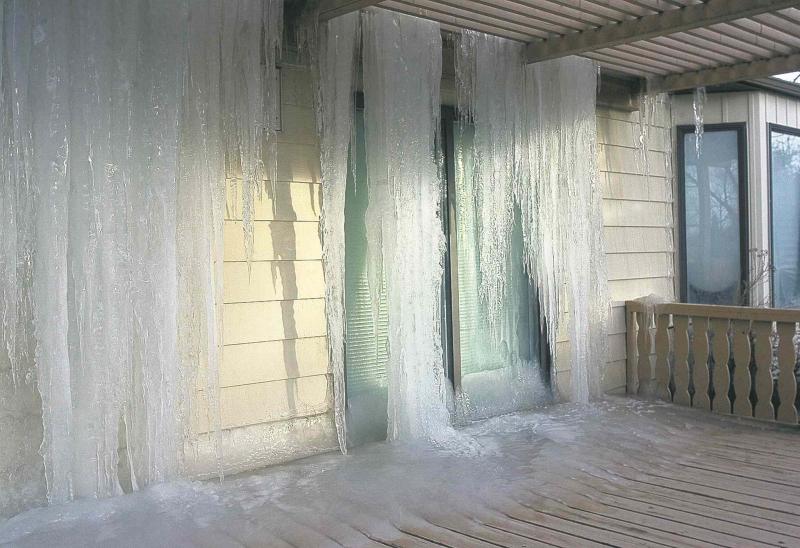
Any idea what this is? Also, the furnace is a 1980 Bryant, high-efficiency, vented through the chimney, angled very low about eight feet from the chimney. The chimney was filled with ice, near the top, in cold weather. I noticed water dripping down the cleanout of the chimney. I'm wondering if this could be the problem causing the seepage in the concrete.
Thanks, Larry Shelest
ANSWER: The colour and location of the water seeping into the basement gives me very good clues to the entry point, but will not identify the whole picture. The chimney ice may be another source of moisture entry but is not likely related to the other problem. I'm glad you included the information about the furnace and chimney, as that situation will also need attention to stop the moisture intrusion.
The small "pinholes" you are describing are a common source of basement seepage, known as snap ties or form ties. These holes are created when small metal rods embedded in the concrete rust through. These thin metal rods or wires have been there since the foundation was poured, as they are remnants from metal ties that held the wooden forms together while the concrete was poured. Once the concrete is sufficiently set and the forms are removed, the ties are cut off roughly flush with the surface of the foundation wall. The exterior of the concrete foundation, including the remainder of the form ties, should have been covered with damp-proofing prior to backfilling to prevent water seeping into the porous concrete.
Foundation leakage can occur, usually after several decades, when the damp-proofing wears out and ground moisture causes the metal form ties to corrode. If this corrosion is severe, the metal will essentially disintegrate, leaving a small round hole penetrating through the foundation wall. During spring thaw and heavy rains, water will seep into the small holes and may leak through into your son's basement. The reddish colour is normally due to rusting of the steel wires, but may also be from dirt or soil washing through from the exterior.
You had the right idea when you tried to plug the holes from the interior but tar or asphalt cement will not last. To properly fill the holes, you may have to drill, chip, or grind out some concrete and metal and then patch it with hydraulic cement or other pre-mixed cement patching compound. In many cases, this will stop major leakage, except during the most severe weather.
Unfortunately, this is not normally a permanent fix, especially if the holes are larger. Injection with epoxy may be the next step, but can be fairly costly if there are several holes. Money may be more wisely spent on exterior excavation at that point, so all the holes can be properly covered with a membrane to prevent moisture entering the foundation wall.
There's a chance some moisture is penetrating the foundation wall from the melted ice forming at the top or inside the chimney, but that is not the underlying cause. The soil outside the foundation can contain significant amounts of water, especially during summer thunderstorms or on warm spring days. This moisture can force its way into the foundation, and any cracks or holes, through hydrostatic pressure. This may be the most common reason for basement leakage. Shovelling snow away from the foundation and extending your downspouts may be the only other way to minimize the seepage without major repairs.
As far as the furnace and chimney are concerned, stopping the ice formation may require an upgrade to the entire system. I think you have erred in calling the furnace high-efficiency -- it's likely a mid-efficient model that still exhausts through the older chimney via a metal vent. Many of these mid-efficient furnaces have problems with ice formation near the top of the chimney, especially as they get older.
If your son's furnace is more than 30 years old, it's time to upgrade. It's exceeded its typical life expectancy, and the exhaust fan that blows the combustion products up the chimney is probably not working properly. This exhaust will cool too quickly, before it exits the top of the chimney, and the moisture it contains will condense and freeze. This can continue throughout an entire winter. When the weather gets warmer, this ice will melt and run back down the chimney and into the basement, often through the cleanout.
Modern high-efficiency furnaces normally vent laterally through plastic pipes exiting the foundation or exterior wall, stopping the ice formation. If the water heater is electric and not vented through the chimney, the older chimney flue can be sealed at the top and bottom and no more ice and leakage problems will occur.
It's likely the newer paint on your son's foundation wall covered the visible signs of seepage through the older form ties, but that will not stop it from reoccurring. The reddish stains are from the water and rust bleeding through the paint during times of high soil moisture. While this is unrelated to the chimney moisture, both a furnace upgrade and foundation repairs are needed to permanently stop the leakage.
Ari Marantz is owner of Trained Eye Home Inspection Ltd. and president of the Canadian Association of Home & Property Inspectors -- Manitoba (www.cahpi.mb.ca). Questions can be emailed to the address below. Ari can be reached at 204-291-5358. Check out his website at www.trainedeye.ca.
trainedeye@iname.com
Renovation & Design
Bassinet wheely good for laundry
QUESTION: My children are grown and I have kept some of the items they used when they were babies. One of my favourite pieces of baby furniture is a bassinet on wheels. Do you have any idea of something that I can use this for other than babies? I just can't bring myself to part with it but also can't justify keeping it because our home is quite small. Glenda (Winnipeg)
ANSWER: You are right to hold on to that treasure. A bassinet on wheels makes the perfect laundry basket because it can easily be rolled from one room to the next. If you need a place to store it, position it as a hamper in your bedroom.
QUESTION: A two-inch by six-inch piece of fabric has melted onto the glass front on my gas fireplace and I'm not sure how to get it off. I turned the fireplace on, heated up the glass and tried to scrape the fabric off with a spatula. Some of the melted fabric came off but I am left with a black smeared area that looks like paint. I will be very appreciative of your expert advice. Thanks for your time. Wendy (La Salle, Man.)
ANSWER: You're on the right track. I called three gas fireplace experts to ask for advice on this conundrum and they all said the same thing (that never happens). All three retailers recommend you use gas fireplace glass cleaner first. If the sticky residue or the black smear remains, use the same blade owners of glass stove tops use to clean their cook top in conjunction with more of the gas fireplace glass cleaner. Do not use Windex, WD-40 or any other solvent.
QUESTION: What's the difference between condensed milk and evaporated milk? Glenn (Winnipeg)
ANSWER: The difference between the two lies in the sugar content: one is sweetened, one is not. Both begin as whole milk. When making evaporated milk, the milk is heated until approximately 60 per cent of the water is evaporated. Condensed milk is made by blending whole milk with sugar. It is then heated until about 60 per cent of the water is evaporated. There is a difference in the flavours of both, which may make a difference when substituting one for another in recipes.
QUESTION: I am having an argument with my sister-in-law that I am hoping you can settle. She says there is no difference between lard and shortening, but I am arguing they are two different products. Also, can you tell me if shortening can be substituted for lard? L.S. (Winnipeg)
ANSWER: Lard and shortening are both common fats used in baking and cooking. Lard is a solid form of fat usually made from pork fat or other animal fat. Shortening, on the other hand, is made from partly hydrogenated vegetable oils, which have been solidified. Shortening is usually charged with nitrogen or whipped to incorporate air and then tempered into a soft product.
Lard and shortening may be used interchangeably most of the time. However, note that each adds its own flavour to the finished product and also produces different textures. For example, pie crusts made from lard are typically flakier than those made with shortening.
QUESTION: I have recently moved away from home and have not perfected the art of cooking (to say the least). Can you tell me how to boil a perfect egg? Bryson (Grunthal)
ANSWER: This is quite possibly easier than you think. Carefully place the eggs in a pot of water. Bring to a boil for 12 minutes. Voila!
QUESTION: Do you have any solutions for stronger fingernails? Lynda (Brandon, Man.)
ANSWER: Other than making sure you have enough calcium in your diet and using nail-strengthening products on the market, you might want to consider a trick that some women in the Dominican Republic use; chop fresh garlic and add it to clear nail polish. Let the concoction brew for 7-10 days before applying. Apparently this is very effective in strengthening nails.
QUESTION: What is the best way to organize mitts, scarves and toques? Les the Messy Man (Winnipeg)
ANSWER: You are not alone. As a mom of four, I needed to tackle this issue before it got out of hand. In our case, we built six wooden full-size lockers, one for each member of the family. This keeps the house organized because even young kids always know where to find their missing mittens.
If you do not have room for lockers or plastic or wooden cubbies, use the following hints. Begin by removing out-of-season apparel and putting them into large plastic bins. All additional winter clothing can be placed into plastic containers and stored in an area such as a large wooden bench that opens. Mittens are safety pinned together and any clothing that has not been used within a two-year time period is donated. Mittens, toques and scarves can also be stored in jacket sleeves or hoods. Tip: If you eat chips from a can, save the cans and store rolled up scarves, mittens or toques inside. You'll be organized before you know it.
Fabulous tips of the week
- Shiny hair: is possible with a bit of coconut oil. Rub oil onto your scalp once a week. Wash hair in the morning.
- Smooth skin: use a version of the secret recipe that Cleopatra used. Into your bath water drop two cups of powdered milk.
I enjoy your questions and tips, keep them coming. Missed a column? Can't remember a solution? Need a speaker for an upcoming event? Check out my videos/blog/website: reena.ca.