Renovation & Design

Renovation & Design
ASK THE INSPECTOR: Sometimes, beauty should only be skin deep
QUESTION: I live in a 92-unit bungalow condominium complex in Winnipeg. I have a heated garage with a concrete floor. Also, there is a concrete grade beam across the front where the garage door is located. When the garage door is closed, half the door is on this piece of concrete and half is on the outside adjacent to my concrete driveway.
Over the past couple of years there has been some surface breaking and small cracks in the concrete. Some small pieces have broken off but there is no evidence that the damage is going very deep in the concrete slab. I bought some cement patching compound and did a patch job which does not look too bad.
Can a grade beam concrete strip, that the garage door rests on when closed, be brought down a few inches and re-concreted so that it looks like new or will the whole grade beam have to be dug out and re-concreted? I sure hope that you can help me in regard to this matter. Bernard Palmer
ANSWER: I commonly see some deterioration to driveway or garage concrete slabs just below the vehicle door from moisture running down the door and collecting at the bottom. You have taken the right approach in patching this area, but anything beyond that may do more harm than good.
When the surface of any concrete component of your home becomes worn due to moisture, road salt or mechanical damage it should be patched to prevent further deterioration. This applies whether the surface is lightly spalling or there is significant cracking or damage. This patching should be done to prevent further deterioration from moisture that can seep into the exposed interior. This moisture can expand when it freezes and further push apart the damaged areas. A good patch job will also improve the look of the concrete, while improving the moisture resistance of the surface, but is not the primary concern. If left too long, structural damage to the concrete can occur, which will be much more costly to repair in the long run.
Cutting or altering concrete foundations or grade beams is not something to be attempted by homeowners, especially for purely aesthetic reasons. I can see little benefit to cutting any of the existing concrete for a repair, unless there is deeper damage than the small cracks and surface wear you have stated. Cutting the concrete may only provide a smoother surface, which can actually prevent adherence of patching material. An uneven section of concrete has more surface area than a smooth section and more nooks and crannies for the patching compound to bond. Other than proper bonding of the patching material, there is also a much more sinister reason not to cut the concrete.
The concrete grade beam for your garage is properly designed to carry the load of the garage walls and alteration, in any way, may compromise this function. Your grade beam is likely sitting on poured concrete piers, commonly called piles, which are the real support below the shallow grade beam. Weakening this short concrete wall by cutting it may cause it to crack between the piers, causing further damage. Also, steel reinforcing rods, or re-bar, are embedded in the concrete to add further strength. If the re-bar is installed near the top surface of the grade beam, cutting down a few inches to allow installation of new concrete may damage or completely remove sections of this important reinforcement. That will only further weaken the concrete and certainly lead to worse damage.
Another issue to address is the potential difficulty in attempting removal of even a small section of the concrete to allow proper forming for new topping concrete. Because the grade beam should be relatively flush with the driveway and garage pad, it may be next to impossible to remove a portion of the top. Cutting straight lines through the surface may be relatively easy with the proper saws and blades, but removal of the material in between may require use of pneumatic tools. Using a pneumatic hammer or chisel to bang away at the concrete is another way to cause serious damage to otherwise healthy concrete. Because a garage grade beam is normally less than a metre deep, there is the possibility of creating serious structural cracks from the pounding required to remove the top layer.
I understand your thinking that you may require a thicker layer of concrete than provided by surface patching for a proper repair, but in this case it does not make sense. Patching the deteriorated surface of the grade beam and any cracks may be all that is practical. Removing otherwise stable sections of the short foundation wall, just to replace it with a newer layer, will certainly lead to weaker concrete. The aesthetic result may also not be to your satisfaction, unless you order redi-mix concrete, which will also be overkill for this situation.
Having stated that your current patch and repair job "does not look too bad" leads me to believe that you have done a reasonable job. You may not need to go further unless the new patching compound crumbles, which is likely over time. If the patching continues holding strong, applying a clear sealer to the surface of the entire area of exposed concrete may also help prevent further water penetration.
Beyond that, any further repairs may not only be unnecessary but can be detrimental to the future integrity of the concrete.
Ari Marantz is the owner of Trained Eye Home Inspection Ltd. and the President of the Canadian Association of Home & Property Inspectors - Manitoba (www.cahpi.mb.ca). Questions can be emailed to the address below. Ari can be reached at (204) 291-5358 or check out his website at www.trainedeye.ca.
trainedeye@iname.com



Renovation & Design
ASK THE INSPECTOR: Wood skirting best bet to insulate cottage
QUESTION: We have built a lakefront cottage in the Whiteshell. We added onto the old cottage. The original was 500 square feet and now it is 1,200 sq. ft.
We reinsulated the old cottage, walls and ceiling to match the new ones. I left three inches of vapour barrier extending out from the bottom of the walls.
The floors were impossible to vapour-barrier the traditional way because it rained so much while building and the water worked its way through the plywood and caused the vapour barrier to bulge with water. I had to cut out the vapour barrier from under the cottage to allow the water to drain and the wood to fully dry. The existing cottage floor did not have a vapour barrier, either.
I have since insulated the floor of the cottage and covered it with metal lathing to keep the rodents out. The lathing is the only way I have found that successfully keeps them out of the insulation. I thought I could lay vapour barrier over the existing plywood floor and join it to the polyethylene coming out of the walls with acoustical sealant. This would complete the vapour-barrier seal around the whole cabin. After, I would lay good on one side 3/8-inch plywood on top and staple it down. I need the new plywood to make a smooth surface to put vinyl-laminate flooring on top of.
The other option would be to forget about the vapour barrier on the floor at all. In that case, I could glue the plywood as well as staple it down. We do not ever foresee living full-time at the cottage. It is only used spring, summer and fall.
ANSWER: Many cottages and summer homes like yours are built without typical concrete foundations or grade beams due to the nature of the landscape or the difficulty in pouring concrete in remote locations. Others are built on posts and pads due to uneven grading and sloping lots in the Canadian Shield. This method may be easier to accomplish and less costly than forming and pouring concrete, but it always leaves a dilemma when deciding how to properly insulate the floor system.
The best way to accomplish this, even with a post-and-pad system, is to construct a pressure-treated wood skirting underneath the perimeter of the floor to grade and insulate and air-seal this skirting. This allows temporary heating of the new crawl space, which will warm the floor and make it comfortable in the shoulder seasons when the cottage will presumably be heated.
If this is not practical, or you prefer to leave the underside of the cottage open to prevent moisture and drainage issues, your floor insulation may have little benefit in providing thermal protection for your cottage.
Insulation and air-sealing for three-season habitation may not have to meet the stringent requirements of winter usage. While it may not be necessary to fully insulate the walls and attic because you are only heating the interior occasionally, it's admirable to conserve energy and increase the comfort level. However, insulating and air-sealing the floor may be a different story.
Because warm air rises, most heat loss in buildings is due to air and heat loss through the attic and walls, which includes the windows and doors. Heat loss through the floor should not be a major factor, so installation of large amounts of fibreglass insulation between the floor joists will do little to improve comfort or energy efficiency. This is because fibreglass insulation does little to stop air leakage, but it does slow down its movement and can trap significant amounts of air and moisture.
Air-sealing may prevent cold air intrusion from below the floor and prevent drafts, which can make the floor feel even colder. Removing the fibreglass insulation from the floor and replacing it with a few inches of blown-in high density polyurethane foam or extruded polystyrene will air-seal and add R-value at the same time. With a sufficient thickness of either of these types of insulation, a polyethylene air/vapour barrier will not be necessary. This method will also prevent the need for the metal lath as it will eliminate the haven for mice and squirrels that fibreglass batts provide.
If you feel it's too costly or labour-intensive to remove the fibreglass batts, it still doesn't make sense to install the polyethylene sheathing where you propose. The poly may trap moisture underneath, which can rot the existing subfloor. A better solution would be to seal the top of seams and fasteners of the existing plywood floor.
Plywood sheathing actually has reasonable resistance to air and water vapour penetration, except at the joints. This will allow you to glue down your next layer of sheathing, which will only improve the air/vapour resistance, especially if you offset the joints with the original sheathing.
Renovation & Design
SOLUTIONS: Use dandruff shampoo to remove blood
QUESTION: How do you remove blood from a blue carpet? My dog has cancer in his nose. Need an answer quickly. Thanks. -- Ann, Winnipeg
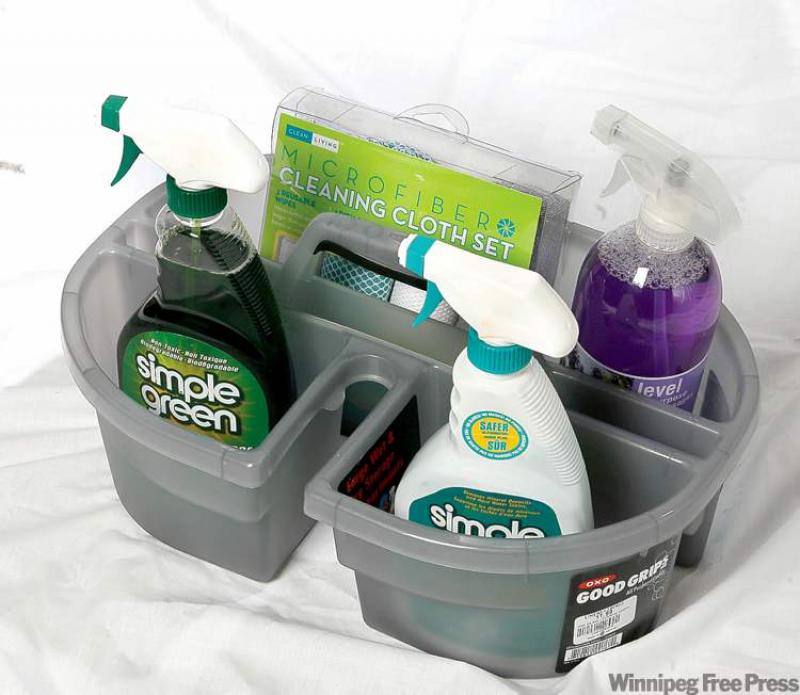
ANSWER: Sorry to hear about your dog. Your best bet for removing blood from the carpet without discolouring the spot is to scrub the area with Head and Shoulders Dandruff shampoo. Rinse with water. Of course you'll want to test the shampoo on an inconspicuous area first.
QUESTION: I went on vacation last November and forgot items in the refrigerator such as milk and an onion which rotted a little. Needless to say, the odour was pretty bad upon my return. I have washed the fridge with water, soap and baking soda. I also placed some vinegar in the fridge. The odour still remains but not as strong. Is there something else I can use? I also threw out all my condiments which were in plastic bottles. Thank-you in advance. -- Evelyne, Winnipeg
ANSWER: I like the way you think! But instead of just placing vinegar in the fridge, pour it in and let it work its way into every corner and crevice that exists in the fridge. After the fridge is clean and dry, unplug it and STUFF it full of several crumpled-up newspaper pages (not this page, of course) and leave it for a week. The ink in newspapers is a dynamic odour absorber and will zap all remaining smells.
QUESTION: How can I clean my oak kitchen cupboards? -- Joan and Cecile, Winnipeg and Brandon, MB
ANSWER: Mild dish soap and water is all that is recommended for cleaning the grease off of kitchen cupboards (just a damp clean cloth and no excess water, dry immediately). This should be very effective, since dish soap is created as a grease cutter.
QUESTION: I have a set of aluminum muffin pans and grease has hardened on them and browned. Can I soak them with something? -- Hazel, Killarney, MB
ANSWER: Presenting the world's easiest and oldest trick! Slice a raw potato in half; next, pour baking soda onto the muffin pan. Use the potato and baking soda combo to scrub away the rust. Extra tip: If you are out of potatoes, use an onion instead.
QUESTION: We bought a new kitchen range in December. It is white. The oven vent comes out below the dials on the front panel. The white plastic above the vent area has discoloured to a yellowish colour. Is there anything that I can use to restore the white colour? You can't feel anything in the discolouration area; it's smooth like the rest.
Also, what can you do to get spruce gum off of clothes? -- Shelley, Ashern, MB
ANSWER: Whoa, four months old and it's already discolouring, I know what I would do... call the manufacturer and ask for their guidance. There are certain manufacturer products with common design flaws. In my experience, the yellowing is permanent and cannot be fixed without replacing the part. You can try cleaning it with the helpful advice from a loyal reader who experienced a similar challenge.
Loraleigh from Manitoba suggests sprinkling the area with baking soda and scrubbing it with a grapefruit peel. However, in my opinion, contact the manufacturer before your warranty runs out -- perhaps the oven is recalled or a service person can be sent out.
To get spruce gum out of clothes, smear with mayonnaise. Wipe off spruce gum. Pour dish soap and water onto area and rinse. Wash as usual.
Fabulous tips to beef up your next meal
-- Sprinkle a little salt into your frying pan before adding meat to cut down on grease splatters.
-- Fancy up meatloaf by baking it in muffin tins or Bundt pans instead of loaves (cooking time will vary).
-- For perfect meatloaf slices, bake it, then freeze it for a couple of hours. Cut, reheat and serve. The added bonus is you can prepare the meatloaf well before serving.
-- To prevent meatloaf from sticking to the pan, lay a slice of uncooked bacon on the bottom before baking. For extra flavour, add a few slices to the top of the meatloaf as well.
Reena Nerbas is the author of the national bestselling Household Solutions series. Her website is www.householdsolutions.org. You can contact her at Box 429, Blumenort, Man., ROA 0C0.