


Renovation & Design

Renovation & Design

Wild things

Sarah Coulber
September 3

Advertisement

Renovation & Design

TREE CARE: Putting down roots

During the summers, I'm often asked about what kind of trees should a homeowner plant. Here are some of my favourite: bur oak, linden, Delta hackberry, Prairie Silk honey locust and Discovery elm.

Bur oak is an under-utilized native tree that really does well when properly planted and maintained in residential yards. People always tell me its growth is too slow, but I tell them to fertilize the tree in the proper manner.

I've always planted a bur oak in every place I've lived on the Prairies. I can usually get one to 1.25 metres of annual height growth. These oaks like the clay loam soils we have in the Red River Valley, and grow quite well if treated properly. It's the best native tree for dry Prairie soils.

There are several varieties of lindens available from southern Manitoba nurseries. Most seem to do very well. The linden has an overall crown that resembles a bee hive, though some varieties more than others. It's one of the more visibly attractive trees, rarely growing more than 12 m high. Remarkably, it's free of serious diseases that affect most other trees.

When a small linden is planted, it's critical that the roots are spread out and not allowed to curl into a root ball. Root curling can cause lindens to self-girdle their trunks when the roots wrap tightly around the base. The tree can die from this effect, or be seriously weakened.

Delta hackberry is also an under-utilized native shade tree that grows naturally at the south end of Lake Manitoba. It's in the elm family but does not have any of the elm's problems, such as Dutch elm disease. Its crown forms a pleasing shade canopy without growing too tall. On our clay loam soils, it will grow up to about 12 m.

Like the oak, the hackberry is virtually free of serious diseases and has only a few minor feeding pests. Its roots are not as aggressive as elms, so it doesn't normally pose a problem for house foundations.

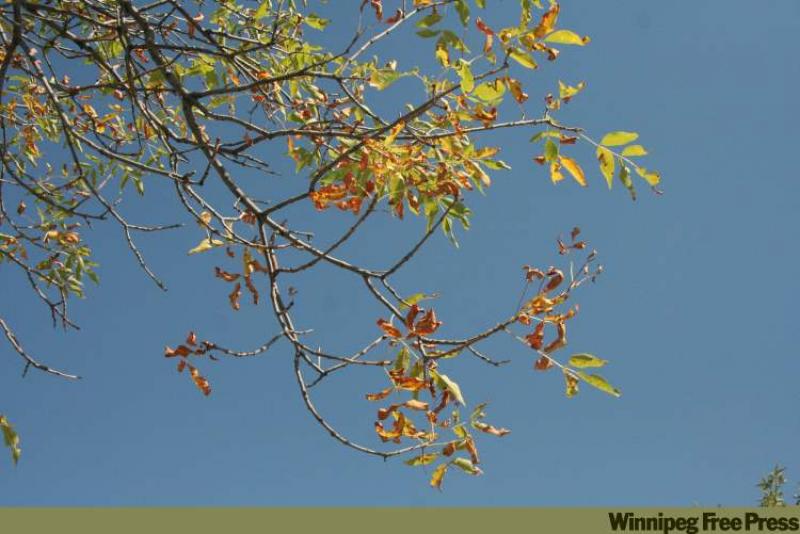
Prairie Silk honey locust is a small tree with outstanding features that clearly make it a candidate for this short-list of great trees. The tree produces horizontal twigs and branches that bear compound leaves having quite small leaflets. Cleanup of fall leaves is simply not a problem as these leaves shrivel up into tiny pieces that decompose quickly. Fall leaves are bright yellow in colour.

The branches tend to be quite symmetrical about the trunk, giving the tree an instant appeal. To date, pests and diseases have not been serious problems.

Discovery elm has Japanese origins but was developed on the Prairies. Its height growth is similar to lindens and hackberrys. With proper care, it's an outstanding tree, tending to produce a flat-topped canopy with a noticeable vase shape.

In a well-spaced cluster of these trees, this effect is visually very appealing, such as in a plaza near the Health Sciences Centre's Buhler Centre on McDermot Avenue. It's my favourite grove of inner-city trees.

Michael Allen is a consulting urban forester, certified I.S.A. arborist and owner of Viburnum Tree Experts. He provides advisory services on trees and shrubs. He can be contacted by calling 831-6503 or emailed at viburnumtrees@shaw.ca

Michael Allen
September 3

Renovation & Design

Lofty ambitions

Room for change / By Connie Oliver
August 27

Renovation & Design

Grey chocolate buds need wet-and-dry fix

QUESTION: I made a birthday cake for my daughter. I bought chocolate buds to decorate the top of the cake and when I opened the box, I was disappointed because the chocolate looks grey instead of brown. How can I make the chocolate look good and are they safe to eat or should I throw them out? Bernadette (Churchill)

ANSWER: Throw out chocolate? No way! Fat bloom happens to chocolate when the cocoa butter separates from the other ingredients. Sugar bloom, on the other hand, is also grey and has a gritty texture; this is caused by weather conditions such as humidity. Some think bloom happens as chocolate ages, but humidity is almost always the culprit.

Take the delicious chocolate buds and dip them in water. Let them dry on a tea towel and they will appear dark once again. Lastly, please remember this important life rule: If you are ever plagued with melted chocolate on your fingers, you are eating it way to slowly!

QUESTION: I live in a one-bedroom house in a little town in Manitoba. The crickets outside my window make me furious! They chirp all night and are so noisy that I can't sleep. What can I do to attract the critters to an area away from my window? I have a plan to chop their legs off so that they stop rubbing them together. They're driving me crazy! Timothy (Gladstone)

ANSWER: Firstly, it is a myth that the sound of crickets comes from them rubbing their legs together, so you might as well forget about that plan. Secondly, it's really only the male crickets that are robbing you of your sleep, because female crickets are quiet little critters. Before you do anything, consider the benefits of crickets: The sound of crickets helps repel mice and rats and many people keep crickets as pets because the chirping helps them sleep. Crickets eat bread, cereal and vegetables. Crickets need to drink water, and if their food is near water, they will often drown in the water trying to get to their food. There are commercial cricket repellents, or you can make your own by sprinkling borax and cornmeal (or Cornflakes) underneath your windowsill. As temperatures drop, cricket sounds will slow down and so you will sleep once again.

QUESTION: I know you've probably addressed this problem in your column on several occasions, but now that this problem has happened to me, I regret not paying better attention to the solution. I have a water stain on my elm dining room table. I've been told that mayonnaise (not Miracle Whip) will take out the stain. I'm reluctant to go forward with this remedy without the benefit of professional guidance, preferably from you. Therefore, I'm asking if you would recommend that I use mayonnaise, and, if so, how long would I leave the product on the stain before wiping it off? Thank You. Ruth (Winnipeg)

ANSWER: No problem, Ruth. Smear the area with mayonnaise and wait for an hour. Wipe area and check if stain is gone. If stain remains, cover spot with a tea towel and press with a hot iron to draw out excess moisture in wood. If neither solution is successful, then you're best option is to refinish the table.

Question for you:

I was sitting at my friend's house enjoying the weather and the wonderful people. The property has a beautiful, large outdoor swimming pool and is situated near a farmer's field. There were no bugs in sight until the food was served. Suddenly, we noticed flying beetles all around -- on plates, all over the table and landing on each person's clothes and hair. The bugs are black and do not bite, but were annoying. They look like black ladybugs and play dead whenever someone touches them. As soon as the food was taken away, the bugs disappeared. Does anyone know the name of these bugs? Reena Nerbas

I enjoy your questions and tips; keep them coming. Check out my website at

www.householdsolutions.org

Reena Nerbas / Solutions
August 27

Renovation & Design

Filling gap under steps stops pests, seepage

Question: I was hoping you might be able to guide me in the right direction. I live in Linden Woods and moved into my house about two years ago. I noticed that beside my front steps there is a gap the size of my fist leading underneath my stairs. I am pretty certain voles and rabbits like to get underneath the stairs, as I have had a problem with voles last spring and now. I was thinking of buying three-quarter or one-quarter gravel to stuff the hole. After looking closer, I am not sure a couple bags of gravel will fill the gap underneath the stairs.

Can you please tell me what people generally do? I am thinking some rock may help and at the very least, cover the hole without filling the space entirely underneath. It would be very hard to push the rock all the way down.

Also, the sidewalk leading up to my front stairs has sunken. If I wanted to get that fixed, even though I don't think it affects much, do you recommend Mud Ruckers?

Thanks for your help,

Ryan S.

ANSWER: Filling in under your steps is an important step to prevent not only pests, but also seepage into your foundation through small cracks or openings that may be hidden from view. The key is to fill the void with whatever material is the most practical, as long as you fill it in to grade level or higher.

The empty space that has developed under your steps is often much deeper than can be observed from the outside. This is due to normal erosion of the soil and will increase with poor grading in the rest of the yard, particularly in the area near the stairs. Filling in this area is part of regular maintenance and will likely have to be done every few years. The good news is a more thorough job now will make future repairs less frequent. To access the area for proper back-filling, you may first have to excavate a larger opening at the side of the stairs to allow shovelling large amounts of fill that will not fit through the small opening you currently can see.

The ideal type of fill under your stairs is the heavy clay soil that normally surrounds your home below the layer of topsoil and grass or other vegetation. This is good material to use because it will only compact to a certain degree and will only absorb a certain amount of moisture before it becomes saturated. Both of these properties will prevent further erosion and seepage into the foundation. The problem with using clay is the difficulty in packing it tight enough under your stairs to accommodate good conditions for proper compaction and slope. You may only be able to fill the area with large clumps of this heavy fill, which may have large gaps between each piece, providing an area to collect moisture and harbour pests.

Using stone for fill under the steps is normally a more practical solution due to the ease of shovelling and the excellent resistance to erosion. Using stone that is not clean will further add to its effectiveness. By this I mean stone that has varying sized pieces, which will fill in more fully. This material is often referred to as three-quarter down or quarter down. The term comes from the size of mesh the raw material is passed through so anything smaller than the size quoted will fall through and comprise the mix. For example, three-quarter down will have stones from just under three-quarters of an inch in size right down to sand-sized particles. The benefit of this type of fill is more complete coverage with minimal compaction required.

Once you have dug down outside the steps enough to see the size of the void underneath, you can do a rough measurement to determine the quantity of fill you need to order. Always order more than required because you are mainly paying for the delivery charges rather than the material. It can be a major pain when you run out of material when the job is almost finished and you can always find some other area around your home or a neighbour's to use the extra stone. Try to fill the gap as high as possible, even above grade along the foundation and deeper under the steps. This is important, as the material will eventually settle and try to fall back out from under the stairs. Once full, the initially excavated topsoil can be replaced and built up along the outside of the stairs and foundation. This will help prevent the new stone fill from pouring out of the void and provide good drainage away from the home.

Lifting the sidewalk by mud-jacking, if it is concrete, may be a good idea to help with the rest of the landscaping. Raising it back up to original height will allow you to replace eroded soil beside it and further improve the grading and drainage. The cost may be slightly prohibitive, but may be worth it if your current sidewalk is in otherwise good condition. If the concrete is deteriorated, removal and replacement with interlocking stone is a better option. If you do opt for mud-jacking, talk to the contractor about the possibility of them filling the void under your steps with the same material they use to lift the sidewalk. If the cost is not too high, it may eliminate a few hours of heavy labour and save you from some back pain.

Ari Marantz is the owner of Trained Eye Home Inspection Ltd. and the President of the Canadian Association of Home & Property Inspectors - Manitoba (www.cahpi.mb.ca). Questions can be emailed to the address below. Ari can be reached at (204) 291-5358 or check out his website at www.trainedeye.ca.

trainedeye@iname.com

Ask The Inspector / Ari Marantz
August 27

Browse Homes

Browse by Building Type