
Renovation & Design

Renovation & Design
Grey chocolate buds need wet-and-dry fix
QUESTION: I made a birthday cake for my daughter. I bought chocolate buds to decorate the top of the cake and when I opened the box, I was disappointed because the chocolate looks grey instead of brown. How can I make the chocolate look good and are they safe to eat or should I throw them out? Bernadette (Churchill)
ANSWER: Throw out chocolate? No way! Fat bloom happens to chocolate when the cocoa butter separates from the other ingredients. Sugar bloom, on the other hand, is also grey and has a gritty texture; this is caused by weather conditions such as humidity. Some think bloom happens as chocolate ages, but humidity is almost always the culprit.
Take the delicious chocolate buds and dip them in water. Let them dry on a tea towel and they will appear dark once again. Lastly, please remember this important life rule: If you are ever plagued with melted chocolate on your fingers, you are eating it way to slowly!
QUESTION: I live in a one-bedroom house in a little town in Manitoba. The crickets outside my window make me furious! They chirp all night and are so noisy that I can't sleep. What can I do to attract the critters to an area away from my window? I have a plan to chop their legs off so that they stop rubbing them together. They're driving me crazy! Timothy (Gladstone)
ANSWER: Firstly, it is a myth that the sound of crickets comes from them rubbing their legs together, so you might as well forget about that plan. Secondly, it's really only the male crickets that are robbing you of your sleep, because female crickets are quiet little critters. Before you do anything, consider the benefits of crickets: The sound of crickets helps repel mice and rats and many people keep crickets as pets because the chirping helps them sleep. Crickets eat bread, cereal and vegetables. Crickets need to drink water, and if their food is near water, they will often drown in the water trying to get to their food. There are commercial cricket repellents, or you can make your own by sprinkling borax and cornmeal (or Cornflakes) underneath your windowsill. As temperatures drop, cricket sounds will slow down and so you will sleep once again.
QUESTION: I know you've probably addressed this problem in your column on several occasions, but now that this problem has happened to me, I regret not paying better attention to the solution. I have a water stain on my elm dining room table. I've been told that mayonnaise (not Miracle Whip) will take out the stain. I'm reluctant to go forward with this remedy without the benefit of professional guidance, preferably from you. Therefore, I'm asking if you would recommend that I use mayonnaise, and, if so, how long would I leave the product on the stain before wiping it off? Thank You. Ruth (Winnipeg)
ANSWER: No problem, Ruth. Smear the area with mayonnaise and wait for an hour. Wipe area and check if stain is gone. If stain remains, cover spot with a tea towel and press with a hot iron to draw out excess moisture in wood. If neither solution is successful, then you're best option is to refinish the table.
Question for you:
I was sitting at my friend's house enjoying the weather and the wonderful people. The property has a beautiful, large outdoor swimming pool and is situated near a farmer's field. There were no bugs in sight until the food was served. Suddenly, we noticed flying beetles all around -- on plates, all over the table and landing on each person's clothes and hair. The bugs are black and do not bite, but were annoying. They look like black ladybugs and play dead whenever someone touches them. As soon as the food was taken away, the bugs disappeared. Does anyone know the name of these bugs? Reena Nerbas
I enjoy your questions and tips; keep them coming. Check out my website at
www.householdsolutions.org
Renovation & Design
Filling gap under steps stops pests, seepage
Question: I was hoping you might be able to guide me in the right direction. I live in Linden Woods and moved into my house about two years ago. I noticed that beside my front steps there is a gap the size of my fist leading underneath my stairs. I am pretty certain voles and rabbits like to get underneath the stairs, as I have had a problem with voles last spring and now. I was thinking of buying three-quarter or one-quarter gravel to stuff the hole. After looking closer, I am not sure a couple bags of gravel will fill the gap underneath the stairs.
Can you please tell me what people generally do? I am thinking some rock may help and at the very least, cover the hole without filling the space entirely underneath. It would be very hard to push the rock all the way down.
Also, the sidewalk leading up to my front stairs has sunken. If I wanted to get that fixed, even though I don't think it affects much, do you recommend Mud Ruckers?
Thanks for your help,
Ryan S.
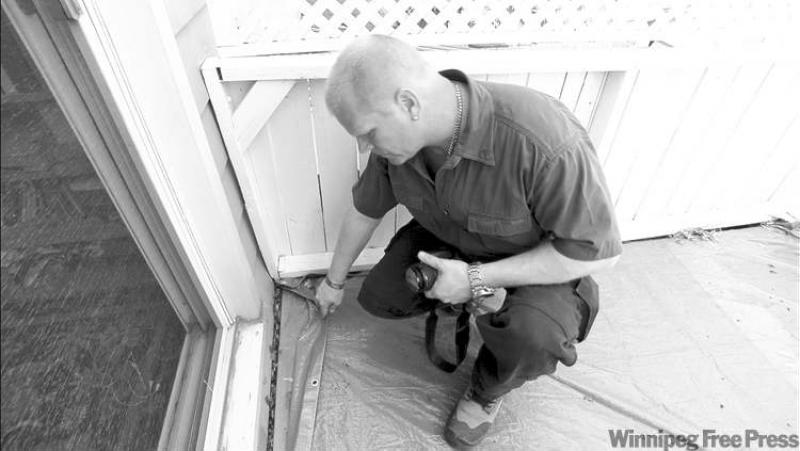
ANSWER: Filling in under your steps is an important step to prevent not only pests, but also seepage into your foundation through small cracks or openings that may be hidden from view. The key is to fill the void with whatever material is the most practical, as long as you fill it in to grade level or higher.
The empty space that has developed under your steps is often much deeper than can be observed from the outside. This is due to normal erosion of the soil and will increase with poor grading in the rest of the yard, particularly in the area near the stairs. Filling in this area is part of regular maintenance and will likely have to be done every few years. The good news is a more thorough job now will make future repairs less frequent. To access the area for proper back-filling, you may first have to excavate a larger opening at the side of the stairs to allow shovelling large amounts of fill that will not fit through the small opening you currently can see.
The ideal type of fill under your stairs is the heavy clay soil that normally surrounds your home below the layer of topsoil and grass or other vegetation. This is good material to use because it will only compact to a certain degree and will only absorb a certain amount of moisture before it becomes saturated. Both of these properties will prevent further erosion and seepage into the foundation. The problem with using clay is the difficulty in packing it tight enough under your stairs to accommodate good conditions for proper compaction and slope. You may only be able to fill the area with large clumps of this heavy fill, which may have large gaps between each piece, providing an area to collect moisture and harbour pests.
Using stone for fill under the steps is normally a more practical solution due to the ease of shovelling and the excellent resistance to erosion. Using stone that is not clean will further add to its effectiveness. By this I mean stone that has varying sized pieces, which will fill in more fully. This material is often referred to as three-quarter down or quarter down. The term comes from the size of mesh the raw material is passed through so anything smaller than the size quoted will fall through and comprise the mix. For example, three-quarter down will have stones from just under three-quarters of an inch in size right down to sand-sized particles. The benefit of this type of fill is more complete coverage with minimal compaction required.
Once you have dug down outside the steps enough to see the size of the void underneath, you can do a rough measurement to determine the quantity of fill you need to order. Always order more than required because you are mainly paying for the delivery charges rather than the material. It can be a major pain when you run out of material when the job is almost finished and you can always find some other area around your home or a neighbour's to use the extra stone. Try to fill the gap as high as possible, even above grade along the foundation and deeper under the steps. This is important, as the material will eventually settle and try to fall back out from under the stairs. Once full, the initially excavated topsoil can be replaced and built up along the outside of the stairs and foundation. This will help prevent the new stone fill from pouring out of the void and provide good drainage away from the home.
Lifting the sidewalk by mud-jacking, if it is concrete, may be a good idea to help with the rest of the landscaping. Raising it back up to original height will allow you to replace eroded soil beside it and further improve the grading and drainage. The cost may be slightly prohibitive, but may be worth it if your current sidewalk is in otherwise good condition. If the concrete is deteriorated, removal and replacement with interlocking stone is a better option. If you do opt for mud-jacking, talk to the contractor about the possibility of them filling the void under your steps with the same material they use to lift the sidewalk. If the cost is not too high, it may eliminate a few hours of heavy labour and save you from some back pain.
Ari Marantz is the owner of Trained Eye Home Inspection Ltd. and the President of the Canadian Association of Home & Property Inspectors - Manitoba (www.cahpi.mb.ca). Questions can be emailed to the address below. Ari can be reached at (204) 291-5358 or check out his website at www.trainedeye.ca.
trainedeye@iname.com
Renovation & Design
It's easy to create a backyard Eden
IT takes more than barbecued burgers and pretty paper plates to throw a summer garden party. Hosting casual backyard get-togethers with neighbours and friends is the perfect time to create fun and festive decorations and tasty snacks to turn the deck or patio into party central.
Everyday Eden, 100+ Fun, Green Garden Projects for the Whole Family to Enjoy (208 pages, Harbour Publishing Co. Ltd., $29.95) by Christina Symons and John Gillespie is filled with inspiring, down-to-earth ideas to help maximize summer enjoyment of your outdoor spaces, be it a sprawling suburban backyard or tiny urban balcony.
Broken down into five chapters -- Elements, Balance, Beauty, Edibles and Celebrations -- the how-to guide combines step-by-step instructions with full-page colour photos to make it easy to create everything from a teepee trellis and a lavender wreath to homemade salad dressings using fresh herbs and a quirky candelabra-style centrepiece made with upside-down cognac glasses, sundae cups and wine goblets.
"Whether you live in the city, suburbs or country, Everyday Eden is filled with inspiring, playful ideas for enjoying the beauty and bounty of a garden," the preface reads. "Using everyday materials and easy techniques, this lively collection of projects and practices will engage beginner and experienced green thumbs alike."
I'm not much of a gardener -- or a skilled crafter -- but even I could make most of the projects in this book. Among my favourites is the "Goody Gumboots" on page 100, a pair of rubber boots hand-painted with bright red hearts and used to hold potted Gerber daisies.
As for that backyard party, there's a recipe for "Sexy Sangria," simple make-your-own garden lights using glass votive holders suspended with twisted wire and plain cloth napkins with the words EAT, SIP and YUM stencilled on them.
For junior guests, the candy-topped cupcakes served in mini terracotta flower pots are guaranteed to be a big hit.
Now let's get the party started.
-- Postmedia News
Renovation & Design
Lighting the night with sunshine
It sounds like a bright idea: Let the sun, which is free, light up your summer nightlife. But are solar lights all they're cracked up to be?
One thing's for sure: They're hot sellers.
"We're seeing a definite increase in solar-light sales, says Frank Turco, Home Depot's manager of trends and design. Prices as low as $3.49 each and ease of installation account for the boom, he says.
Although Turco wouldn't disclose total sales volume, he says solar now accounts for about 75 per cent of the company's garden and post-cap light sales (post-cap lights are those ambient toppers for fence and deck posts). They're also gaining popularity with condo dwellers, who pop stake lights into flower pots on their terraces.
Over at IKEA, virtually the whole line of outdoor lighting for this summer is solar-powered, and product is flying off the shelves. Solvinden, for example, has outdoor floor, pendant and cheery-coloured table lamps starting at $29.99. Many have already sold out.
For kitsch fans, there are solar lights shaped like toadstools, bugs, birds and a Queen Elizabeth statuette with a waving hand.
However, many say inexpensive solar lights really don't cut it where it counts: lighting paths safely, accenting trees and plantings and serving as security lights.
"No one's shown me one that can store enough energy in an esthetically pleasing design that gives the volume of light you need," says Bruce Morton, president of Greenscape.ca, a lawn-sprinkler systems and landscape lighting company. "All they have is a tiny LED emitter that might be able to light up a little bush or a statue for a limited time."
Those LED lights, which shine up to 25 times brighter than earlier solar lights, are a new development. They use 90 per cent less battery power than incandescent lights and can last 10 years.
"The huge benefit of the solar LED is because no electricity is needed; there are no cords. You can put outdoor lighting anywhere you want in your backyard or on your balcony instead of planning around where electrical outlets are and where the cords will run," says Andrea Mills, spokeswoman for IKEA Canada, of the convenience of solar lighting. "And it's affordable."
But they're still not bright enough, says David Lepine. He owns a company specializing in automated outdoor watering, lighting and other garden services. One problem, he says, is the too-small array of solar cells, which convert sunlight into electrical current.
The other is the batteries that store the energy: They are too small to store much of it for very long. Between feeble collection and storage systems, there's just not enough energy for much LED oomph. "The technology is somewhat there for big customers, but not in what you get in the stores. It'll take a few years before that happens."
A quick check of store shelves tells the tale.
The Hampton Bay Solar LED Walk Light, $3.49 each at Home Depot, collects enough energy on a sunny day to run for about 10 hours, according to the box. However, it produces only 1.2 lumens, a measure of light commonly used in the industry.
Hampton Bay's eight-pack of LED landscape lights, which includes two spotlights, sells for $39.99. They also throw 1.2 lumens each.
By contrast, a single 23-watt compact fluorescent lamp emits around 1,600 lumens.
Do the math.
The biggest customer complaint is solar lights' lack of a brilliant beam, says Turco. That could mean recently introduced motion-detector lights using solar power may not detect a whole lot.
He adds that individual stake lights, commonly used in gardens and along pathways, sometimes give varying levels of light, possibly because one gets a little more direct sun than another.
Turco suggests grouping them in threes or fours to better light your way. Just be careful when you're sticking them in the ground -- the Internet bristles with complaints about plastic stakes snapping off.
The batteries will last a couple of years but won't work well in the winter. Best to store the lights inside during the cold months.
In the end, it looks like we're stuck with the conclusion in a 2008 Consumer Reports article about outdoor lighting: Solar fixtures deliver fairly anemic light. They're for decoration, not for tasks such as lighting a path.
-- Postmedia News
Renovation & Design
Not all flowers make the cut
This summer, the season for dinner parties, barbecues and patio cocktails is in high gear.
Fresh flowers are a foolproof way for entertainers to ready a home for guests -- but foolproof doesn't always mean easy.
Much more than throwing a bunch of posies together and hoping they stick, expert arrangers must consider everything from ratios and symmetry to colour theory and climate control.
There are lots of little things to think about and understand, says Lynne McAlpine, who teaches floral design.
If arranging flowers is starting to sound as intimidating as organic chemistry, don't fret.
This week, Style asked McAlpine to share her top floral design essentials. These five steps promise even the newest green thumbs are prepared.
Flex those math muscles
If you're a gardener, you might be tempted to snip blooms from the flower bed that holds a spring's worth of your blood, sweat and tears.
Don't. Some flowers in your garden aren't for cutting and bringing indoors, says McAlpine. Some are just meant to be left outside. You also don't want to inadvertently infect your indoor plants with bugs and disease from your garden.
For the novice, McAlpine recommends buying cut flowers from grocery stores or flower shops. Once you bring them home, recut the stems under warm water.
If you cut flower stems under the water, the first thing they'll do is slurp water, which is what they needs, McAlpine explains.
People have a tendency to cut stems too short, taking off more than needed, McAlpine says. Keep your stems long. You can always bring them down.
Start by snipping off 2.5 centimetres of the stem and continue by cutting a little bit at a time.
The general rule is to cut your flowers to two to 2.5 times the height of your container. A vase that's 20 centimetres high, for example, should hold flowers between 40 and 50 centimetres tall.
If you're adamant about using finds from your garden, stick to greens that will survive pruning. They transfer well into vases, where they'll also highlight your star flowers.
Greens are beautiful, McAlpine says. They're there so they can frame your arrangement.
Beware of burnout
Keep arrangements out of direct sunlight, which will cause colours to fade and push flowers toward death.
If you're creating for a little table out on your patio, make sure you're working with really sun-hardy flowers, McAlpine says. Even then, she says, try to keep them in the shade as much as possible.
Alternatively, use potted plants, such as little gerberas or roses, outside. You can create really beautiful little dish gardens that are fantastic for your patio table -- they'll withstand the sun and the heat, and maybe even cool summer nights.
Spice up pots by creating a mini-garden out of ivies, spider plants and trailing herbs, McAlpine says. The effect is beautiful and they add aroma.
Choose wisely
If you're going for a theme revolving around a particular hue, McAlpine suggests bringing a colour wheel along as you shop for your blooms. If you don't have a colour wheel, put them next to one another before you buy, she says.
Rather than impulse buying, think it out; that will help you spend your dollars wisely and give you the overall feeling you're trying to obtain.
Of course, McAlpine emphasizes that there are no rules.
In nature, everything is beautiful and harmonious. When you think about it that way, anything goes.
Follow nature's lead
Set long flowers, such as gladiolas, snapdragons and larkspur, around the base of your container first, then move into chrysanthemums or roses, says McAlpine. Top it off with something like a lily.
Always think about nature when you're creating, McAlpine says.
When you're in nature, what's on the top of the plant? The top of the plant is always the bud. The open bloom is always down at the base of the plant. That's how you should arrange your flowers.
Make sure to turn open flowers so they face you, instead of up.
Beginners can ensure arrangements have symmetry and balance by following a simple rule, McAlpine says. Whatever you do on one side of the arrangement, immediately turn it around and do the same thing on the other side.
Keep it fresh
Use the floral food that comes with your purchase and make sure you keep your water clean.
You don't even have to take your flowers out of the vase, McAlpine says. Simply put your arrangement under the tap and let the water refresh itself every few days.
Floral design takes practice, McAlpine says, so don't be discouraged.
Look at lots and lots of pictures. Learn about flowers, she says. Always pay attention to how flowers have been placed.
Be persistent, she adds, and don't give up. Remember, they're flowers, so smile. They're always beautiful.
-- Postmedia News
Renovation & Design
Ask auditor how your house works
Home-energy evaluation, audit, rating -- they all mean the same thing when you're qualifying for any federal or provincial government upgrade grants.
The whole idea is to identify where your home rates on a scale from 0 to 100. The audit cost will have a very quick return on your investment if performed properly.
However, I've heard some very interesting stories of how energy audits are performed, ranging from a brief chat across the kitchen table to three hours spent up and down ladders, down in the crawlspace and up in roof cavities.
In fact, the average energy evaluation should take about two to three hours, depending on the size of your home.
Keep in mind you will see some advertisements that offer a free energy audit if you buy a furnace, windows or heat pump. This means you may be committing to the purchase of expensive items, rather than more important but not so cosmetically pleasing items, such as insulation, draft-proofing, exhaust ventilation and heat-recovery systems.
I'm not going to suggest that it won't be a great deal for you, but you should prioritize your upgrades.
Here's what you should expect from an energy audit -- from an auditor with the answers on how your house works, not just a computer software program:
-- How much insulation do I have now in my walls, ceiling, basement and crawl space? (The energy adviser will have to look.) What should I have and why? What does R-value mean? What is vapour barrier?
-- Answers on exhaust venting. Bathroom fans, range hoods, HRV (heat-recovery ventilator): Why are they necessary when older homes have none of the above? How should they be installed? What does CFM relate to?
-- What is the difference between an ENERGY STAR rated window and a standard insulated glass window? What is Argon? Are triple glazed windows better value? Should I put better windows in the west and south elevations of my home?
-- Why is a fan-door test done on my home? What does a negative or positive air test mean? What does a smoke-pencil test prove? What is makeup air? What is combustion air?
-- Will my new furnace be smaller or larger physically or in BTU output? What is a BTU?
I've listed six points that a qualified home energy auditor should address. Here is a priority list of where to obtain the biggest bang for your buck:
-- Upgrade insulation and draft-proofing.
-- Upgrade heating, air conditioning and ventilation.
-- Upgrade windows and doors.
-- Undertake other upgrades for ENERGY STAR products.
-- Postmedia News
Renovation & Design
Buy a house that suits your lifestyle
Dear Marc: I am in the market to buy a new home. My husband and I want to buy a house we can design to reflect our personalities. My husband and I both work long hours, so the time we spend at home together is very important. This is our first home purchase, so I'm not sure what to look for in our new home. -- Cheryl
Dear Cheryl: Have you ever walked into a friend's home, seen its design, then turned to your husband and said, "This can't be Jill and Ned's house; it looks nothing like them?" If so, then your friends were not true to their lifestyle when designing their home.
Many homeowners try to replicate designs they have seen in another space without realizing those designs were tailored to the owner's taste and lifestyle needs, not theirs. This is a recipe for disaster, because you end up with a space that is not functional for your family's lifestyle needs.
It's important for a space to adhere to the homeowner's needs. A successful design is not a pretty space with no function. Successful design is based on the integration of furniture, accessories, and a set colour scheme that reflects the homeowner's style.
A homeowner's style should be defined by her way of life, hence the word lifestyle. For instance, if a professional couple with no children has a spare bedroom that's never used because all their family and friends live close by, then turning the spare bedroom into a home office would best reflect their lifestyle needs.
To determine your lifestyle needs, look at your schedule and your activities in a single month. Do you spend your time at home constantly entertaining large groups of people? If so, then look for a floor plan that allows guests to access the key areas of the home's public areas (foyer, living room, and dining room) without passing through the private areas of your home. If you're a casual entertainer, then you can look for an open-concept floor plan that incorporates the kitchen, dining room and living room in one space.
For more formal entertainers, consider having a separate formal dining room that can be accessed without passing through the kitchen. This way, you can entertain your boss and her husband without them seeing your dirty cookware sitting in your kitchen sink from preparing your five-course meal.
Choose a design that best suits your lifestyle so you can proudly open the door after a long day at work and say Honey, I am HOME!
Marc Atiyolil is the editor-in-chief of Home Trends Magazine. To submit a question for Marc Atiyolil, visit MarcAtiyolil.com.