
Renovation & Design


Renovation & Design
SOLUTIONS: No butts in the garbage grinder, please
QUESTION: I work at a hotel in the U.S. and read your column in the Winnipeg Free Press every week. My question: Can cigarette butts be put into my garbage disposal? Luke (Grand Forks, N.D.)
ANSWER: No! Avoid putting the following into your garbage disposal: Cigarette butts, shellfish, unpopped popcorn kernels, hard bones, plants, hair, grease, paper and large fruit peelings.
If you find that your disposal smells, one solution is to put the garbage in it (as usual) and grind it up while running water. Next secure the plug and fill the sink with water. As the water is filling, add a generous squirt of liquid dish soap. Fill the sink at least half full with water. Remove the stopper from the sink and quickly turn the disposer back on. If you could see the inside of your disposal, you would see a wild vortex of action.
QUESTION: Do you have a solution to clean the surface of a newer ceramic stovetop? I have tried vinegar. Stephen (Winnipeg)
ANSWER: There are ceramic stovetop cleaners available on the market, but the easiest way to clean your stovetop is with a little tool sold at most places where ceramic tops are sold. This little tool is shaped like a razor blade and takes off stains left from cooking. Oddly enough the blade does not damage the stove.
QUESTION: Please provide me with a healthy alternative to commercial furniture polish. Alison (Winnipeg)
ANSWER: I like to refer to this wonderful oak-beautifying recipe as Annie Oakley Wood Polish: In a pot boil 1 quart beer, 1 tbsp. sugar, 2 tbsp. beeswax. Cool and wipe mixture on oak, allow to dry, polish with a soft cloth.
Fantastic Feedback from Readers:
Dear Reena,
Your column is a wealth of information and I have a hint to add. Paintbrushes are not just for painting! I dampen them with soap and water and use them for dusting crevices, grill areas and around doorknobs. I choose soft or firm brushes depending on the job to be done. Works well! Mary, (Winnipeg)
Great Tips of the Week:
HEY HONEY, GOT A SPLINTER? Honey naturally draws out splinters. Smear a layer of honey on the area and cover it with a band-aid just before bed. By morning the splinter should be closer to the surface of the skin making extraction a piece of cake.
YUMMY IN YOUR TUMMY SUMMER FUN ICE CREAM RECIPE:
Add the following ingredients to a pint-size Ziploc freezer bag and zip shut: half a cup whipping cream, 1 tbsp. sugar, and one quarter tsp. vanilla (you can try other flavours). Place that bag in a larger (quart-size or bigger) Ziploc bag. Add ice to fill the big bag halfway, plus 6 tablespoons salt (course or kosher). Zip that one shut. Shake, turn, toss and mix the bag. In about 5 or 10 minutes, you will have cold hands and yummy ice cream!
Note: Don't try to double this, as it doesn't seem to work. (Also, be sure you get all of the salt off of the small bag before you open it.)
Decorate with chocolate syrup, sprinkles or leave plain and enjoy!
Reena Nerbas is the author of the national best sellers, "Household Solutions 1 with Substitutions", "Household Solutions 2 with Kitchen Secrets" and "Household Solutions 3 with Green Alternatives" available on-line and in stores across Canada. Her website is www.householdsolutions.ogrg. Contact her at Box 429, Blumenort, MB, R0A0C0


Renovation & Design
MIKE HOLMES: Build for the worst, hope for the best
When I look at the recent news images of the houses hit by tornadoes -- roofs torn off, framing joists and trusses scattered like toothpicks across backyards -- I have to ask myself: Why aren't we building better? Why aren't we building houses that will withstand severe weather, will protect the families who live in them and will last?
I get it that a F5 tornado is powerful enough to tear up pretty much everything in its direct path. But F5s are rare. And a properly built house could withstand a smaller tornado like the more common F1 or F2, which is what struck last week north of Toronto.
I think it's possible to design and build a tornado-resistant house. Construction built to seismic code is common in areas prone to earthquakes. I've built a house in Los Angeles that complied with it. These buildings are designed based on many years of experience in seismic areas. So, why isn't it done in areas prone to tornadoes?
If you live in tornado alley in the U.S., or even in Canada -- we get an average of 80 tornadoes every year, believe it or not -- you need to build smarter.
Basically, a tornado is wind blowing in a cyclonic direction, and that wind exerts an upward force that lifts up whatever it encounters. The path of a tornado is unpredictable, they move fast and erratically, but the type of force it exerts on a building isn't, and neither is the kind of damage it will do. The upward force tears off roofs or floors, or lifts the house off its foundation. That's why mobile homes are so vulnerable -- they are tossed around like toys.
The force of the wind will find the weak points in the house's construction. The roof flies off -- or even the entire floor -- taking the homeowners with it. Or, the roof is torn off, and the exterior supporting walls collapse because they are now more vulnerable to lateral wind loads.
But where a house is bolted down, to its foundation, and the roof is properly anchored to the walls, it might be damaged but it won't be destroyed. If the same anchorage that's used in seismic zones were mandatory in tornado zones, a house could survive an F2 with minimal damage.
And it wouldn't cost much. What's the costs of a few anchors and bolts and ties? Of glue and screws instead of nails? I guess builders play the odds; the likelihood that your home will ever by hit by a tornado is very small, so they don't factor that possibility in when they are designing and constructing homes. Especially when that would be building above code.
You think of heavy rain when you think of hurricanes, but most of the damage is caused by wind. So, the exterior envelope of the house needs to be built to withstand 200 km/h winds. That's not that hard to do, believe it or not. Choosing the right building materials, and assembling them properly will make all the difference. Don't just nail sheathing to the frame -- glue and screw it and you'll increase the strength and wind resistance dramatically.
Hurricane ties are required by code in areas hit by hurricanes in the U.S. (but I'd bet they aren't in the Atlantic provinces, where they are often hit by tropical storms) but they won't do the trick alone. You've got to use them as part of a properly designed wall assembly. The whole wall structure has to be tied together -- from the roof and top plate through to the sill plate, all the way down to the foundation.
Keep your home from being blown away by the big bad wolf.
In my experience rebuilding after Hurricane Katrina, I was shocked to find most of the houses that were destroyed weren't on footings, they were just sitting on grade, or on concrete blocks. Why is that? It doesn't make sense. A house is not a boat, it's not supposed to float. Anchor it. Secure it to the ground so it doesn't float away in a flood.
And, why wouldn't you elevate the structure above the flood zone to protect both the residents and their belongings? And while you're at it, build with materials that can get wet and will dry out -- without moulding -- after the storm passes.
I think smart building of the future will take into account regional climate and geography. Houses need to be built sustainably, and in a design appropriate to the local conditions.
Catch Mike on Handyman Superstar Challenge airing Thursdays at 8 p.m. ET/10 p.m. PT on HGTV. For more information visit www.hgtv.ca.
-- Canwest News Service
Renovation & Design
CONNIE OLIVER: Why live in a dull dorm?
For some students, back to school means living away from home. Dorm rooms are spaces that are notoriously lacklustre when it comes to the décor. Students rarely have funds to update or enhance their space, so they are left living in a room that is less than homey. A boring, stark space can make it difficult for a student to concentrate or be inspired.
To thwart the student dorm blues and keep spirits up, one must make every effort to inject personality into your living space. Colour, pattern and style can all be had for less than you might expect. You just have to be clever with your decorating dollars and shop around for the best buys. Using your imagination is also a must, because it will allow you to create a space that is uniquely you.
Even a teenager living at home might want to update their personal space to begin the school year. Inexpensive updates can be made whether you’re a university student living off campus or a high school student living at home.
Where to begin
Start with making a list of what you have and what you absolutely need. If your dorm room comes complete with a bed, a small sofa and chair (even if they are unattractive), then you don’t need to replace these items. Dressing them up will fit the bill for this temporary living space. A fresh sofa cover, which can be as simple as a bed sheet, will help disguise ugly furniture so you can use your decorating dollars elsewhere.
You will need a desk to study at, a good reading lamp and bedding. These are must-haves that have got to be addressed in your budget. If you can finagle any of these items away from friends or family, then by all means do so. If not, then the items should be put at the top of your budget list. Then you can have fun with accessories, rugs, clocks and display units, which are not absolutely necessary but will help create a great space.
Many of the items in our feature photograph are available at Wal-Mart. The cube ottoman (under $30) makes a great storage unit for books and CDs as well as a foot rest and additional seating. Choosing items that do double or triple duty will definitely stretch your decorating dollar. The student desk and chair come at around $200, which is money well spent, as it will go with you when you leave. Other items like the colourful drapes (under $40), wire four-teir shelf ($50), decorative frames and mirrors ($20) and fun paper clip clock ($15) are affordable items that will help make your space unique. Affordable bedding is also available and can be used to bring in colour for your room. (All prices are approximate and are before taxes.)
No money? No worries
If your budget is blown with the purchase of necessary items, that doesn’t mean your room can’t be unique and fun. If you are allowed to paint your space, then paint is the way to go for a cheap update and injection of personality. Before you go ahead and buy paint, check with family and friends to see if they have any leftover interior paint from past projects. You might end up with a kaleidoscope of colours that can be used to paint walls, wooden furniture, picture frames and so on. If you can’t afford artwork, then use the various colours to paint a vibrant mural directly onto the wall. If you have to purchase paint, then head for the mis-tint area for deals.
If you don’t have enough funds to purchase window coverings, try using linens as window coverings. Colourful bed sheets, tablecloths, shawls, quilts, blankets and so on can be fashioned into fun window treatments. Be creative. Sometimes large fabric remnants can be found at thrift stores for a song. Wash them up and hang them as window coverings. A little hot glue can be used to adorn the window treatments with fun items like colourful buttons, beads, ribbon, fringe, braiding and so on.
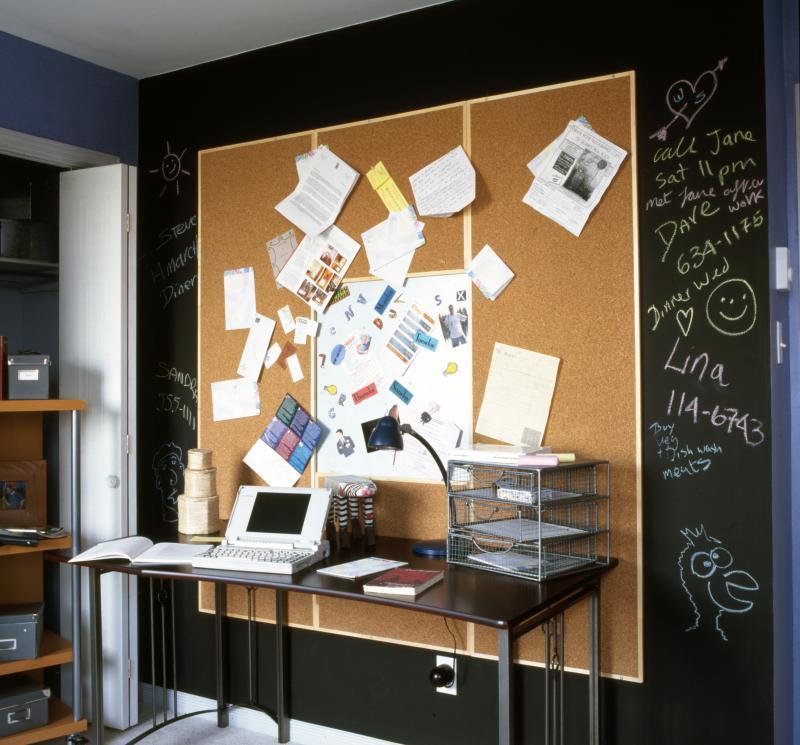
Having photos of family and friends in view will help keep the homesick blues away. If you can’t afford to frame them, find inexpensive ways to make sure they are front and centre. For example, in our feature room you could place one photo in each arm of the paper-clip wall clock to create a photo fan display. Inexpensive cork sheeting or bulletin boards can be painted in a co-ordinating colour and used as a photo or memo board. Even a simple wire strung along the wall or hung from the curtain rod or ceiling can display photos. Simply hang the photos from the wire using colourful clothes pins. Plastic clothes pins are readily available at dollar stores, but wooden ones can also be painted to match the room. You’ll probably need clothes pins for laundry day anyway, so use them to your decorative advantage. The photo display can be easily updated and changed at will. If you’re super creative, you can use craft wire that holds its shape to create a large wall design, then hang the photos from your creation (rather than in just a straight line). You might shape the wire into, say, a guitar if that’s your passion, just as one example.
Budget-savers
There are many items that you might already have on hand that can be used to make fun accessories and artwork. Coloured paper clips can be glued to photo frames, mirror frames, strung together to make colourful chains that can be used in place of beaded curtains or used to hang photos as mentioned above. If you have to buy binders for school, then purchase a colour that will co-ordinate with your space so they will look great on display and will be easy to access as well. Most students have some sort of computer, so use it to print favourite photos in black and white or to create a collage. You have to eat, so display fresh fruit, colourful pasta, rice and dried beans in decorative containers in the open as accessories in your eating space.
Wallpaper might be the last thing you want to consider, but you can frame it and use it as artwork. Check out the clearance bins and see what you might be able to find.
Inspiration
Use inspiring words or quotes to decorate your walls, furniture or accessories. Yes, you are finally allowed to write on the walls! (Just be sure you have permission from your landlord before painting or writing on the wall.)
Temporary quarters and a small budget don’t have to equal a boring space. Use your imagination to create a room that will be homey and inspiring for the school year to come. Good luck in your studies.
Connieoliver@shaw.ca
Renovation & Design
SOLUTIONS: Egging very aggravating
QUESTION — My house was “egged” a couple of weeks ago. The house is stucco — the kind that is troweled on, not the kind with little stones and pieces of glass. There are four circular blotches with stains running down where the egg white dripped. I have got all the dried egg off, but the stains remain. So far I have tried: dish soap, vinegar, graffiti remover (almost seemed to make it worse), and Arm & Hammer laundry soap (liquid). Any ideas? Thanks for any help. Kate, Winnipeg
ANSWER – Sounds like you are exerting tremendous effort into zapping this stain! The “protein” shadow that you describe is not only on the surface and therefore difficult to remove. Over time, sunshine will naturally either lighten or darken the stain (older stucco will likely darken). If the stucco is painted you may be best off purchasing a small can of paint and covering the area.
However, another option is to combine: 1 gallon warm water, 1 quart household bleach and 1 cup trisodium phosphate (TSP). Apply the solution to the entire area and lightly agitate with a soft bristle brush. Rinse thoroughly with clean water. Repeat until the stain vanishes. Although bleach is dangerous when combined with ammonia, research indicates that bleach may be combined with trisodium phosphate.
If the stain remains you may want to try a stronger product, test on an inconspicuous area first. Zap the stain with either oxalic acid and water or muriatic acid and water (use according to directions on the container). Muriatic is one of the most dangerous products available for household use therefore use caution. Oxalic acid is a bleaching agent and will work similar to bleach.
QUESTION — Thanks for your column in the Winnipeg Free Press each week, always interesting! I have a problem that needs a solution. My relatively new, front loading washing machine has an odour. Basically, it smells like wet clothes that have been sitting in a pile for too long. Leaving the door open after each load seems to help a little, but is not practical in the long run. Besides, I don’t like the idea of washing clothes in something that doesn’t smell clean. Any ideas you have would be appreciated. Sincerely, Carol, Winnipeg
ANSWER — It is great that you keep the lid open when the machine is not in use so that moisture can escape. Run 1-cup of vinegar through the machine at least once a week to kill the odour. Also, stop (if you are) using liquid fabric softeners. These tend to build up in the machine and produce a mouldy smell. Another favourite product for getting rid of the smell of musty machines is washing soda you can find it in the laundry department of grocery stores. It is called “So Clean”, by Arm & Hammer. This product is amazing at whitening and brightening fabrics. As a matter of fact, I like to add a one-quarter cup to each load of laundry when I wash whites (it contains no bleaches or phosphates). If you can’t find washing soda, use borax (both borax and washing soda are great for killing odours). Lastly, sometimes mould builds up inside the machine in places that are hard to get at. If the odour persists, call in a professional.
I enjoy your questions and tips, keep them coming! Check out my website! www.householdsolutions.org
Come and see me at the Winnipeg Autumn Home Show, Sept. 25 & 26 at the Winnipeg Convention Centre.
Renovation & Design
ASK THE INSPECTOR: Carpet in basement not always a good idea
Question: I would like to get rid of the wall to wall carpet in my basement, but am having trouble figuring out what to replace it with. Each vendor tells me something different. I’d like it to have a warm and attractive appearance. I have blond hardwood throughout my main floor, and would like to carry it down the stairs, but it doesn’t make sense to put hardwood in the basement.
Cynthia Stewart, e-mail
Answer: Unfortunately, carpets are not a good choice for installation directly over concrete due to the dampness often associated with cool basements. The carpeting or underpads have a tendency to absorb moisture and odours. In very wet cases, the carpets can become mouldy and may create a health hazard for homeowners susceptible to mould sensitivities.
The best way to prevent contact of carpeting, or other floor coverings, with cold concrete basement floor slabs is to install a subfloor. Traditionally, this consisted of thin strips of wood or “sleepers” which were laid directly over the concrete and covered with boards or plywood sheathing. Often the sleepers were made from cedar, which has natural resistance to rot but is still subject to moisture damage over time. The separation of the wood sheathing from direct contact with the concrete created only a partial thermal bridge and allowed a small airspace to prevent quick rotting from wicked-up moisture.
The separation and airspace allows for a much warmer floor surface to the touch and a much dryer floor to install carpeting. This system may work well for many years, but can quickly deteriorate if the foundation leaks or the sewer backs up.
A more modern approach to the use of untreated wood for this purpose is to use pressure treated plywood for the sleepers and the plywood sheathing. This will be very successful in preventing rot and mould growth, but may be a health concern from off-gassing of the chemicals in the treated wood into the living space.
Check with manufacturer’s specifications and local building officials before using large amounts of any treated wood or preservatives in your basement.
An even more recent approach to the problem of moisture damage and rot from subfloor contact with concrete is the use of specialized plastic membranes underneath the sheathing. These membranes are slightly raised with dimples or ridges that allow a good, moisture proof separation for the sheathing and sufficient space for air in the gaps between the ridges, which prevents trapping moisture underneath the subfloor.
The original installations were done by creative contractors who used exterior foundation waterproofing membranes covered by plywood or OSB. While these were somewhat effective, they typically had to be secured to the concrete, which did not allow for easy removal if excess flooding occurred.
Several manufacturers realized the value of this type of system and developed a hybrid that included the membrane already bonded to the sheathing.
The small size of the individual panels and the tongue and groove edges allow for very easy installation over most basement floor slabs. In most cases, securing the panels is not required and is a real benefit in case of a leak in basement plumbing pipes, hot water tank or sewer back-up.
Popular options like laminate flooring can be a good choice for the final floor covering in this situation as it is normally installed without permanent fastening and may be easily removed or sections replaced if damaged.
Every year there are many new products being introduced not only for new home construction but also for renovations or retro-fit situations like those in your question.
Care should be taken to employ new or old technologies that will work well in modern, well insulated and sealed homes without creating new problems like condensation and mould growth. I recently viewed the installation of one such new system designed by a local inventor for insulation of foundations that prevents moisture and mould growth. It works by employing a de-humidification system built into the design.
Ari Marantz is the owner of Trained Eye Home Inspection Ltd. and the President of the Canadian Association of Home & Property Inspectors - Manitoba (www.cahpi.mb.ca). Questions can be e-mailed or sent to: Ask The Inspector, P. O. Box 69021, #110-2025 Corydon Ave., Winnipeg, MB. R3P 2G9. Ari can be reached at (204) 291-5358 or check out his website at www.trainedeye.ca.
trainedeye@iname.com