Renovation & Design
Renovation & Design
Going for a modern kitchen? Think outside the box
QUESTION: We are building a new home and the kitchen cabinets are a toffee-coloured birch. We have decided on black-and-cream-mottled granite for the countertops and a cream-coloured porcelain tile floor. The overall look is modern. I am wondering what type of kitchen table and counter stool design we should look for.
ANSWER: When you are dealing with natural elements, you have a large range of options. The natural qualities of these materials lend themselves to embrace designs from contemporary to country and everything in between.
The options for kitchen furnishings are great. If you are inclined to develop a sleek, modern ambience, incorporate metal into your selection. Many outdoor-furniture shops have a wonderful assortment of tables and chairs that can be outdoor- and indoor-friendly.
You could select the table only and match chairs from a different vendor. These tables tend to have tempered glass tops which are removable, offering a unique design option which allows you to have a granite top custom-fitted. To avoid overuse of the countertop granite, select a stone with less pattern, but in one of the prevailing countertop colours.
Another design option is to look for a two-toned wood table. A black top with brown stained legs (or the reverse) offers a definite urban feel to a kitchen. A straight or unadorned tapered leg will reflect a contemporary statement, whereas a turned or fluted leg will give the space an urban-country flavour.
QUESTION: I have a landscape question. What should we consider for creating a low-maintenance yard? We have seen some yards that are devoid of grass and look really attractive, and then there are others that look like a desert wasteland. How do we make this project always look good without the effort?
ANSWER: Just like an indoor design project, a successful and professional-looking landscape project needs to follow the same principles of scale, balance, colour and texture. You need to view your yard (and home) in its entirety. Your home should be the focus, with interesting landscaping that incorporates secondary and tertiary focal points to complete the picture.
There are many landscaping materials that are low maintenance. A popular choice is the use of rock to replace grass. Although this is a natural and easy-to-care-for option, it needs to be viewed as a backdrop for your project and not the main event.
If a yard is predominantly rock, without the addition of other elements, the project ends up looking uninspiring and unprofessional. Look to add interest in height, colour and texture with the inclusion of trees, shrubs and perennial plants.
Develop your design as a professional florist arranges flowers in a bouquet: Use height in the back or middle, surrounded with mid-height blossoms and framed with low-lying greenery.
Plants and trees are not completely devoid of maintenance, but with the right advice these species tend to take care of themselves with little additional effort, once they establish themselves.
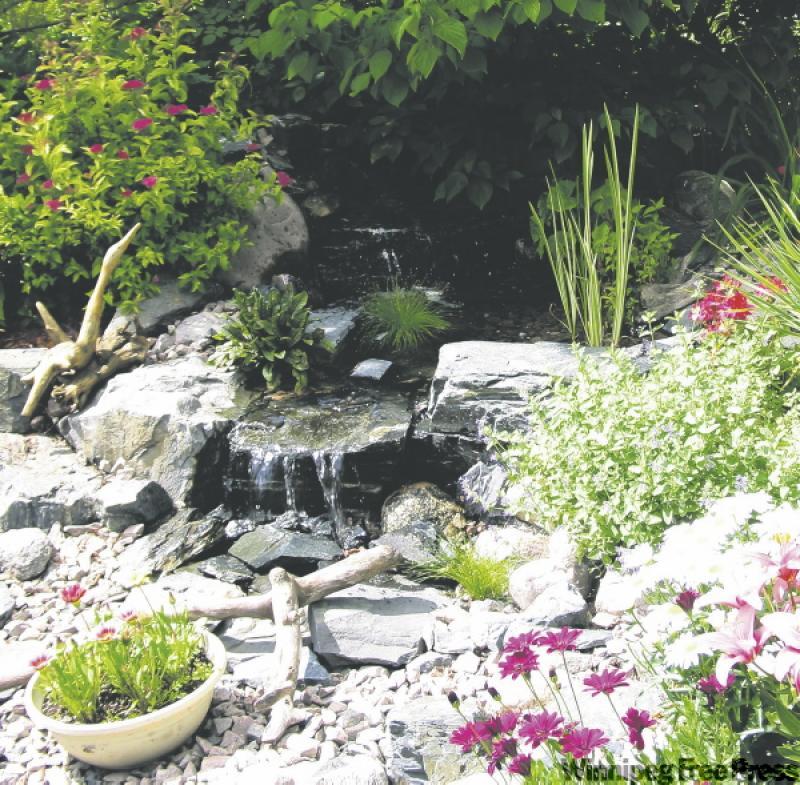
Trees and shrubs are important for an esthetically pleasing yard that is predominantly rock.
Select various species that provide seasonal variation with blossoms and leaf colour. This will create a visually interesting display year-round. Adding conifers (evergreen varieties) will also offer interest even during the grey and white days of winter.
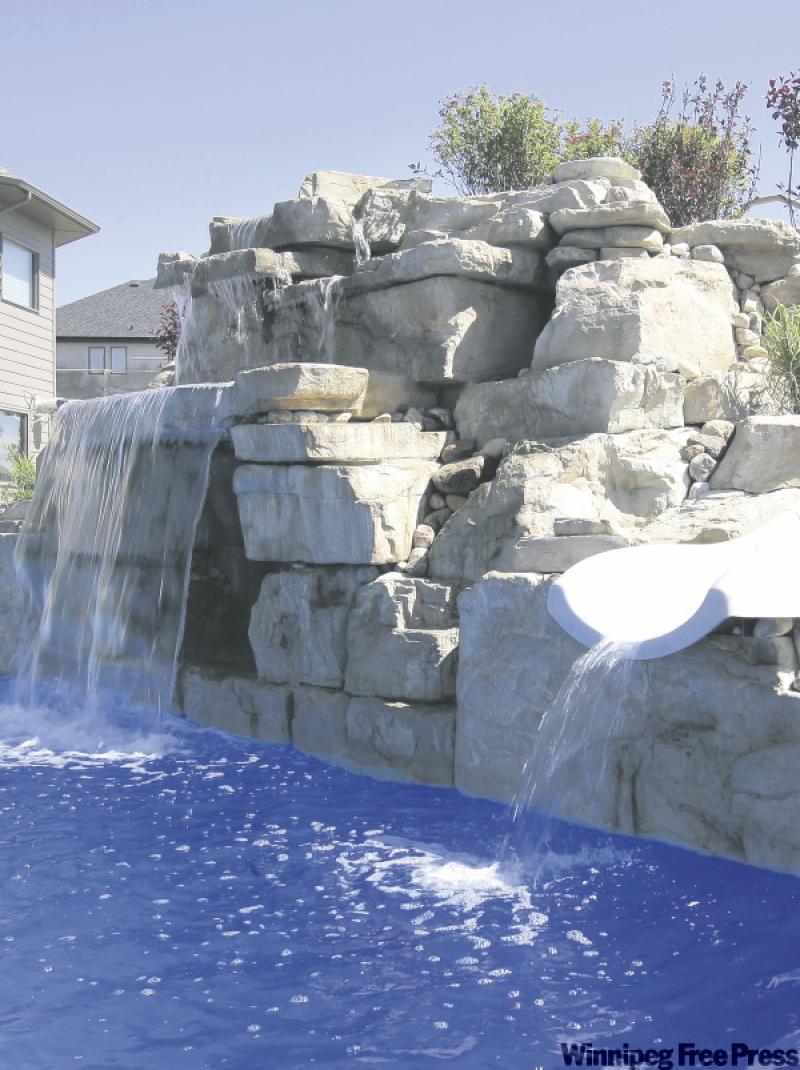
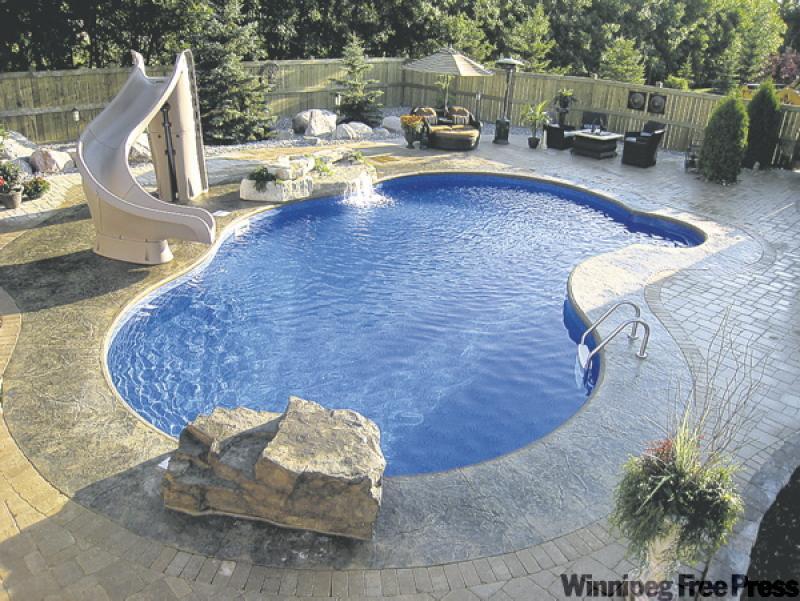
Large rocks, sculptures and waterfalls add interest to a yard, but their placement is very important. These elements will draw attention, so they must be considered as part of the whole project. Too often, homeowners add a sculpture or rock configuration that is simply incongruent with their home's style.
The expertise of a landscape or gardening specialist will be invaluable to achieving a professional look, even if you plan to do the bulk of the work yourself.
-- Canwest News Service
Leanne Brownoff is an Edmonton design consultant who welcomes your questions at www.leannebrownoff.com. Answers will be featured in her column, as high volumes prevent individual responses.

Renovation & Design
SOLUTIONS: Jersey got a rough ride
QUESTION: I would be forever indebted to you if you could advise on getting stains out of a green Roughrider jersey! I have two and when I purchased the second one I swore that I would not get it near food or drink. Well, guess what? The newest one now has stains on it. I always wash the jerseys in cold water and hang to dry. The stains are worse on the first one I bought (it has made the trip to three Grey Cups). I've tried dish detergent rubbed in, which works great on grease stains but doesn't even touch the other stains which I think must be either a beverage or drippings of food. Lynette, Russell, MB
P.S. Thanks for your tip on rhubarb tea - the ants in my yard have been sent packing - it worked! Haven't seen an ant since!
ANSWER: It's a little hard to advise you on cleaning your jersey because I am of course a Bombers fan. However I do feel for you and therefore I have a few suggestions. First of all, always wash your jersey right away to remove stains like mustard, ketchup, or beer. The longer these stains sit on your jersey the harder they will be to remove. Pre-treat them and then wash the jersey according to the label directions. Some store bought pre-treatment products can be too harsh for your official team jerseys, so homemade solutions like baking soda, vinegar, or plain seltzer are much better options. If I were you I would begin by making a paste of borax and water and applying it to the stained areas. Let sit for a few hours and wash. Or soak the jersey in enough water to cover the fabric, add 1 tsp. dish soap and half cup of borax. Soak for a few hours and wash. Mustard is a very tricky product to remove because it contains turmeric which is sometimes used as a permanent fabric dye. One solution that has had positive results is glycerine. Pour it onto the stains. Let sit and wash. Or scrub with a bar of Sunlight laundry soap.
When you put your jersey into the washer, make sure that you always turn it inside out. This will help to preserve the life of the numbers and logos on the front and back of the jersey. Whether they are sewn or ironed on, turning the shirts inside out will keep them looking newer longer. A famous costume designer says in her opinion 'Zout' is the best product on the market for removing mustard, ketchup and barbecue sauce.
QUESTION: I'm wondering if you can suggest something that will remove the residue of the double sided tape from a window insulating kit that was left behind on my wooden window frame after removing the plastic. I've tried the commercial products, but they have not worked. Short of sanding it off, which I hope to avoid, is there anything that will remove this awful yellow stuff, which is now several years old? -- Margaret, Winnipeg
ANSWER: Your best bet is to spray the area with WD-40. Let it sit for 10-15 minutes and scrape with a plastic putty knife and an abrasive cloth (not an S.O.S pad). After the area is no longer sticky, make a solution of dish soap and water and wipe the area well.
QUESTION: I have light buff limestone in my family room. The installer did not seal the limestone before installing and the grout has gotten into the pores of the soft stone. I do not know how to get it out and the floor looks very blotchy. It is driving me crazy and the floor installer will not do anything about it. Can you help? I will have to do it myself, but with what and which method? I don't believe the grout has gone in too deep. Thanks so much for your time. I will try anything. -- Leone, Gimli, MB
ANSWER: For this situation you will need a strong chemical to clean up the mess. You may want to once again try and call in the professionals. If you were just tackling a haze from the grout you could clean the area substantially with plain old vinegar and water. However this situation requires a stronger solution. One of the products that readers have shared is the best for this mess is Sulfamic Acid Cleaner from TileLab at Home Depot. If you are going to tackle this job on your own, take caution; use at your own risk and read the label. Also test the chemical on an inconspicuous area and ventilate the room. It will take some elbow grease, a nylon scrub brush, Scotchbrite pads and a plastic scraping tool. The clean-up of this mess will take a few hours and when you are finished, clean the area with plain old water.
Bite Back Tips of the Week:
* When deterring mosquitoes DEET is the most aggressive remedy but not everyone chooses to use such strong chemicals on their porous skin. You can make your own mosquito repellent by combining the following into a spray bottle: 4 quarts (4 L) water, 4 tbsp. (60 mL) lemon dish soap, 2 tbsp. (30 mL) original Listerine. Spray liberally (safe for small children).
* For the yard, instead of spraying poisons, burn citronella candles to repel the little critters. Or have a fan blowing near where you are sitting (mosquitoes don't like wind).
* Spray the yard with garlic and water.
* Build a purple martin or bat house.
* For humans; use Caress soap, avoid wearing perfume. Wear light-coloured clothing; eat an orange before going outside (mosquitoes do not like the smell of citrus).
* For pets; dip a rope in eucalyptus oil, wrap in a bandana and tie around your pet's neck.
* Mosquitoes do not like the smell of rosemary, marigolds and geraniums.
I enjoy your questions and tips, keep them coming!
Reena Nerbas is the author of the national bestsellers, Household Solutions 1 with Substitutions, Household Solutions 2 with Kitchen Secrets and Household Solutions 3 with Green Alternatives available online and in stores across Canada.
Renovation & Design
ASK THE INSPECTOR: Avoid hardwood and laminates in the kitchen
QUESTION: I have recently started to renovate my old kitchen. The old cupboards have been replaced with beautiful dark chocolate brown new ones. The old tiles from the backsplash have been taken out, revealing gaping holes and uneven surfaces. Before I have a new backsplash installed should I have it drywalled so it will be an even surface?
Also, I love the look of ceramic floors, however, I have been warned that dishes and the tiles can break easily if something falls on it. Also, I know it is cold on the feet. Are there any floors that you would recommend for a kitchen? The main floor of my house has lots of hardwood.
-- Rhonda Renovating, e-mail
ANSWER: I faced a flooring dilemma a few years ago, and decided to go with tile.
The first issue of the deteriorated plaster behind the backsplash is easily answered. It depends on the current wall condition and the type of covering chosen. If you chose a material like the removed ceramic tile, granite or cultured stone, repairs may be minimal. If you chose a laminate or similar backsplash, then new covering material will be needed.
Tile and other masonry products require a solid and stable surface for proper adhesion, but a few holes and unevenness should not be an issue. If the old plaster is soft or moisture damaged, then replacement should be done, regardless of choice of covering. If this is required, I would suggest choosing plywood or cement board, which will be much more moisture resistant than drywall. If the backsplash is to be covered with laminate to match a similar countertop, good one-side plywood should be installed to ensure a smooth surface and proper adhesion of the plastic laminate sheathing.
As for the flooring, the porcelain tile I installed in my own kitchen a few years ago was an excellent choice. It is extremely durable, moisture-resistant and attractive. The odd dropped plate or glass has broken, but that may have occurred on any surface. Only sheet-vinyl flooring with a thick backing may have prevented that infrequent occurrence.
I would recommend staying away from products like hardwood and laminate flooring that may become damaged and swell from standing water.
The issue of coolness is true with any masonry or concrete surface. This is most apparent on cool mornings when the flooring fails to warm as quickly as the surrounding air, but may be an advantage in warm summer weather.
The true issue with this may not be the surface temperature of the ceramic tile, but the firmness. The flooring material will be extremely hard and rigid and may lead to easier fatigue when standing for a long period of time. Wear soft-soled slippers or running shoes to solve both problems.
One other issue is the current condition of the subfloor and requirements for upgrades before the new flooring is installed must be evaluated. If your old vinyl flooring's surface is badly damaged or loose, removal may be required to secure the new subfloor properly before the tile installation. If the surface is relatively even, installing new sheathing over top of it may be possible.
It is absolutely critical to have a solid, proper base installed prior to the tiles to prevent movement and cracking of the rigid new surface. Cement board, wire and mortar, or newer plastic subflooring materials should be installed according to manufacturers' specifications prior to tiling. This may raise the floor up to 25 millimetres, so ensure that adjoining flooring is taken into consideration.
Beware of advice given by those who have little experience with masonry flooring. There are numerous homes with many types of natural stone or manufactured tile floors that perform well for decades and have exceptional durability.
Ari Marantz is the owner of Trained Eye Home Inspection Ltd. Questions can be e-mailed or sent to: Ask The Inspector, P.O. Box 69021, #110-2025 Corydon Ave., Winnipeg, MB. R3P 2G9. Ari can be reached at (204) 291-5358.
trainedeye@iname.com