Renovation & Design
Renovation & Design
ASK THE INSPECTOR: Sacrificial anode? How do you know about that?
QUESTION: If the hot-water tank comes equipped with sacrificial anodes, is it a good investment to have them replaced? Will this extend the life of the tank?
Rob Matthews, Winnipeg
ANSWER: You have asked a rather unusual question about something that very few homeowners even know exist. The answer to your question would be different if you lived outside the city, and I will address this issue with that in mind.
Sacrificial anodes are metallic rods that are installed inside water heater tanks to help prevent excessive corrosion of the metal tanks due to corrosive minerals often found in the water. The idea is that the corrosive minerals will attack the bare, uncoated rod before the tank, which may be lined with fibreglass or other coatings to help protect the inner surface. These rods do have a limited life expectancy and should be replaced on a regular basis, but the need for this will depend on the water quality in your home.
Inside the City of Winnipeg boundaries, we have exceptionally soft water that contains very few minerals, which is why our water heaters and plumbing fixtures last for many years. The straight answer to your question is no, you shouldn't need to replace the anode on your water heater, as it may not deteriorate much over the life of the tank.
If you live outside the city and have well water or municipally treated water that is high in minerals, especially lime, then regular replacement of the anode is an excellent idea. Even if you have a salt bath water softener or iron filter, you may still find that excessive minerals can be seen building up on the plumbing fixtures. Also, if your water has a strong mineral odour when a faucet is opened, it's advisable to regularly change the anode.
The difficulty in changing this protective element of your water heater is to know when it is damaged to the point of being ineffective. It's normally accessed by loosening a bolt at the top of the tank that is attached to the rod. It is advisable to shut the water-supply valve to the tank and partially drain the tank to prevent leakage. If the water is heated by electricity, the power must be shut off prior to any draining, as the elements can very quickly burn out if they become dry. For a gas-fired unit, the temperature on the thermostat should be turned to the lowest point before any water is drained.
As previously stated, requirements for maintenance on water heaters may vary considerably depending on the water quality in the home. With soft city water, rarely is draining or replacement of anodes required, but with hard well water, maintenance is necessary. This may include replacement of the anodes, but also will require periodic draining of water to help clear minerals from the bottom of the tank.
With very hard water, considerable mineral deposits may develop in the bottom of the tank. Elimination of these deposits by periodically flushing the tank, removing the bottom electric element and physically extracting the clumps of minerals may help extend the life of the unit. In some cases, the mineral buildup may cause damage to the bottom element due to contact. If this occurs, replacement of the element after clearing the debris will improve heating performance and capacity.
While replacement of sacrificial anodes will help prevent premature corrosion of the tank, regular maintenance of water-softening equipment is also very important. Following the manufacturer's instructions for maintenance as well as adding salt regularly to the softening system will be critical for proper function. If these items are neglected, not only will the water quality in your home suffer, but the life expectancy of the water heater, metal faucets, drains and other components of the plumbing system may be negatively affected. I have seen homes in certain areas where the chrome and brass in faucets are literally eaten through by the corrosive minerals in the water.
Just like any system in your home, water-heater maintenance is important to maintaining the longevity and performance of the component. This maintenance may include changing of the sacrificial anode in your tank, but water-quality control is just as important in this case. Surprisingly, within the area serviced by the Winnipeg municipal water supply, this is not an issue. The water quality is excellent to begin with and any treatment of the water that is required is done at central facilities and not normally necessary for the average homeowner.
Ari Marantz is the owner of Trained Eye Home Inspection Ltd. and the president of the Canadian Association of Home & Property Inspectors -- Manitoba (www.cahpi.mb.ca). Questions can be emailed or sent to: Ask The Inspector, P. O. Box 69021, #110-2025 Corydon Ave., Winnipeg, MB. R3P 2G9. Ari can be reached at (204) 291-5358 or check out his website at www.trainedeye.ca
trainedeye@iname.com
Renovation & Design
SOLUTIONS: Try mayo or toothpaste to save table top
QUESTION -- I put a hot dish on my oak dining table and it took the finish off. Is there a way to get rid of the white mark without restaining the table top? I would really appreciate hearing back from you. Thanks kindly. Sherry, Winnipeg
ANSWER -- It depends on how deep the heat penetrated the wood. Begin by blow drying the area. This may be all you need to do. If the spot remains, wipe the area with either mayonnaise or non-bleach, non-gel toothpaste. Leave for about an hour and wipe off. If the mark is not deep it will disappear. If the mark is still there, you can lighten the area by applying oxalic acid or a product that contains oxalic acid. Many furniture restoration professionals sell these products and should be able to help you select a product best suited for your needs. Oxalic acid will bleach the wood so be aware that once the water mark is removed, you'll probably have to refinish the piece. Test on a hidden spot.
QUESTION -- I have a black gas stove (that I really love) but would like to find something that cleans the black stovetop without using harsh scrubbers or chemicals because I am afraid to damage the surface. It would be nice to also do this without streaks! Is this covered in any of your three books? If not, any ideas? Thanks so much, Brenda (Russell)
ANSWER -- Using a good quality micro fibre cloth, wipe your stovetop after each use when it has cooled. Clean burners with dish soap and a plastic scouring pad. Stubborn cooked-on spills can be cleaned with a mild abrasive cleanser that you can make yourself by combining 50/50 borax and baking soda. If the spills are difficult to remove, allow the baking soda and borax combination time to sit on the food stained area before scrubbing it with a plastic scouring pad. Wash removable burner grates in a sink full of warm, soapy dishwater with a plastic scouring pad. Rinse all parts with warm clear water and dry.
Be careful to avoid the gas ports on your burners. If they are plugged use a toothpick to clean the ports, or brush gently with a soft-bristled brush. For pilot-less stoves, check the port and area below the igniter wire and clear it as well. Debris left under the igniter can keep the gas burner from lighting. To remove streaks combine 50/50 vinegar and water and wipe stove top.
QUESTION -- We have just recently purchased a used tent trailer and it smells like mothballs and it has been stored since 2008. Is there something that could get rid of these smells? Your help is greatly appreciated. Christine, Winnipeg
ANSWER -- You may want to consider renting an ozone machine. This little machine is not recommended for regular use but it is great for enclosed areas that have had smoke or flood damage or just smell. The machine lets out a molecule called O3 (which of course is oxygen with an extra molecule attached). The third molecule escapes into the air and absorbs all odours. These machines can be rented at tool rental retailers as well as some hardware stores.
If the machine is not an option for you, the best idea is to overpower your home with another smell but something not damaging to your health. If I were you, I would visit a gift shop or candle shop and purchase a bunch of soy candles. I have a few soy candles that carry a nice long-lasting scent without even being lit. If you choose a soy-based candle, make sure that you put it into a votive because as it melts it needs to be contained. Put several of these around the trailer and soon your summer home will smell nice. Wash everything including window treatments with a combination of vinegar and tea tree oil. Rinse with water. Lastly, the most obvious suggestion, which is to leave the windows open as much as possible.
Fabulous Tip of the Week:
I received this tip while in Europe. To keep cheese from going mouldy, wrap it in wax paper.
To prevent broom handles or metal vacuum wands from marking walls, put old socks over the ends. Both tips submitted by Kathy Felgate.
When oven spills occur, quickly pour a generous amount of salt onto the area. Wait about an hour and wipe up. The salt will absorb the spill and make clean-up a snap! Submitted by me: Reena Nerbas
Reena Nerbas is the author of the national best sellers, Household Solutions 1 with Substitutions, Household Solutions 2 with Kitchen Secrets and the BRAND NEW Household Solutions 3 with Green Alternatives available online and in stores across Canada.
I enjoy your questions and tips, keep them coming! Check out my website! www.householdsolutions.org
Renovation & Design
Five easy ways for homeowners to beat the heat
Awnings
A simple and affordable way to cool a home is the use of awnings. The great appeal of awnings is that they are a natural way to cool without the need for air conditioning or tinted glass. A deployed awning blocks out the sun's rays while admitting daylight and allow air to circulate between the interior and exterior.
Awnings help to protect furniture from fading due to sunlight. They are cost-effective because they need no energy to operate. By keeping the house cool, awnings reduce the use of an air conditioner. Awnings can reduce the heat gain up to 65 per cent on south-facing windows.
Trees
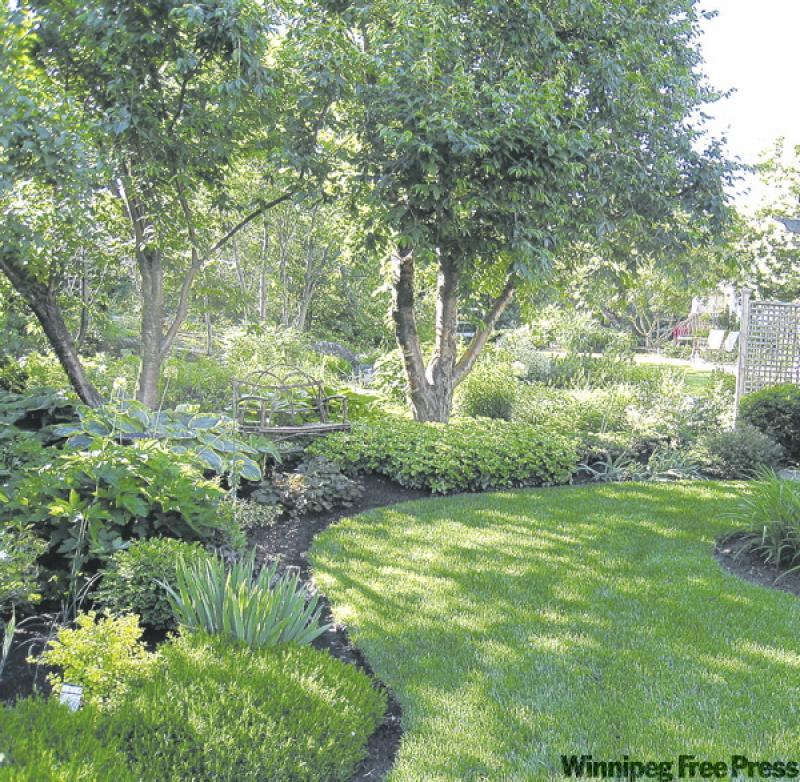
Homeowners should also keep in mind shade that comes from nature. When planted south or west of a house, deciduous trees will shade a house in the summer and allow light through in the fall and winter after the leaves have fallen.
Trees large enough to shade a whole house include ginkgo, maple, magnolia, horse chestnut and black locust. Ginkgoes can reach 13 to 15 metres, maples and locust nine to 12 metres.
Blinds
Window blinds help diffuse and block the sun's rays while serving as a decorative element in a room. The two most common blinds are cellular and vertical sheers.
Cellular blinds can come equipped to drop from the top as well as rise from the bottom, and have an R-value (a measurement of insulation) of 3.2, lowering heat loss in the winter. A four-foot by five-foot window would cost approximately $340.
Sheers have an openness factor from one to 14 per cent. Vertical sheers with closed vanes can block up to 99 per cent of the sun's UV rays. Vertical shears can cost between $600 to $750.
Overhead Fans
These devices don't cool the air -- they move air over the skin, which makes it feel cooler. With units as low as $100, overhead fans are a cost-effective method of moving air in a room.
A basic fan weighs only 4.5 to seven kilograms and can be mounted on a ceiling box that formerly held a ceiling light. Basic units are operated by a simple pull chain and more deluxe ones by a hand-held remote control.
Evaporative coolers
Those who can't or don't want to use air conditioners might consider an evaporative cooler, also known as an air cooler.
These devices cool the air blown over its surface through the evaporation of water. Evaporative coolers are suited to climates where the summers are hot but the humidity is low.
At $130, the units are cheaper than a refrigerative air conditioner, which works by drawing moisture out of the air. Without water, the evaporative coolers functions like a fan.
-- Canwest News Service