Renovation & Design

Renovation & Design
ASK THE INSPECTOR: Don't use wood to damp-proof foundation
QUESTION: I wanted to know your opinion on waterproofing a 1960 basement foundation. We are planning on doing only two sides of our foundation and the other two in about five to eight years. We can’t afford to do it all at once.
The house is a three-level split, with only about four feet below grade. We had some leaking around the joists as we graded to high outside. This problem has been fixed by an epoxy injection on the inside and by lowering the grade outside. We would like to waterproof the foundation for peace of mind.
Is a Delta brand membrane a good option for our climate? The other quotes we have received include a paper application with the sprayed on rubber type material and another one that applies a wood on the outside and additional material for a seal. Any information you can shed on this type of work would be greatly appreciated.
— Karen Joyal, email
ANSWER: Repair to foundations and reinstallation of damp-proofing is quite common on homes after they hit the 40-year milestone. Yours may be a little more complex due to the multi-level design of the home and the low-lying floor system, but the methods of repair may be quite similar to a single-level home.
Most concrete foundations, especially those over 20 years old, use a simple method to prevent saturation of the semi-porous concrete from exterior moisture. Most have a bitumen-based damp-proofing material sprayed, rolled or trowelled over the fresh concrete before backfilling. This asphalt-based material may be installed by itself, or with an embedded membrane or mesh to prevent deterioration. It may also be covered with rigid foam insulation or protective sheathing to prevent damage from backfilling, but is often uncovered. Along with weeping tile, installed near the footing below the foundation wall, this thin membrane is the main protection the concrete foundation has from moisture intrusion.
This method has been successfully used for decades and works well, but may have a limited life expectancy, certainly less than that of the concrete foundation. Frequent movement of the soil outside the foundation, caused by seasonal temperature changes and freeze-thaw cycles, can wear away this thin foundation coating. After several decades, water may begin to permeate the concrete in areas where the coating is worn or small cracks or holes have opened. This is particularly problematic in older homes where weeping tiles have become blocked. The only real solution is to excavate around the perimeter of the foundation and redo the membrane and weeping tile systems. There are several newer products available, but the bitumen-based membrane system is still used.
The “Delta” membrane is well suited to our climate, but may be the most difficult option to properly install without complete excavation around the home. This very durable material prevents moisture absorption by the concrete foundation. The dimples provide added strength to the membrane while providing a small drainage plane between the bumps. This allows any moisture which seeps behind the membrane a route of escape. There are several manufactures of similar products.
A third option is a self-adhesive, rubberized membrane often called “blueskin” because of the blue colour of one of the major manufacturers. This material is very pliable and highly resistant to moisture. It is often used along with rigid foam insulation or other sheathing over top to prevent damage from backfilling.
While it may seem either of the two types of membranes may be superior to the bitumen based coatings, they are not nearly as widely used. On new homes, the reason is normally an economic one. Some foundation contractors have told me that they have difficulty adhering the membranes to older, uneven foundations. They often prefer the trowel or roll on products due to their ease of application for complete coverage of the foundation. Most will also add an embedded layer of mesh or other material to give added durability and strength to the foundation coating.
Using a paper or wood-based product below grade is a bad idea. It may be subject to rot or moisture damage. Pressure treated plywood is sometimes used to protect a foundation coating or membrane from soil damage, but that is not typical.
Ari Marantz is the owner of Trained Eye Home Inspection Ltd. and the President of the Canadian Association of Home & Property Inspectors - Manitoba (www.cahpi.mb.ca). Questions can be emailed or sent to: Ask The Inspector, P. O. Box 69021, #110-2025 Corydon Ave., Winnipeg, MB. R3P 2G9. Ari can be reached at (204) 291-5358 or check out his website at www.trainedeye.ca.
trainedeye@iname.com
Renovation & Design
The new neutral
Sharon Grech knows a thing or two about colour and she's not afraid to paint her walls to prove it.
Hues inside her home range from a golden tan to a tawny orange to a dark purple-brown. She'll probably switch it up again in a couple of years to keep her interior current.
"Buying a gallon of paint is a lot less expensive than buying a whole bunch of (new) cushions," says Grech, a colour expert with Benjamin Moore.
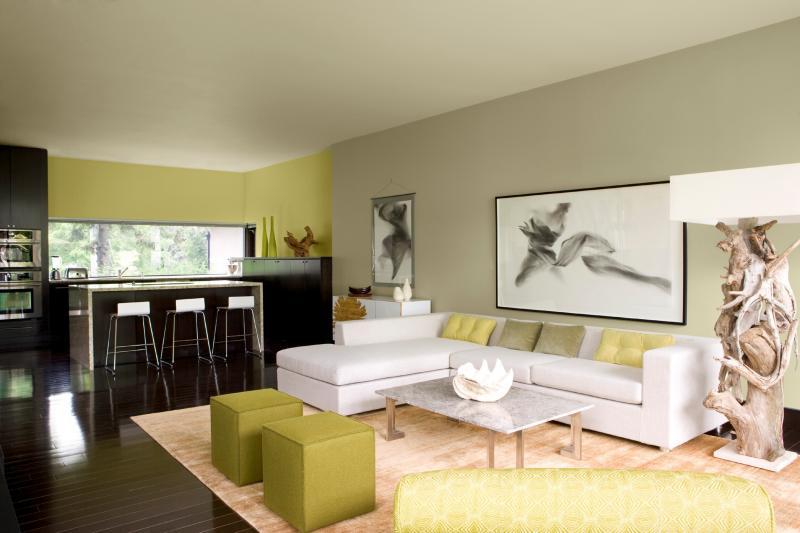
Benjamin Moore's up-and-coming colours for 2009 has a shade for everyone, from blushing red (a Caribbean-infused hot pink) to white sand (a barely-there beige). But two hues of note showed up on each of three palettes: grey and green. "We've been really seeing grey taking over from that beigy neutral," says Grech.
Grey, in turn, has helped usher in a flood of cool colours that look great paired with it, from the purples and aubergines of last fall to the blues and, especially, greens popular this spring. Be it pale avocado, brookside moss or dry sage, this all-natural shade has been so popular the past several years, it's becoming a neutral too, says Grech.
Para Paints recently rolled out 18 new hues, including a steely grey called digital and a grey dubbed treadmill.
General Paint's colour card for 2009 features pale powder, a washed-out grey-blue, and harlequin, a dark charcoal-navy. An eclectic mix of purples, blues and browns round it out.
"Colour experts search the world for inspiration," says Yvonne Provencal, the company's brand and creative services manager.
"It could be the kingfisher blue of an Indian sari, the sleek shine of a copper bowl or an elusive shade of grey found in a stormy sea.
One global concern of late has been the environment, whose go-to colour is, surprise, green. So intertwined are the colour and the concept, "We talk about green even when we don't mean the colour now," says Grech.
So, is the rise of grey, like a thunderous sky, a metaphor for the sodden days of recession? Not at all, says Aly Velji of Alykhan Velji Design in Calgary.
"Greys are becoming huge in interiors now because they are little more complex. Greys are no longer reminders of dark and stormy days, but of more sophisticated colour palettes. We are seeing greys as all-around wall colours, in flooring and furniture," he says. "It's the new neutral and works with so many other colours."
-- Canwest News Service