Renovation & Design

Renovation & Design
SOLUTIONS: Very bad hair day: Can't wash out tree pitch
QUESTION: I hope you can help me with a sticky problem. My hair got dripped on by a big old fir tree and now it is standing straight up at the back. The pitch just won't wash out with shampoo. I hesitate to try coal oil, which I think is an old remedy. It would probably be effective but burn my scalp in the process. Help, help!
-- Anne, Winnipeg
ANSWER: Mayonnaise is your best bet. Rub it into your hair, wait about 20 minutes and rinse. Not only will this help with the sticky mess but it will condition your hair at the same time.
QUESTION: I have a wooden curtain rod on which the wooden curtain rings stick and "shudder" when pulling the curtains open or closed (I've actually pulled the curtains off the end rings by the yanking they require). How can I best get these non-compliant rings to move smoothly over the curtain rod? Is WD-40 an option or will it become sticky over time?
Margaux, Benito
ANSWER: Rub a bit of furniture polish on clothing rods so that hangers slide easily. Candle or paraffin wax will have the same effect but are more difficult to apply. Although I don't think that WD-40 will become gummy, it will smell for a while, and you don't want that odour on your clothes.
QUESTION: I listened to you on the radio and recall you giving a tip on how to clean BBQ grease stains from a wooden deck. Can you send me an environmentally friendly way to do this?
Greg, (Selkirk)
ANSWER: In terms of grease stains on a deck, if the deck is not sealed the grease may be impossible to remove (unless the deck is sanded down and refinished). If the deck is sealed, your best bet is to clean the area with one of the following: TSP (trisodium phosphate), washing soda or a commercial deck cleaner (powder is more effective than liquid). Or on a sunny day, make a paste of baking soda and rubbing alcohol (test on an inconspicuous area). Apply to the grease stain. Cover with a black piece of sheet metal. Leave in direct sun for 90 minutes. Lift the metal and remove the dried paste; wash with vinegar and water. Wash again with detergent and water; rinse. If the stain remains, sand and re-stain. Taken from Household Solutions 2 with Kitchen Secrets.
QUESTION: In one of your books I came across the recipe for your 'Super Smelly Jelly' and was wondering if this would work well as an air freshener in my living room and bedroom? Currently, I purchase air fresheners and as you know, they are incredibly expensive and last only 30 days. I know things must stop smelling nice eventually but I have six mobile air fresheners in our place so it is an expense and I want to explore a better cost-effective solution that will provide the same results. What are your thoughts on this?
Barbara, Winnipeg
ANSWER: The 'Super Smelly Jelly' recipe is great for small areas such as bathrooms, lockers and cupboards. The most effective way to keep your air smelling fresh is to purchase an air purifier. Research Consumer Reports before making a selection. You may be happiest with an air purifier that does not have a filter but instead a carbonized screen. Setting out rose bowls filled with vinegar and floating candles is a tricky yet effective way of absorbing odours. As well, a bowl of unused charcoal briquettes also absorbs odours. Or use cat litter to absorb smells, put it in a decorative vase or a candleholder. One of my absolute favourite solutions is to find a small piece of corrugated cardboard (you can just rip it off of a box). Sprinkle the cardboard with your favourite essential oil, i.e. cinnamon or tea tree oil or lavender. Leave it in a room; it smells great and if you do choose cinnamon, people will think that you just baked!
You might also check out purchasing a diffuser that you can plug into the wall and add some really nice-smelling essential oils. Essential oils are very therapeutic and make great homemade spritzers. You can make up several different scents to keep on hand for different areas of your home. Just use one part oil to at least four parts water.
Fabulous Tips of the Week:
Devilled Egg Delight! Put cooked egg yolks in a sealed zip lock bag. Mash until smooth. Cut off the corner tip of the bag and squeeze mixture into cut egg white halves. Discard bag when finished.
If you can't eat grapes fast enough after purchasing them, freeze them. First wash and air-dry (not you, the grapes); lay them neatly on a cookie sheet (not touching each other). Place the tray in the freezer. When the grapes are frozen, transfer them to a freezer bag or airtight container. Store in the freezer and just take out what you need. Eat them as is or add them to things such as yogurt, smoothies and ice cream.
I enjoy your questions and tips, keep them coming!
Reena Nerbas is the author of the national bestsellers, Household Solutions 1 with Substitutions, Household Solutions 2 with Kitchen Secrets and the BRAND-NEW Household Solutions 3 with Green Alternatives available online and in stores across Canada.
Check out my website! www.householdsolutions.org
Renovation & Design
ASK THE INSPECTOR: Moisture problems in fibreglass insulation?
QUESTION: About 10 years ago, a sunroom was attached to the back of my house, with access from the back door. The floor level of the room is about 12 inches from ground level. The floor was insulated with yellow fibreglass batts. The walls and ceiling have been finished and now we want to install vinyl flooring to make it complete. Before we install flooring, I was wondering if we should be changing the insulation to something rigid or if the fibreglass is fine. My concern is with the fibreglass getting wet and causing problems in years to come. If we need to change the insulation, how would we go about doing it, as we can't work from underneath?
Thanks,
Diane Nichol, email
ANSWER: Fibreglass batt insulation will not rot or deteriorate when it gets damp, as it can hold a considerable amount of moisture, due to the large amount of airspace between the strands. But if the batts remain wet for long periods of time, it can accelerate rot of the floor joists.
The first thing to consider is whether the sunroom is to be heated or not. If you don't plan to use the room in the winter, the insulation under the floor should provide little concern, or benefit. If the building is not heated and the underside of the floor joists is open to the air year-round, there should be little chance of the insulation becoming wet from condensation.
There is some possibility it will get wet from contact with melting snow that blows under the area in the winter, but that should easily be controlled. Removing excess snow around the sunroom in the early spring or putting up temporary skirting to prevent blowing snow may eliminate that issue. Be sure to remove the skirting after the snow melt to allow the damp soil under the area to dry. In that case, leaving the batts where they are should not create a problem, except to provide a possible haven for mice or insects.
If the sunroom is to be used in the colder months and heaters are installed to make it habitable, then heating the room above the crawlspace may cause the flooring to become considerably warmer than the outside air. Insulating this floor with fibreglass batts will not prevent warm-air loss to the underside of the sheathing, but will slow it down, unless a really well-sealed air/vapour barrier was installed. This warm air may condense inside the insulation, as it cools, creating a moisture and frost problem when the weather warms.
This may or not be a big issue, depending on the amount of heating and the air leakage in the rest of the addition, but could cause premature rot in the floor joists and sheathing, if they are not pressure-treated. If this matches your usage, replacement with foam insulation may be warranted.
Another item to address is the need for floor insulation, in the first place. Whether you heat the addition or not, insulation in between the floor joists will do little to make the room more comfortable and will not prevent much heat loss. Because of the fact that warm air rises, even a well-insulated floor may be uncomfortably cold in a situation like yours. This cannot be solved simply by adding or changing the floor insulation.
The solution to this is to remove the insulation from the underside of the floor and replace it with well-insulated skirting around the perimeter of the crawlspace. After that is done and a good air/vapour barrier is installed over the insulation and soil at the bottom of the crawlspace, adding heat to the crawlspace will complete the job. In that situation, heating the crawlspace will warm the underside of the floor sheathing and the insulated skirt will prevent cold-air infiltration, which would make the floor feel even colder in your current configuration.
It may indeed be difficult to complete any work under the floor due to the limited space available. Because you have not installed floor covering in this area, it may be possible to pull up some sections of floor sheathing to allow access to the crawlspace and the dirt floor below. This will be easier if the sheathing was screwed down, as the screws may be backed out using a power drill or drywall gun. Once the underside is exposed, much of the insulation and air-sealing work could be completed after the perimeter skirting is installed from the exterior.
I would suggest leaving the floor alone unless you plan to heat the building for cold weather use. In that case, a complete renovation of the underside, including insulated skirting and heat, will be the way to go.
Ari Marantz is the owner of Trained Eye Home Inspection Ltd. and the president of the Canadian Association of Home & Property Inspectors -- Manitoba (www.cahpi.mb.ca). Questions can be emailed or sent to: Ask The Inspector, P.O. Box 69021, #110-2025 Corydon Ave., Winnipeg, MB. R3P 2G9. Ari can be reached at (204) 291-5358 or check out his website at www.trainedeye.ca
trainedeye@iname.com
Renovation & Design
Are you involved in a thermo-spat? Here's how to chill out
"Don't open that window! I'm cold."
"If you're cold, put on a sweater. It's warm and stuffy in here. I need some air."
Sound familiar?
Nearly half of all Canadians report domestic discontent over the temperatures in their homes, according to a recent Angus Reid survey conducted for Direct Energy. And, is it a coincidence, the company asks with a little levity, that the divorce rate in Canada is 44 per cent?
The conflicts may be rooted in the fact that 63 per cent of male respondents reported that they were in charge of the thermostat in their home, while 67 per cent of women reported the same finding.
Talk about potential for a cold war.
Thermo-spats, as the Direct Energy survey calls them, can be avoided in a few ways.
One way, suggests Dave Walton, director of home ideas, is to sit the entire family down to discuss the cost of heating and cooling, and to come to an agreement on a constant temperature everyone can live with.
So much the better if you can agree on ways to make your energy consumption habits more energy efficient, something 86 per cent of respondents said they were motivated to do to save money.
Some of Walton tricks are pretty simple.
"If they do little things, like caulking around windows, homeowners, over the course of the year, can save 20 to 30 per cent," Walton says.
Walton is also a big proponent of getting an energy audit, something for which homeowners can get a portion rebated from the government.
"And, you'll recoup your outlay when you make the changes suggested," he says. There are further rebates for some of the work that will be suggested. He says you should consider getting an energy-efficient air conditioning unit -- more rebates available -- as well as having your central air conditioner checked.
"Equally important, from a maintenance perspective, are the little things like keeping curtains and toys from blocking the registers and using blinds to keep the heat out," he says.
Direct Energy also advocates ceiling fans, which are a good way of keeping a particular room cool, and programmable thermostats. With the latter, you can program your unit to be off when everyone's at school and work, and have it come on as you're driving home.
Walton also suggests turning the air conditioning off, or temperature up, at night. Even a five-degree difference can save 10 per cent on the energy bill.
For more information visit www.directenergy.com.
-- Canwest News Service
Renovation & Design
It's not a deck -- it's a customized summer home
It is the ultimate icon of summer.
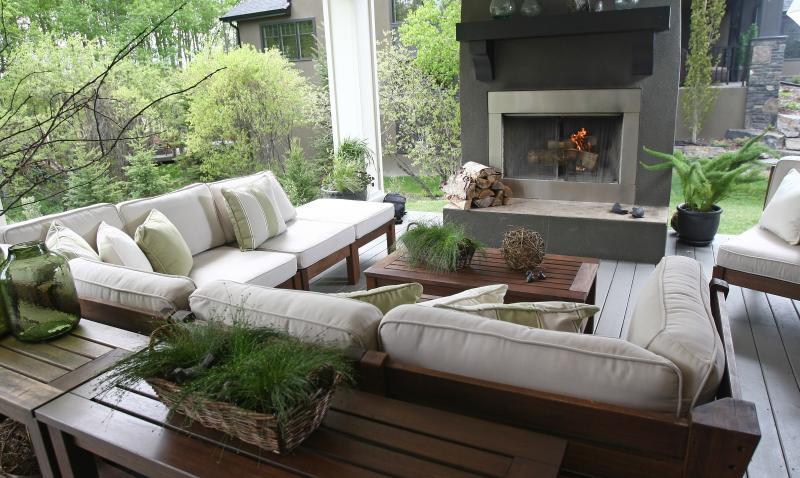
The ubiquitous backyard deck, topped with a barbecue, dining table, maybe even a hammock, is where homeowners love to chill during the hot months.
What began 30-something years ago as a functional platform from which to view the garden is evolving into a highly designed space to rival indoor rooms.
Stephan Beaulieu, owner of Patios et Clotures Beaulieu in Montreal, says the homeowners who hire him to build their decks are influenced by current trends in kitchen design in which zones are created for specific functions.
"I always ask my clients if I can see the inside of their homes," Beaulieu said. "I want to see their space and how they live in it. It's a good place to start."
"They want an area for entertaining guests, a cooking area for the barbecue and they might also want to have an area for a little bistro table where they'll eat breakfast, as well as one for a large dinner table. They want to transfer the feeling from inside the house to the outside."
Moreover, the classic deck design that encompasses a railing and spindles is giving way to a more open look, he says.
As people have embraced gardening and beautified their yards with plants, Beaulieu says, few want to have their view of perennial borders and ornamental ponds obscured by deck spindles.
"Some people are replacing the spindles with tempered glass panels that have black metal railings," he said.
Beaulieu calls it "a simple tweak" that permits a sense of openness rather than enclosure and one favoured by mothers who want an unimpeded view of their children in the swimming pool.
Storage benches are also being integrated into contemporary decks, he said.
"We're also doing integrated hot tubs and built-in bars."
Mike Tustin, a contractor and owner of Supreme Sundecks in Pointe Claire, Que., says decks are getting bigger.
"They used to be little boxes when I started building them 20 years ago. Now, people want to live on their decks. Young families are building them with gates to keep their small children in."
And, says Tustin, many homeowners want way more than just a flat platform.
"I'm seeing a lot of screened gazebos being built on decks," he said. "We build pergolas and benches. Decks are not just platforms anymore."
Nor are they boring rectangles.
Stephan Beaulieu is being asked to create decks with rounded edges, a seemingly impossible feat he pulls off by cutting thin strips of cedar, which are laminated to make them malleable. Homeowners who are conversant with the principles of feng shui want curvaceous edges on their decks to facilitate the flow of chi (energy) in their backyards, he says.
"When you're building rounded decks, you have to take your time to create fan-shaped joists," he said. "I use cedar because it has a long wood grain that allows it to be bent."
Tustin says the era of the square or rectangular deck has given way to hexagons and octagons.
"I'm also seeing wraparound stairs," he said.
Beaulieu, a former high school teacher who began building decks in 1998, says most of his clients are requesting decks made of untreated wood, such as cedar.
"When I started, 100 per cent of my clients asked for pressure-treated wood. Now, it's only 10 per cent. Fewer people are asking for pressure-treated wood because of environmental concerns. Also, in time, it twists."
He says cedar stands up well to the elements.
Beaulieu discourages his clients from having multi-level decks.
"When you have more than one level, you'll always be telling your guests to be careful of not falling off," he said.
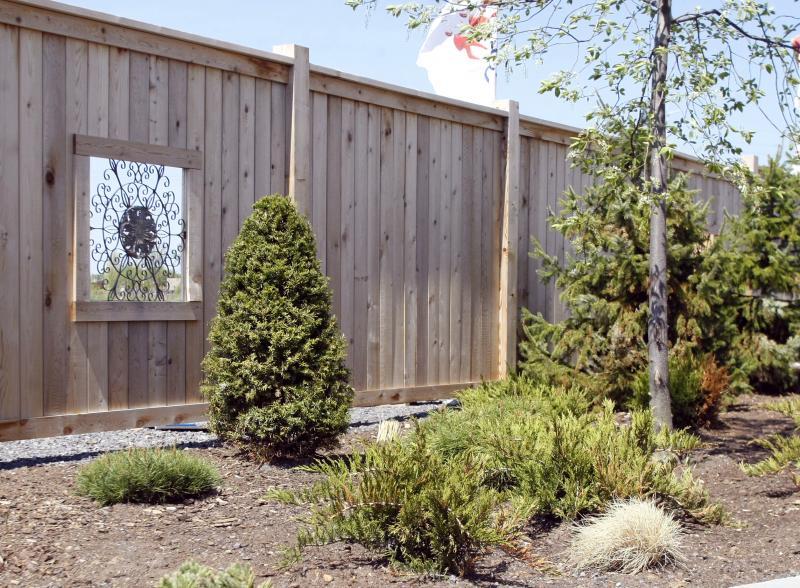
Privacy is a key concern of homeowners, particularly on small building lots, says Beaulieu, which is why many are opting for ground-level decks and privacy screens made of trellis or lattice.
"Smaller is better, and as low to the ground as possible is ideal," he said.
The floor space of today's decks is generally larger than it was a decade ago.
"A 12-by-14-foot deck was standard eight or 10 years ago," Tustin said. "Now, people are opting for larger decks because they're buying more stuff to put on them. So they're 12-by-18, 12-by-20 and 14-by-16 feet."
Some homeowners, he says, are requesting decks made of composites, materials made of wood chips and plastic.
"It's for non-maintenance," said Tustin, who confesses he prefers natural materials. "Composite is not wood."
"I don't like composite material," Beaulieu said. "It cannot be recycled at the end of its lifespan, and it eventually changes colour with exposure to UV light."
-- Canwest News Service