Renovation & Design
Renovation & Design
Glass and mirrors --versatile and timeless
DEAR Debbie -- I've seen a lot of glass and mirror in kitchen displays and wonder if they are just for show. What a cleaning nightmare! Would you use them in your kitchen?-- Marisse
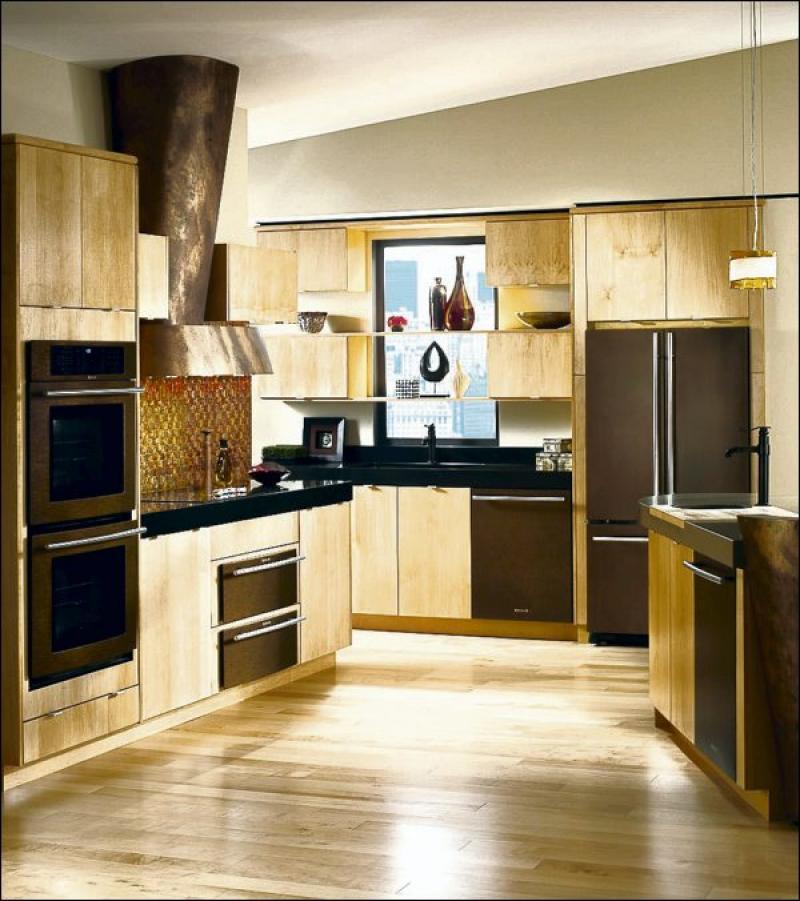
DEAR Marisse -- Glass and mirror have always been decorating favourites, chosen not only for their subtle aesthetics but also for their inherent reflective qualities. You are seeing more of these materials in kitchens and bathrooms as new products and styles evolve. Every surface can be transformed, from counters and backsplashes to cupboard doors and even ceilings. Glass can be added to an older kitchen to immediately update it. For an inexpensive backsplash, try cutting a piece of mirror that fits snugly above your countertops. Your local glass cutter will do this for you. This is an ideal solution for making a tiny kitchen appear much larger. Today, there's a huge variety of clear and coloured glass tile in squares, rectangles and blocks. These are both practical and decorative on walls, backsplash areas, countertop insets or tabletops. A popular idea for changing the look of old cupboard doors is to cut out the centre and insert etched and frosted glass panels. Glass is easy to clean -- avoid mirror in busy areas, but otherwise its serene purity is magical. Glass will never go out of vogue.
DEAR Debbie -- We are considering repainting some walls that were previously sponge-painted. The sponge effect has created a wall that is no longer perfectly smooth. We are concerned that if we prime and then paint over these walls, the bumps will be visible under a smooth coat of latex paint. The room to be painted is a well-lit bathroom. What do you suggest?
-- Shaun
Dear Shaun -- Yes, the horrors of some of the old paint finishes do come back to haunt us. The problem with a sponge finish is that if undiluted paint was used rather than thinned-down paint, you do get a thick, dappled effect over the smooth surface of the wall. I am afraid you will still see these sponge marks when you cover it with a roller. Don't despair; there are a couple of options. One is wallpaper, which is the big trend at the moment. You will not feel these slight bumps under the paper. Or, if a fresh coat of paint is your option, then I would run over the wall with a sanding pad. Remember, it's only paint, not plaster, so it will smooth down very easily. If your surface is very bumpy you may want to apply a skim coat of plaster, but this shouldn't be necessary in your case.
DEAR Debbie -- I have a beautiful floor-to-ceiling fireplace made of flat river stone. The mantel is a strip of 1 1/2-inch cedar. I'd like ideas for a new mantel with a little more substance. Also, decorating the mantel is a challenge to me. How large should the objects be?
-- Charlotte
DEAR Charlotte -- When building a new mantel, it's a good idea to cut one to size out of cardboard first to make sure the scale is pleasing to the eye. Too small and it will look dwarfed by the stone as your existing cedar mantel does; too big and it will look clumsy. Try a different material such as an old beam or any rough piece of wood cut to the appropriate size. For a contemporary look, try a thick piece of glass -- it will look like it's floating on the stone. Make sure the mantel is supported properly as it will be heavy; either have it inserted well into the existing stone, or build a surround for it.
Mantel decorations look best if they are grouped. A set of picture frames together and then a group of vases, or try two tall vases either end. This is the fun part of decorating, and it's all about what pleases your eye.
Debbie Travis' House to Home column is produced by Debbie Travis and Barbara Dingle. Please e-mail your questions to house2home@debbietravis.com
Renovation & Design
Put water woes on ice by drying air inside home
QUESTION -- Can you tell me why my four-year old house has ice build up on all the windows? The windows are double pane argon filled. What is causing this and how can I eliminate the problem? This only happens on very cold days.--Al Silva, e-mail
ANSWER -- At least once a year, I answer an inquiry on this very popular topic, which is probably the most frequent question I receive. The recent cold snap seems like an ideal time to address your question. Due to the large number of similar questions from faithful readers that I have stored on my hard drive, I ask that everyone please refrain from sending their version of this same problem. I hope that the following submission will answer most of your questions, so that my request will not be difficult to comply with.
To properly answer your question, we first have to address a couple of basic physical principals of the environment inside and outside your home. The first of these factors is the behaviour of air within our home, with relation to heating and cooling. As discussed many times in this column, house air contains a significant quantity of moisture in the form of dissolved water vapour. This moisture is typically measured as the Relative Humidity (RH) within the home, and this is the most useful measurement method to explain our issue of condensation on windows within your home. The reason that the humidity is "relative" is the fact that air can hold a finite quantity of water vapour at any given temperature. This quantity will increase significantly with air temperature. In simple terms, warmer air can hold more moisture and vice-versa.
If we say that our home has 50 per cent RH at normal room temperature of 21C, this may increase to 75 per cent RH, or higher, if we drop the air temperature by several degrees without adding any extra moisture. If we drop the air temperature dramatically, the RH will rise to near the saturation point of the air, or 100 per cent RH. If this threshold, often called the "dew point", is exceeded then the moisture in the air will be released in the form of condensation. In the natural world of Earth's atmosphere, this process leads to the formation of clouds and precipitation. In the interior environment of our homes, this precipitation may form on any surface that is significantly cooler than the heated air in the home. In your home, that surface is the cool glass of the windows.
While most modern windows have high quality glazing, called sealed units, that may be filled with inert gas and covered with a specialized coating, they are still subject to temperature fluctuations. The area of the window where the glass is inserted into the frame will have a seal or weather-strip integral to prevent air leakage, but it is difficult to completely seal these locations and prevent transfer of air and heat through these transition areas. In normal conditions, warm moist heated air inside the home will surround the window. On very cold days the heated air will deposit some of that moisture on the cool glass, which is colder than the surrounding walls & window frame. The coldest area of the glass is typically at the corners where the most air & heat loss occurs, for the reason stated above. That is why you typically see condensation and ice forming only at the corners of the sealed units. On the very coldest, windiest days, like those experienced recently, the water vapour may even freeze producing the ice you have described.
Now that we know why this is occurring, we can address your most pressing question about the remedy for this condition. Following through on our scientific explanation, there appear to be two basic methods to stopping the condensation and ice formation on the windows. The first approach would be to prevent the dramatic temperature drop at the windows, which causes the warm air to condense. This may be accomplished, to some degree, by caulking or sealing the windows better at these problem transition areas. Also, improving the air flow from the heating registers, by directing them toward the windows, may warm the window surface enough to prevent excessive sweating. The improved air flow will also aid in evaporation of any condensation that does form. While these measures may help to some extent, it may not solve the problem on the coldest days, so the following methods may be more successful.
The second approach is to reduce the amount of moisture in the air. To explain this, we must return to our physics lesson. As previously stated, dropping the air temperature will raise the relative humidity, making the likelihood of condensation much greater. If we cannot do much about the temperature drop at the windows on really cold days, we must concentrate our efforts on the other variable, the RH of the room air. If we have a RH of forty to fifty per cent at normal room temperature, which is not uncommon, it does not take that dramatic a temperature drop to reach the saturation point of one hundred per cent. If we reduce the RH at room temperature to twenty five per cent or lower, it will required much more of a temperature change to reach saturation. The less moisture dissolved in the warm air, the less the chance of condensation on the cool windows.
The approach of moisture management within the home may be much more effective to prevent sweating & ice formation on your windows. This can be accomplished by using your new home's heating and ventilation systems effectively. Because of the young age of your home, you probably have a central exhaust fan or HRV connected to registers in the bathrooms, and other rooms, that will exhaust moist air from the home and replace it with relatively dry exterior air. This should be controlled by a humidistat, often located next to the thermostat at a central location in the home. Also, a kitchen exhaust fan should be vented to the exterior and used anytime you are cooking, washing, or boiling water in this area. Running the furnace fan continuously may also help the exhaust system and will certainly aid in improving air flow over the windows.
The only drawback of this second approach is that the air in the home may feel excessively dry and be noted by dry skin and throats. Fortunately, it will be healthier for the components of the home to maintain a lower RH and may also prevent rot and mould growth, which will be healthier for you and your family.
Ari Marantz is the owner of Trained Eye Home Inspection Ltd. and the President of the Canadian Association of Home & Property Inspectors - Manitoba (www.cahpi.mb.ca). Questions can be e-mailed or sent to: Ask The Inspector, P. O. Box 69021, #110-2025 Corydon Ave., Winnipeg, MB. R3P 2G9. Ari can be reached at (204) 291-5358.
trainedeye@iname.com